So Why Is Curaçao’s Success Such a Surprise?
A Reflection on Colonial Memory, Identity, Belonging, and the Meaning of Competition
Following Curaçao’s historic qualification for the FIFA World Cup, a curious observation began circulating.
Only one player, some noted, was born in Curaçao.
At first glance, the statement appears harmless. Perhaps it is merely a fact. Yet the timing is interesting.
Why, in a moment that should have united people in celebration, did some feel compelled to measure authenticity? Why did birthplace suddenly become part of the story? And perhaps the most intriguing question of all: why does Curaçao’s success still surprise some people?
The answer may reveal something much deeper than football. It may reveal how history continues to shape the way we think about belonging, achievement, and identity.
The Power to Define
Throughout history, powerful societies have often claimed something more valuable than territory. They claimed the power to define.
To define civilization. To define legitimacy. To define belonging. To define who mattered and who did not.
When European powers crossed oceans and occupied territories throughout the Caribbean and the Americas, they did not arrive asking indigenous peoples who truly belonged there. They arrived with military power. They planted flags. They renamed territories. They rewrote laws. And they assumed the authority to define reality itself.
In Curaçao, the Caquetío people were already here. Yet history was largely written by those who conquered rather than by those who were conquered. Power became the author. Power became the judge. Power became the historian.
Centuries later, colonial administrations may have changed, but many of the assumptions they created remain surprisingly familiar.
A Small Island With Large Obstacles
For generations, Curaçao faced realities that larger nations rarely had to confront.
Limited resources. A small population. Dependence on decisions made elsewhere. Migration. Brain drain. The departure of talented young people seeking opportunities unavailable at home.
Yet despite those challenges, Curaçao continued producing remarkable individuals.
Musicians. Writers. Teachers. Entrepreneurs. Scientists. Baseball players. Athletes. And now footballers competing on the world’s biggest stage.
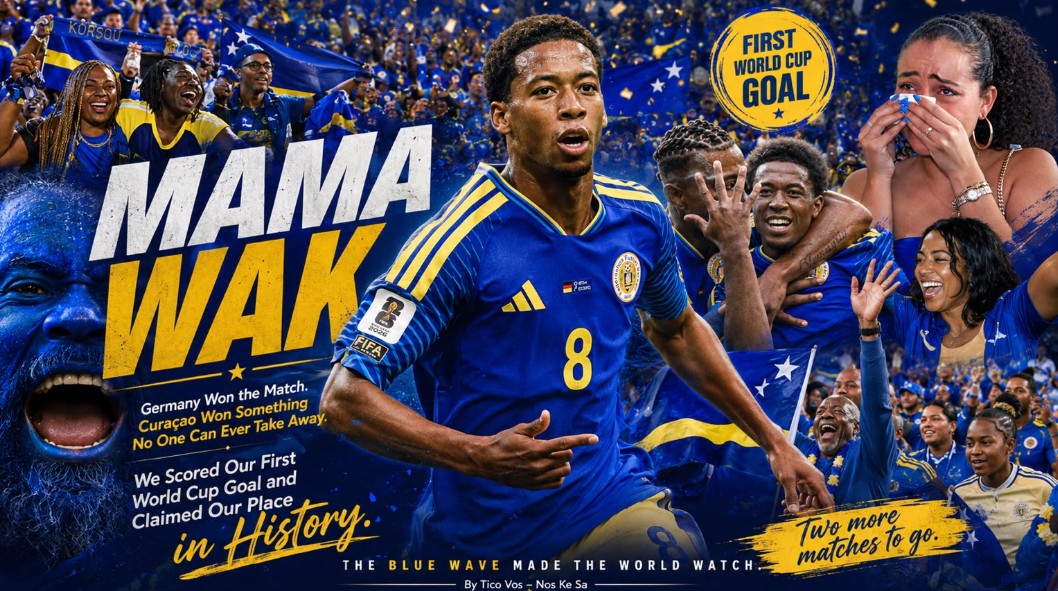
Why should that be surprising?
Why do some people still unconsciously assume that greatness must come from larger places?
Sometimes the surprise tells us more about the observer than about the achievement itself.
Curaçao’s Unique Position
The constitutional restructuring of 10 October 2010 changed the Kingdom of the Netherlands. Yet Curaçao continues to occupy a curious position.
Autonomous in some areas. Restricted in others. Not fully sovereign. Not fully represented internationally as independent nations are.
Its voice is sometimes heard through others. Its achievements are sometimes counted by others. Its athletes often compete within structures designed far beyond the island itself.
This creates contradictions that many Curaçaoans recognize immediately.
When responsibilities must be assigned, Curaçao can be treated as separate. When achievements must be celebrated, Curaçao can suddenly become inseparable.
Whether one agrees or disagrees with that observation, the tension remains part of the conversation.
Beyond Football
The football team is not the real story. The story is what the team reveals.
Across Europe, North America, and much of the world, societies continue debating immigration, ancestry, authenticity, integration, and belonging.
Yet many of these same societies were themselves built through centuries of migration, conquest, colonization, slavery, trade, and cultural mixing.
The very civilizations that once ignored indigenous claims to territory now frequently engage in intense debates over who legitimately belongs within borders that were themselves shaped by conquest, migration, empire, and human movement.
Human beings often forget how they arrived while becoming intensely concerned about how others arrive.
That contradiction is not uniquely Dutch. Nor uniquely European. It is profoundly human.
The Spirit That Captured Attention
Perhaps that is why so many people around the world have embraced this Curaçao team.
People see the joy. People see the dancing. People see the smiles. People see players who seem genuinely grateful simply to participate.
The message appears refreshingly simple:
Let’s enjoy the game. Let’s compete. Let’s do our best. May the best team win.
If we win, we celebrate. If we lose, we learn. If we score, we rejoice. If we are defeated, we shake hands and continue forward.
Even after a 7–1 defeat against Germany, one of football’s historic powers, the players did not appear humiliated. Because dignity is not measured by a scoreboard.
They represented Curaçao. They shared the field with some of the best athletes in the world. They earned their place.
That alone is extraordinary.
Winners, Losers, and Human Illusions
Before every tournament begins, we already know one thing.
Almost every team will eventually lose. Only one nation will lift the trophy.
The same is true of the World Cup, the Olympic Games, the World Baseball Classic, and almost every competition humanity creates.
There will always be winners. There will always be losers.
But will the world become more peaceful because one nation wins? Will poverty disappear? Will injustice vanish? Will wars end?
Probably not.
Yet something valuable still occurs.
People meet. Cultures encounter one another. Children find inspiration. Communities celebrate together. Human beings connect.
Perhaps that is the true victory.
Not domination. Not superiority. Not proving one people are better than another.
But participation. Respect. Friendship. Human connection.
A Final Reflection
Perhaps the greatest lesson of Curaçao’s World Cup journey has nothing to do with football.
Perhaps it reminds us that human potential cannot be measured by geography. Nor by population size. Nor by ancestry. Nor by birthplace. Nor by classifications inherited from another age.
The players did not ask whether they were supposed to be there. They simply earned their place.
And perhaps that is what surprises some observers most.
Not that Curaçao qualified.
But that despite centuries of obstacles, despite migration, despite dependency, despite limitations, despite every expectation placed upon a small Caribbean island—
Curaçao never stopped believing it could.
And maybe that belief is worth celebrating long after the final whistle has blown.
Coming Next
Yet another question remains.
If Curaçao’s achievement deserves celebration, why does one particular observation keep appearing?
“Only one player was born in Curaçao.”
Why is that detail repeated so often?
Is it simply an innocent fact? Or does the repetition reveal something deeper about identity, migration, authenticity, and the way modern societies define belonging?
That question deserves its own investigation.
By Tico Vos
Reporter and Columnist