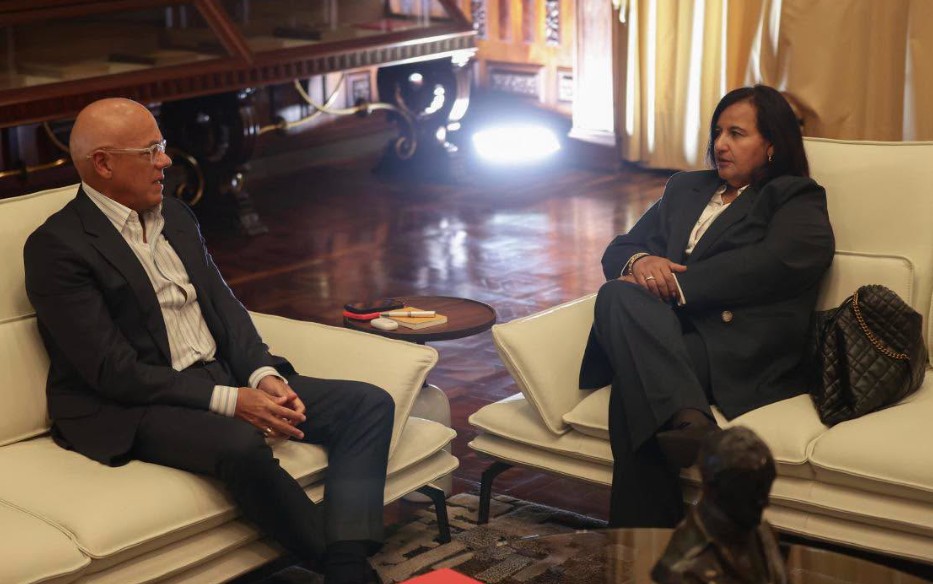
CARACAS – The recent meeting between Venezuelan National Assembly President Jorge Rodríguez and former opposition lawmaker Dinorah Figuera is being interpreted by many as the beginning of a negotiation over who will govern Venezuela in the coming years. However, the significance of the talks appears to go far beyond names, candidacies or the distribution of political power.
At the center of the process is a deeper question: under what rules will Venezuela be governed in its next political phase?
The meeting, held in Caracas, marked one of the most significant public contacts between representatives of the ruling movement and the opposition in nearly three years. While few details were released publicly, the discussion has been linked to a broader agenda involving democratic transition, the strengthening of Venezuela’s National Electoral Council and the creation of conditions for political participation and civic freedoms.
That suggests that the current dialogue is not only about future elections, but about rebuilding the institutional framework needed for any election to be credible, stable and accepted by all sides.
For years, Venezuela’s political debate has focused largely on personalities: who should lead the opposition, who should represent the government, who should run in an election and who should ultimately hold power. The current talks appear to move the discussion toward a different question: what kind of system must exist before a legitimate political contest can take place?
That distinction is important. Before a country can choose its next leaders, it must first have institutions capable of guaranteeing that the rules are respected. That means electoral authorities, political guarantees, civil liberties, checks and balances, and mechanisms that allow differences to be resolved within the system rather than against it.
In that sense, the key word is institutionalization.
The emphasis appears to be on building the board before playing the game. Stabilization would be the first step, institutional recovery the second, and electoral competition only the third. This approach differs from the more immediate focus on candidates and election dates that has dominated much of Venezuela’s political discussion in recent years.
The inclusion of actors who have spent years on opposite sides of the political conflict is also significant. The process does not appear to be centered on creating a single candidacy, but on establishing a negotiation table. Such tables often outlast governments because their purpose is not only to divide power, but to define the rules under which power can be exercised.
The experience of other political transitions shows that lasting stability rarely depends only on charismatic leaders. It depends on rules, guarantees, institutions and controls that continue to function regardless of who wins an election.
That is why the central question in Venezuela may be changing. For years, the question was who would govern the country. Now, the more important question may be under what rules Venezuela will be governed.
The first question looks for a person. The second looks for stability.
A durable transition requires all political actors, even those with opposing visions, to operate within a common institutional framework. The real objective is not to eliminate political conflict, but to ensure that conflict is processed through democratic rules instead of through confrontation, paralysis or institutional collapse.
From that perspective, what is now being discussed is not merely the distribution of power. It is the architecture of a future political system designed to prevent Venezuela from returning to cycles of instability.
Representation can be negotiated. Timelines can be negotiated. Political participation can be negotiated. But the need for institutions capable of surviving future changes in government cannot be avoided.
That may be the most important message of this new phase.
The transition now taking shape does not appear designed only to decide who will govern tomorrow. It appears designed to decide what no future government should be able to destroy again.