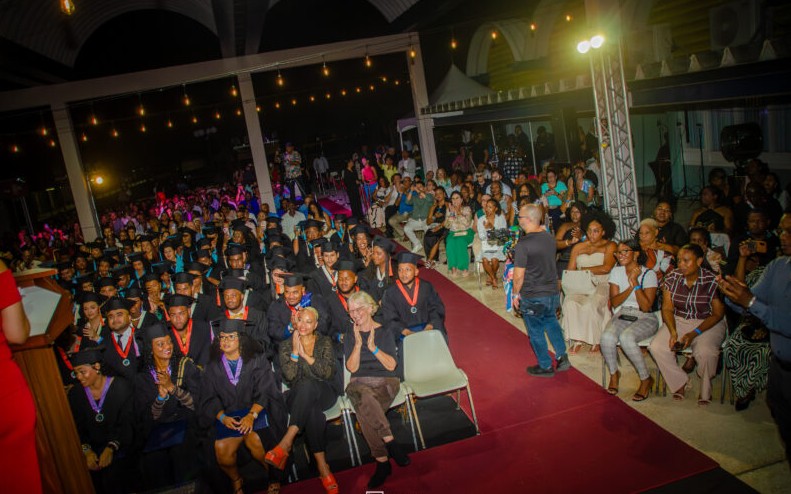
WILLEMSTAD – The University of Curaçao (UoC) has awarded degrees to 297 students this year, marking another important contribution to the island's professional workforce. The graduating class includes new teachers, legal professionals, engineers, and specialists in business administration and hospitality, all entering a labor market where qualified local talent remains essential.
Among the graduates are 89 professionals in business administration and hospitality, 78 education graduates, 65 law graduates, and 42 graduates in higher professional engineering programs. The remaining graduates completed studies in other academic disciplines.
The university emphasized that its programs meet the quality standards established by the Accreditation Organisation of the Netherlands and Flanders (NVAO), the same accreditation body responsible for assessing higher education programs in the Netherlands.
This accreditation framework is intended to ensure that students pursuing higher education in Curaçao receive qualifications that meet recognized academic and professional standards.
Keeping Curaçao's Talent on the Island
Despite the graduation milestone, the university acknowledges that Curaçao continues to face challenges in retaining talented young people and reducing the number of students who discontinue their studies abroad.
For many Curaçao students, pursuing higher education in the Netherlands or elsewhere represents an important opportunity for personal and professional development. However, studying abroad also requires students to adapt to a different educational environment, culture, and way of life.
The UoC believes that providing a strong academic foundation closer to home can help students prepare more effectively for these challenges.
By offering accredited programs locally, the university aims to give young people the opportunity to begin or complete their higher education in Curaçao while developing the academic skills needed for further studies abroad.
According to the institution, this approach can help strengthen the island's workforce while allowing students to pursue international educational opportunities when they are better prepared.
The graduation of 78 new education professionals is particularly relevant to Curaçao's education sector, while the addition of 42 engineering graduates contributes to the availability of locally trained technical professionals.
The university also sees the graduates in law, business administration, and hospitality as an important addition to the island's professional capacity.
Artificial Intelligence Makes Lifelong Learning Essential
During the graduation ceremony, UoC Rector Magnificus Stella van Rijn emphasized the importance of lifelong learning in a world undergoing rapid technological and economic change.
She highlighted artificial intelligence as one of the developments transforming how people work, learn, and develop their professional careers.
According to Van Rijn, obtaining a university degree should not be regarded as the end of a person's educational journey.
Instead, graduates must remain willing to acquire new knowledge, adapt to technological developments, and continuously improve their professional skills.
The growing influence of artificial intelligence means that professionals in nearly every sector will increasingly need to understand and respond to new technologies.
For the university, preparing students for this changing environment requires an educational approach that encourages adaptability, critical thinking, and continued professional development.
Recruitment Campaign Begins This Month
With this year's graduation activities completed, the University of Curaçao is preparing to recruit students for the next academic year.
The university will participate in Curaçao's Study and Career Fair on November 18 and 19, where prospective students will have an opportunity to learn more about available academic programs and career opportunities.
Following the event, the UoC plans to conduct recruitment activities in Suriname as part of its efforts to attract students from the wider Caribbean region.
The university is also preparing renewed open-day activities in Curaçao early next year, giving prospective students and their families an opportunity to explore its educational offerings.
Through these initiatives, the institution hopes to strengthen its position as a higher education provider while encouraging more young people to consider studying locally.
The graduation of 297 students demonstrates the university's continuing role in preparing professionals for Curaçao's economy.
At the same time, the UoC maintains that its broader mission extends beyond awarding degrees. The institution wants to help retain local talent, support students who eventually pursue further education abroad, and prepare graduates for a future in which continuous learning will become increasingly important.