ORANJESTAD - Climate Justice Flotilla takes action against the fossil fuel industry, calling for Dutch-Caribbean sovereignty, energy embargo, and just transition, right before the Santa Marta Conference on transitioning away from fossil fuels.
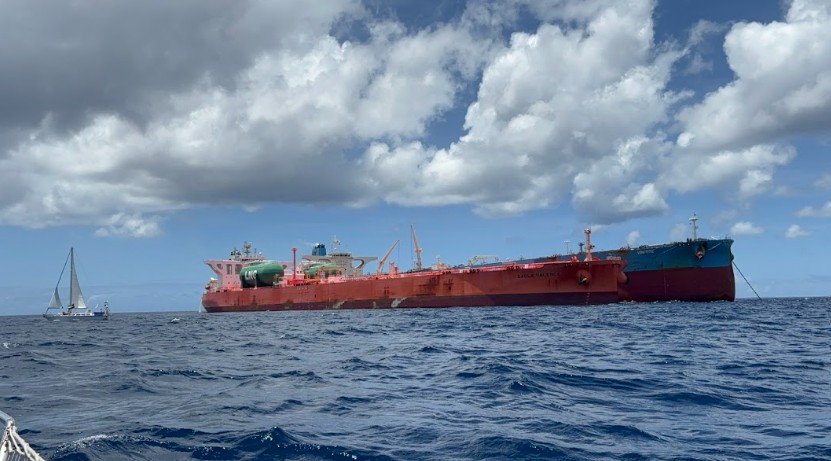
April 21, 2026 - Today three vessels of the Climate Justice Flotilla demonstrated in front of two oil tankers in the waters of Aruba, Dutch-Caribbean. The action signals an alliance between local nature defenders and international activists: no more war and exploitation fueled by the fossil industry. The Flotilla will sail to Santa Marta, Colombia, to bring its message to the First Conference on Transitioning Away from Fossil Fuels.
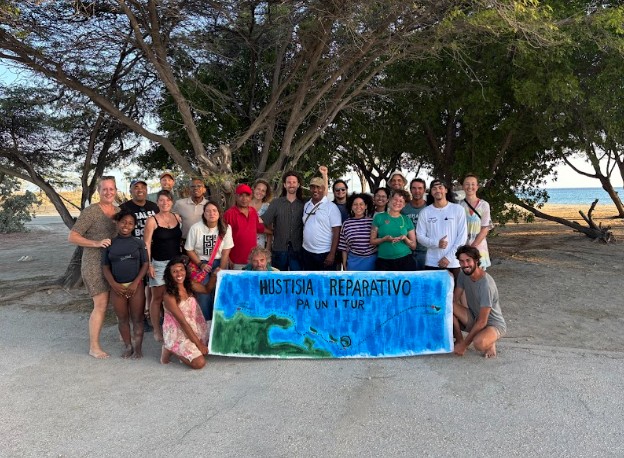
Flotilla group in Aruba
The coalition opposes the concession of oil exploration in Aruban waters, granted to Armstrong Oil and Gas through Aruba state-owned company Compañía Arubano di Petroleo (CAP) by the Kingdom of the Netherlands. It also condemns the exploitation of Aruba as a port for fossil fuel trade connected to war and colonialism, including Venezuelan oil.
It demands a just transition grounded in energy sovereignty for the Dutch-Caribbean.
An existential threat for Aruba
Aruba’s economy is strongly centered on tourism (84.3% of jobs), while communities have sustained themselves from fishing for generations. In an island in which the entire life is built on the health of the marine environment, an oil spill would not be a contained environmental incident. It would be an economic extinction event, with no possible commensurate compensation.
Furthermore, Aruba has already publicly committed to 100% renewable electricity, due to favourable conditions for energy self-sufficiency. The oil Armstrong seeks will not power Aruba, but will fuel war and fill the pockets of foreign investors, generating profit for its shareholders and leaving the residual risk to the island’s community.
The role of the Netherlands
Despite reaching the status of an autonomous country, Aruba is still part of the Kingdom of the Netherlands. The island's sovereignty, therefore, is constrained by Kingdom-level institutions in areas including defence, foreign affairs, and resource extraction. Armstrong's entry into Aruban waters, such as transit of foreign oil tankers, is made possible by this asymmetry, a direct product of its colonial history.
The concession process did not consult the fishing communities whose waters are affected. This goes against ILO Convention 169 and the UN Declaration on the Rights of Indigenous Peoples, which require Free, Prior and Informed Consent before undertaking extractive operations affecting communities dependent on related natural resources.
The same Netherlands that proposes itself as a climate leader, co-hosting Santa Marta’s conference, grants offshore petroleum concessions in Caribbean waters, without meaningful community consent, through a governance framework that is a product of colonialism.
The Climate Justice Flotilla
The Climate Justice Flotilla will arrive in Santa Marta on April 24. The mission seeks to amplify Caribbean voices in the climate debate. It aims to hold the Global North and the Netherlands–in its role as co-host of the Conference and with its colonial past and present-- accountable for climate inaction that disproportionately impacts the Caribbean region.
By sailing together toward Santa Marta, the Climate Justice Flotilla declares that the age of colonial extractivism, unrestrained economic growth and imperial domination must end— and that a just, regenerative future can be built through decentralized and community-led energy alternatives.
Quotes
Nigel Maduro, Aruban indigenous Caquetío activist and sustainability scientist, and Climate Justice Flotilla crew member, said:
“The Climate Justice Flotilla gives us hope, and a sense of liberation. As Dutch-Caribbean people we are often left out, not considered, or not represented in the Climate Change conversation. Whether it comes to conferences or signing treaties, due to our colonial status within the Dutch Kingdom, we are often dependent on the Netherlands to make decisions for us in terms of climate change.”
He said, further:
“The Fossil Fuel industry has always disrespected Mother Earth through extraction and pollution, taking advantage of overseas countries and territories, and through exploitation of humans. It has always disrespected the balance between humans and nature. We must phase it out for the sake of protecting Small Island States like Aruba, Bonaire, Curaçao, Sint Maarten, Sint Eustatius, Saba (Dutch-Caribbean). We are in the frontlines - the most vulnerable in experiencing climate change - and we’re still not represented correctly in these conferences.”
Paolo Destilo, Dutch climate justice activist and steering committee member of Climate Justice Flotilla, said:
“Fossil fuels are being routed, traded, insured, and weaponized through systems of war, occupation, and colonial power. Climate governance does not regulate the production, trade, insurance, refining, and supply chains that continue to funnel fossil fuels to genocide, colonial war, and military occupation. An energy embargo, in which states refuse to aid or assist grave internationally wrongful acts, is key for the credibility of a Fossil Fuel Treaty in the current scenario.”
Action demands
We demand:
Immediate suspension of all exploration activity by Armstrong Oil & Gas in Aruban waters, pending a full independent environmental and social impact assessment conducted with and accountable to Aruban fishing communities and coastal populations.
Free, prior and informed consent (FPIC) and binding liability arrangements as a condition of any continuation of operations—or, if it cannot be demonstrated that such consent was obtained at the time of concession, revocation of the Armstrong concession. The Kingdom framework process did not constitute FPIC as defined under international law.
Public accountability from the Kingdom of the Netherlands for the gap between its domestic climate commitments and its behaviour as the sovereign authority granting petroleum concessions in Caribbean territories. The governance framework that enabled this concession must be reformed.
Investment by the Kingdom in Aruban renewable energy sovereignty—supporting a transition the island has already begun, rather than enabling extractive operations that generate risk for Aruba and revenue for distant shareholders.
As part of the wider Caribbean campaign: a just phase-out of fossil fuel extraction across the Caribbean basin, built with and led by the communities most affected, and held accountable to an energy embargo legal framework classifying fossil fuel uses linked to warfare, genocide, ecocide, and climate apartheid as violations of the obligation to protect life.