Stripan’s open letter raises a fundamental question: who determines how Curaçao’s living heritage is presented to the world?
International recognition can bring visibility to a culture. Its meaning depends on how that recognition is pursued, whose history is told and whether the people who sustain the tradition have a real voice in the process. These questions stand at the centre of an open letter from Fundashon Stripan and Museo di Tambú Shon Cola concerning the proposed UNESCO nomination of Curaçao’s tambú.
Dated 14 March 2026, the letter is addressed to Susan Larmonie-Van Heydoorn, Secretary-General of OWCS, and signed by mr. dr. René Vicente Rosalia, president of Fundashon Stripan. It challenges the proposed route through the Netherlands or Kingdom and calls for Curaçao to take responsibility for presenting its own cultural heritage.
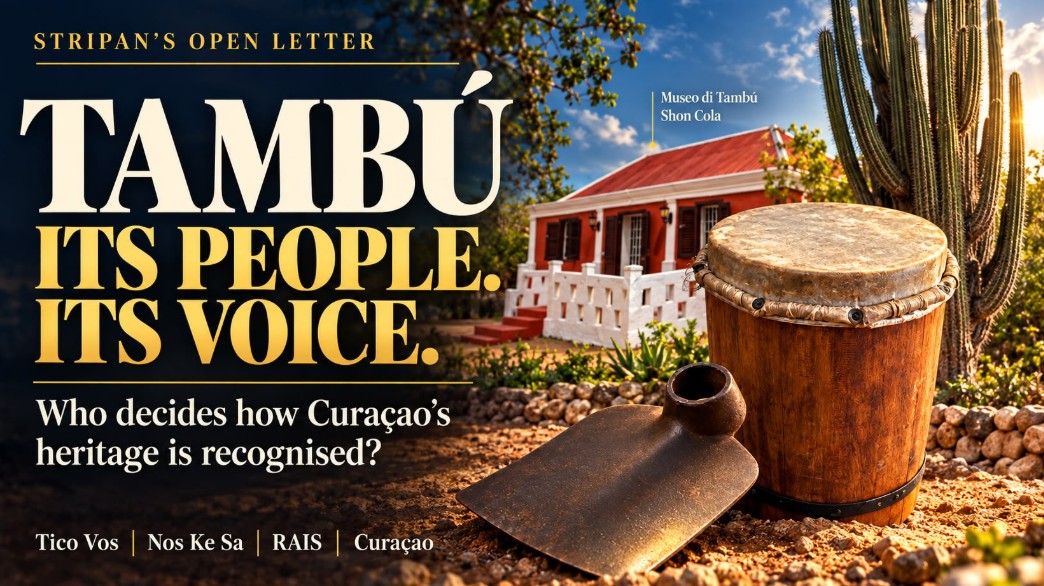
Stripan supports international recognition for tambú. Its objection concerns the terms of that recognition. The foundation wants Curaçao’s historical relationship with tambú, and the authority of its practitioners, to remain unmistakable.
The letter also reveals a disagreement about communication. According to Stripan, a government letter dated 23 February 2026 suggested that the foundation already knew the nomination process had been halted in 2024. Stripan disputes this, stating that the February letter was when it learned of that decision. It separately explains that, on 26 February 2024, it had chosen to oppose the Netherlands or Kingdom route and advocate a nomination directly through Curaçao’s government.
That distinction matters. Opposing a particular procedure does not necessarily mean abandoning the objective. The correspondence referred to in the letter would need to be examined alongside the government’s response to establish the complete administrative history.
Behind this disagreement lies a deeper concern about historical recognition. Stripan presents tambú as an expression that survived repression by Dutch colonial authorities and opposition associated with the Catholic Church. The letter reproduces Dutch prohibitions concerning tambú dancing and its allowance on rented government land. These passages form part of its argument that institutions associated with suppression cannot now assume the leading role in celebrating the tradition without confronting that past.
The original ordinances and rental conditions deserve publication with their dates and archival references. Making those records accessible would allow the public to examine how repression operated and how people continued to preserve their cultural expression.
For Stripan, the history also shapes the meaning of performance today. The foundation strongly objects to the idea of tambú being performed at the Fort at the Governor’s initiative. It interprets the location and office as continuing symbols of colonial authority.
This is Stripan’s political and historical interpretation. The attached letter does not include the Governor’s explanation of the initiative. Nevertheless, the objection raises a serious question: under what conditions can an official celebration acknowledge a painful history in a way that its cultural bearers consider honest?
A performance alone cannot answer that question. The answer requires dialogue about the setting, the historical account presented, the participants’ freedom to speak and their role in deciding what the occasion means.
The UNESCO procedure also requires precision. The relevant framework is the 2003 Convention for the Safeguarding of the Intangible Cultural Heritage, with its Representative List of the Intangible Cultural Heritage of Humanity. This is distinct from the World Heritage framework for sites and monuments.
Stripan proposes using Article 33 of the Convention or Curaçao’s UNESCO associate membership to pursue a direct submission. Article 33 provides a route to accession for certain self-governing territories, subject to conditions, including treaty-making competence. It does not, by itself, establish that Curaçao can submit independently. Nor does a general right to put proposals before UNESCO automatically settle eligibility under this particular Convention. The proposed route therefore needs a clear, publicly available explanation from the competent authorities and UNESCO.
The distinction between the authority submitting a nomination and the community whose heritage is being recognised is equally important. Stripan’s concern should be addressed through the actual proposed nomination text: how would it name Curaçao, describe tambú’s history, identify its practitioners and safeguard their participation?
Here UNESCO’s own principles give the discussion a firm foundation. Its guidance states that inscription requires the free, prior and informed consent of the community or group concerned. Community participation is therefore part of the process itself. A credible nomination must demonstrate how that consent has been obtained and how practitioners will help shape safeguarding measures.
Stripan’s contribution deserves serious attention, while consultation must also make room for the wider range of people who practise and transmit tambú. Their experiences, disagreements and aspirations belong in the discussion.
The letter ends with an opening for cooperation. Fundashon Stripan and Museo di Tambú Shon Cola express willingness to work with the Ministry of Education, Science, Culture and Sport on a framework to safeguard tambú.
That offer provides a practical starting point. Curaçao needs a transparent account of the nomination’s status, a documented explanation of the available procedures and a safeguarding plan developed with practitioners. Such a plan should address teaching, recordings, historical research, spaces for practice and the resources needed to pass knowledge to younger generations.
The value of international recognition will ultimately be measured in what it helps sustain here. Children must have opportunities to learn. Practitioners must be heard. The history of repression must be documented, and the people who kept tambú alive must be visible in the account presented to the world.
Stripan’s letter asks Curaçao to consider the responsibility that comes with recognition. Tambú’s place on an international list should strengthen the living relationship between the tradition and its people.
Tico Vos | Nos Ke Sa | RAIS | Curaçao
Columnist