On Friday, September 11, Dr. Joy Angela DeGruy will speak in The Hague about the lasting psychological consequences of transatlantic slavery. Her visit raises a question that directly concerns Curaçao as well: what continues to happen today because the structures and wounds of slavery were never fully repaired?
For centuries, Dutch commercial, administrative, military, and financial interests participated in a system that reduced human beings to property. Families were torn apart, identities were suppressed, and violence was legally protected. Abolition ended the legal ownership of people, but it did not automatically restore families, social relationships, economic opportunities, or damaged human dignity.
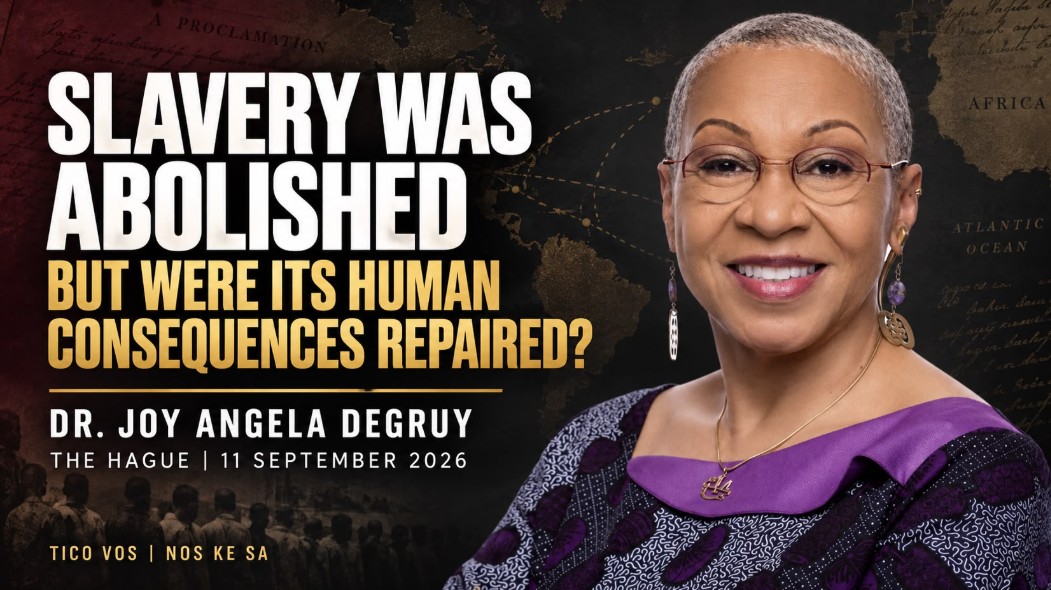
DeGruy, author of Post Traumatic Slave Syndrome, examines how survival behaviors that developed under slavery and racial oppression can be passed down within families and communities. Her theory is primarily based on the African American experience and should therefore not be applied to Curaçao without further research. Our island has its own history, language, family structures, and colonial reality.
Nevertheless, her central question is essential. History does not live on only in archives. It can continue through poverty, education, health, employment opportunities, family relationships, and ideas about skin color, authority, and human worth.
In Curaçao, the legacy of slavery may, for example, be visible in persistent poverty. Abolition did not make formerly enslaved people economically independent: they were not given equal access to land, capital, or well-paid work. Many remained dependent on former plantation owners or other powerful figures. That unequal starting position can continue across generations through differences in property ownership, income, and living conditions. Even today, families may therefore have fewer financial reserves, struggle with debt more often, and be more vulnerable when employment or health problems arise. This does not mean that every poor person in Curaçao became poor directly because of slavery, but historical power relations may help explain why inequality remains so persistent.
In education, the legacy may be visible in the way knowledge and language are valued. During the colonial period, European norms, history, and language were treated as the standard, while the knowledge, culture, and dignity of the Black population were minimized. This may still have an impact when Papiamentu, local history, or Afro-Curaçaoan contributions receive less space than Dutch or European perspectives. Students who rarely see themselves reflected in educational materials may develop less confidence in their own abilities. At the same time, low expectations among teachers, parents, or students themselves can reinforce educational disadvantages. Research must determine the extent of these effects, but the connection deserves serious attention.
Historical experiences may also continue to affect health. Slavery involved physical violence, poor living conditions, malnutrition, and a lack of control over one’s own body. After abolition, social and economic inequalities remained. People with lower incomes may live in poorer conditions, postpone medical care, or have less access to healthy food and preventive services. Distrust of institutions can also arise when people have experienced, across generations, that their bodies and interests were not taken seriously. Health disparities are therefore not only a matter of individual choices, but also of income, access, trust, and institutional treatment.
The historical connection is equally conceivable in employment opportunities. During and after slavery, Black people were systematically excluded from equal positions, property ownership, and decision-making. Status, skin color, family name, and social networks could become more important than talent or education. When such patterns persist for a long time, some families have greater access to contacts, capital, and influence than others. In Curaçao, this may be visible in differences between people who easily gain access to well-paid work and those who remain largely dependent on temporary, low-paid, or insecure employment. Discrimination does not always have to be explicit: it can also be hidden in selection procedures, perceptions of professionalism, or the assumption that certain positions belong to certain groups.
Family relationships may represent the most direct human legacy. Under slavery, parents could lose their children, partners could be separated, and family ties could be legally disregarded. After abolition, these consequences did not disappear immediately. Families had to survive without property, security, or sufficient support. Under such circumstances, patterns of absence, distrust, premature adulthood, silence about pain, or a strong emphasis on self-reliance could emerge. Some families, by contrast, developed powerful forms of mutual care and resilience. It is important not to suggest that Curaçaoan families were “damaged” by slavery or are less strong as a result. We must, however, acknowledge that historical disruption may have influenced the ways care, authority, grief, and responsibility are passed down within families.
These examples do not prove that every contemporary problem in Curaçao is caused by slavery. Unemployment, migration, political decisions, globalization, and recent economic developments also play a role. But without taking colonial history into account, inequality can easily appear to be a personal failure or a random outcome. With that history in view, it becomes clearer why some differences can persist across generations.
Children do not inherit the personal guilt of their ancestors. Societies do, however, inherit consequences and unfinished responsibilities. Further research is therefore needed into income differences, educational outcomes, health, labor-market selection, discrimination, and family histories in Curaçao. Scientific caution must not become an excuse for moral evasion. Anyone who wants to know whether the legacy of slavery still continues must ask not only what people feel, but also who owns property, who receives opportunities, who can live a healthy life, and who feels safe and recognized.
The English-language event will take place at EBGH, Koningin Emmakade 66 in The Hague. Doors open at 6:00 p.m. The event begins at 7:00 p.m. and ends at 9:00 p.m.
By Tico Vos
Columnist