WILLEMSTAD – Members of the Curaçao Parliament have raised serious questions about the government's proposed new Aviation Ordinance, criticizing the nearly seven years it has taken to bring the legislation before lawmakers and demanding guarantees that the country has the financial resources, qualified personnel, and independent institutions needed to enforce the new rules.
The concerns emerged during Tuesday's Central Committee meeting, where parliamentarians examined a comprehensive legislative proposal containing more than 239 articles intended to modernize Curaçao's aviation regulatory framework.
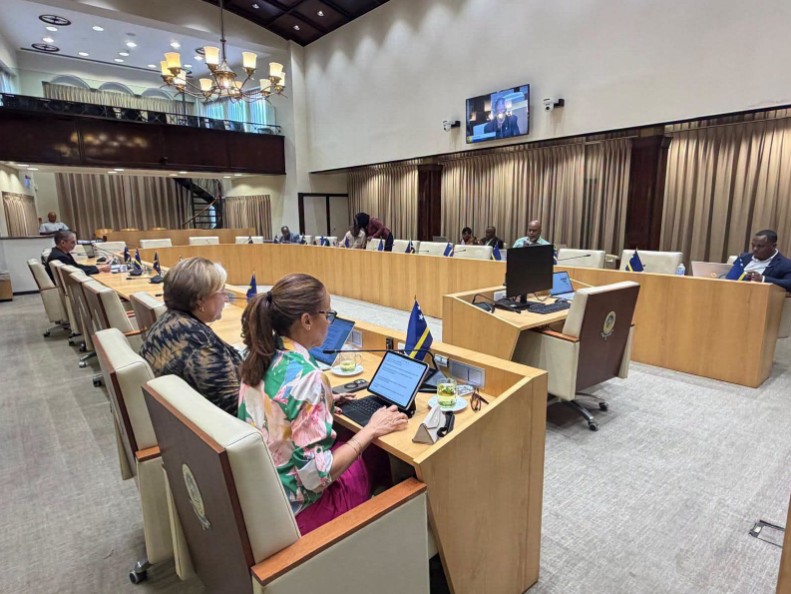
Curaçao Parliament during aviation debate
The proposed legislation was already submitted to the Council of Advice in December 2019. However, it has only now reached the parliamentary examination stage, nearly seven years later.
PAR Member of Parliament Shaheen Elhage questioned the reasons for the lengthy delay and asked the government to identify the legal, administrative, and organizational obstacles that prevented the legislation from progressing sooner.
According to Elhage, the aviation industry has undergone significant changes since 2019, particularly in international safety standards, technological developments, cybersecurity, and air cargo operations.
He questioned whether the proposed legislation adequately reflects these developments and whether the government has the operational capacity to implement its provisions.
Elhage emphasized that effective aviation oversight requires more than legislation. It also depends on qualified inspectors, adequate funding, modern equipment, and cooperation among the institutions responsible for regulating the sector.
MAN-PIN parliamentary leader Giselle Mc William also demanded an explanation for the delay and asked the government to provide a detailed account of deficiencies identified during previous inspections by the FAA and ICAO.
She wants to know which shortcomings have been corrected, which remain unresolved, and whether the proposed law directly addresses the problems that have kept Curaçao in FAA Category 2 since 2012.
Another major concern involves the independence of the Curaçao Civil Aviation Authority.
The proposed legislation is intended to strengthen the authority's institutional autonomy, but Mc William questioned whether genuine independence can be achieved while its personnel remain under the Ministry of Traffic, Transport and Spatial Planning.
She asked how the government would ensure that decisions involving aviation safety and regulatory enforcement remain free from political influence.
MAN-PIN parliamentarian Suzy Camelia-Römer focused on the financial and legal implications of the proposed legislation.
She requested a detailed explanation linking each identified aviation oversight deficiency to the specific legal provision intended to resolve it, together with a timetable for implementation.
Camelia-Römer also highlighted the complexity of the proposed law, which contains more than 239 articles and, according to her assessment, at least 36 references to additional implementing regulations.
She warned that important regulatory decisions could effectively be transferred to the government without sufficient direct parliamentary scrutiny.
The parliamentarian wants clarification about which measures the government would be authorized to introduce independently and how Parliament would retain oversight of the regulatory framework.
The potential financial consequences for the aviation industry were another point of discussion.
Camelia-Römer questioned how new fees and charges associated with aviation supervision could affect airlines, aircraft maintenance companies, training institutions, airports, and ultimately passengers.
She stressed the importance of ensuring that regulatory costs do not become disproportionately burdensome for businesses operating in Curaçao's aviation sector.
Meanwhile, PNP Member of Parliament Ruisandro Cijntje argued that the proposed legislation should be connected to a broader national economic strategy.
He called for the development of a National Aviation Plan covering the period from 2027 to 2035, with measurable objectives for expanding air routes, attracting investment, creating employment, and developing Curaçao into a regional center for aviation, aircraft maintenance, cargo transportation, and logistics.
Cijntje also wants the government to examine how the new regulations could affect airline ticket prices, Curaçao's international connectivity, and the competitiveness of Curaçao International Airport.
According to the parliamentarian, aviation legislation should not focus exclusively on supervision and regulatory compliance but should also support economic development.
The debate takes place as the government works toward a possible FAA reassessment in 2027, which could determine whether Curaçao is eligible to regain Category 1 aviation safety status.
Although parliamentarians broadly recognize the need to modernize the existing legal framework, the central concerns involve the government's ability to translate the legislation into effective aviation oversight.
Following the Central Committee meeting, Parliament agreed to submit the questions raised by legislators to the government and request written responses.
The proposed Aviation Ordinance has not yet been approved, and further parliamentary consideration will be necessary before the legislation can enter into force.
The government's responses will be important in determining whether the new regulatory framework can provide the institutional independence, financial sustainability, and operational capacity needed to strengthen Curaçao's aviation sector.