WILLEMSTAD – Scientists have identified a previously unknown insect species living on Curaçao, Aruba and Bonaire, a discovery considered so distinctive that researchers have established not only a new species but also an entirely new genus to classify it.
The tiny insect, measuring less than five millimeters, is a type of planthopper that has been given the scientific name Aridorama cobbeni.
The discovery was made by an international team of scientists, including researchers affiliated with Naturalis Biodiversity Center in the Netherlands and universities in the United States.
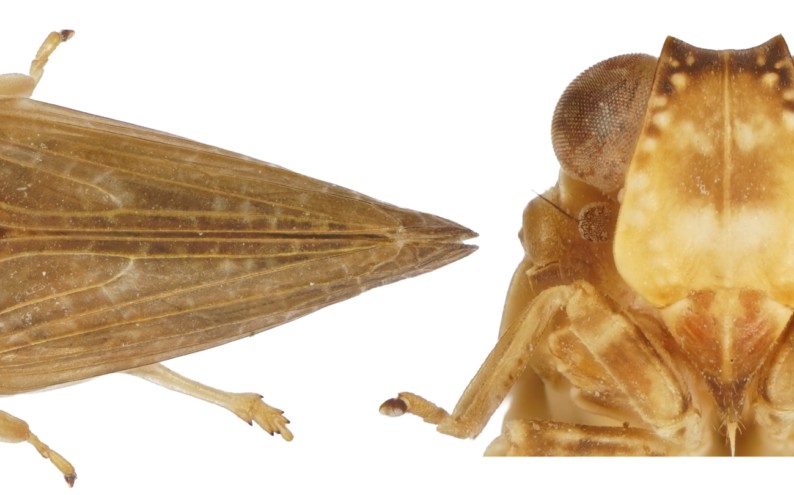
Their findings have been published in a scientific journal and highlight the largely unexplored biodiversity of the Caribbean's dry and coastal environments.
Discovery Began During Expedition to Bonaire
The scientific investigation began during a research expedition to Bonaire in 2022.
While examining local vegetation, researchers repeatedly encountered a small planthopper on different plant species.
The insect initially attracted attention because of its unusual characteristics, prompting scientists to conduct more detailed examinations.
Using microscopic analysis and DNA sequencing, the researchers compared the specimens with previously documented relatives.
The results revealed significant differences between the newly collected insects and known species.
Those differences were sufficiently distinctive for scientists to conclude that the insect could not be placed within an existing genus.
As a result, the researchers formally described a new genus, Aridorama, and its newly recognized species, Aridorama cobbeni.
Museum Collections Reveal Decades-Old Specimens
One of the most remarkable aspects of the discovery emerged when researchers examined historical insect collections preserved in museums.
They found that specimens of the newly identified insect had already been collected on the ABC islands during the 1950s.
The insects had been gathered decades earlier by a Dutch entomologist but had not been formally recognized as belonging to a separate genus and species.
The newly described species was named in honor of that entomologist.
The discovery demonstrates the scientific importance of historical museum collections, which can contain specimens that remain unidentified or insufficiently studied for many years.
By combining modern genetic techniques with historical collections, researchers were able to establish that the insect had been present across Aruba, Bonaire and Curaçao for decades.
The findings also show how modern scientific methods can reveal previously overlooked distinctions among organisms collected long ago.
A Tiny Insect with Major Scientific Significance
Planthoppers are small insects that feed on plants and belong to a diverse group found in many parts of the world.
Although Aridorama cobbeni measures less than five millimeters, its scientific importance lies in its distinctive biological characteristics.
The fact that researchers had to establish an entirely new genus indicates that the insect differs substantially from its closest known relatives.
Its discovery adds to scientific knowledge of the insect populations inhabiting the southern Caribbean islands.
It also raises questions about how many other small and poorly studied organisms may remain undocumented in the region.
Hidden Biodiversity in Dry Caribbean Landscapes
The researchers emphasize that the discovery illustrates the biological richness of dry and coastal habitats in the Caribbean.
These environments may appear less biologically diverse than tropical rainforests, but they can support distinctive plants and animals that have received relatively little scientific attention.
The identification of Aridorama cobbeni on all three ABC islands demonstrates the value of studying habitats that are often overlooked in biodiversity research.
Scientists believe such environments may contain additional species that have not yet been formally identified.
The findings also reinforce the importance of protecting natural habitats against degradation and other environmental pressures.
Importance for Nature Conservation on Curaçao
For Curaçao, the discovery provides another example of the scientific value of the island's natural environment.
While marine ecosystems, coral reefs and larger wildlife species often receive the greatest public attention, small insects also form part of the island's biodiversity.
The identification of an entirely new genus and species demonstrates that important biological discoveries can still be made in familiar landscapes.
According to the researchers, the findings underline the need for continued scientific investigation and conservation of dry and coastal ecosystems throughout the Caribbean.
The discovery of Aridorama cobbeni shows that even an insect smaller than five millimeters can reveal previously unknown aspects of the natural history shared by Curaçao, Aruba and Bonaire.