WILLEMSTAD – The Curaçao Monuments Foundation (Stichting Monumentenzorg Curaçao), Delft University of Technology (TU Delft), the Curaçao Monuments Fund Foundation (Stichting Monumentenfonds Curaçao), and the University of Curaçao organized a three-day program dedicated to addressing one of the most persistent challenges in preserving the island’s historic buildings: salt damage.
The initiative, known as Saltcura Week, took place from October 21 to 23, 2026, with support from the Dutch Research Council (NWO). The program focused on scientific research and practical solutions to combat salt deterioration in historic masonry and plasterwork.
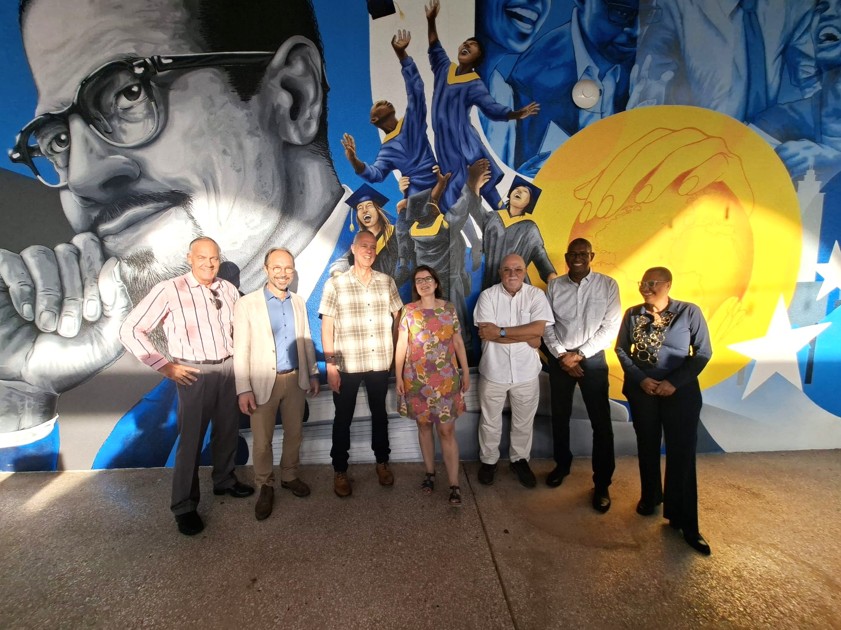
The event was organized as part of the Saltcura research project, which investigates whether newly developed plaster mortars with increased resistance to salt damage can be used effectively in the restoration of historic buildings in Curaçao.
Salt damage remains one of the most difficult problems facing monument preservation on the island. Many historic buildings were constructed using porous, salt-containing materials such as coral stone and rubble stone. In addition, builders historically used mortars mixed with saltwater or brackish water, meaning that considerable quantities of salt may have been present in the masonry from the beginning.
Curaçao’s warm, windy marine climate further complicates the situation by continuously introducing salts and exposing buildings to changing moisture conditions. When moisture evaporates from masonry, the remaining salts can crystallize, causing deterioration of plaster layers and masonry.
Existing treatment methods do not always provide lasting solutions and, in some cases, may even create additional problems.
The program began with a scientific symposium on Wednesday, October 21, at the University of Curaçao. The event attracted local participants as well as specialists and other attendees from the Netherlands, Aruba, and Bonaire who traveled to Curaçao specifically for the gathering.
Barbara Lubelli of TU Delft opened the symposium with a presentation on her research into plaster mortars containing encapsulated crystallization inhibitors. These substances influence how salt crystals form, with the objective of reducing damage to plaster surfaces.
Lubelli presented findings from previous laboratory research and field trials conducted in the Netherlands, explaining how the experimental mortars function and discussing their potential applications in historic building restoration.
Her colleague Erik Schlangen of TU Delft addressed other developments in self-healing construction materials. These included concrete containing microorganisms that can produce limestone deposits when exposed to water and air, thereby sealing small cracks. He also discussed asphalt technologies that use induction heating to repair damaged bonds within the material.
Michiel van Hunen of the Cultural Heritage Agency of the Netherlands presented examples of Dutch monuments where different approaches had been used to address salt damage. His presentation illustrated how treatment results can vary considerably and highlighted complications that may arise when applying different restoration techniques.
Michael Newton of Newton Heritage Consulting provided a historical overview of research into salt damage and plaster systems in Curaçao. Such research dates back to 1957 and has involved cooperation with institutions including TU Delft and the Netherlands Organisation for Applied Scientific Research (TNO).
Gregory Zandwijken of the Curaçao Monuments Foundation expanded on this historical perspective by discussing the organization’s practical experiences in treating salt damage over the decades. He reviewed the results, limitations, and potential pitfalls of different methods tested during restoration projects.
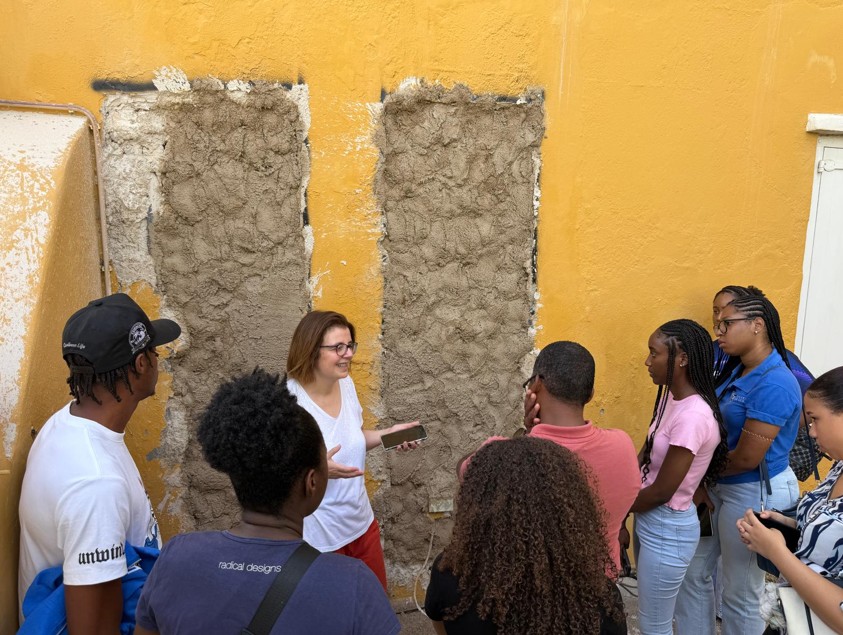
On Thursday morning, October 22, researchers and restoration specialists gathered at the historic Pachi de Sola building at Scharlooweg 150 for a practical demonstration of how plaster mortar containing encapsulated crystallization inhibitors is applied.
The demonstration allowed participants to evaluate the material’s practical handling and provided an opportunity for researchers and local craftsmen to exchange knowledge and experiences.
Saltcura Week concluded on Friday, October 23, with a meeting involving representatives of the construction and restoration sectors. The central question was what steps should follow the research and demonstrations.
Discussions focused on continuing scientific investigations, developing suitable restoration materials and treatment methods, and identifying ways to better manage salt damage in monuments whose original building materials contain high concentrations of salt.
The organizers emphasized the importance of combining scientific knowledge with practical restoration experience to develop solutions appropriate for Curaçao’s historic buildings and environmental conditions.
Saltcura Week was coordinated by TU Delft in cooperation with the Curaçao Monuments Foundation and the Curaçao Monuments Fund Foundation, with the participation of the University of Curaçao. The program was funded by the Dutch Research Council (NWO).