WASHINGTON – U.S. Secretary of State Marco Rubio has called for a complete overhaul of Venezuela’s electoral institutions before the country holds another presidential election, arguing that the system established under former President Nicolás Maduro was designed to manipulate election results and cannot guarantee a free and credible vote.
Speaking to reporters, Rubio said Venezuela must replace the institutional structures that governed elections during Maduro’s presidency before voters can be asked to choose a new national leader.
According to Rubio, the existing electoral machinery cannot be trusted to administer a legitimate presidential election without fundamental changes to the judiciary and the National Electoral Council.
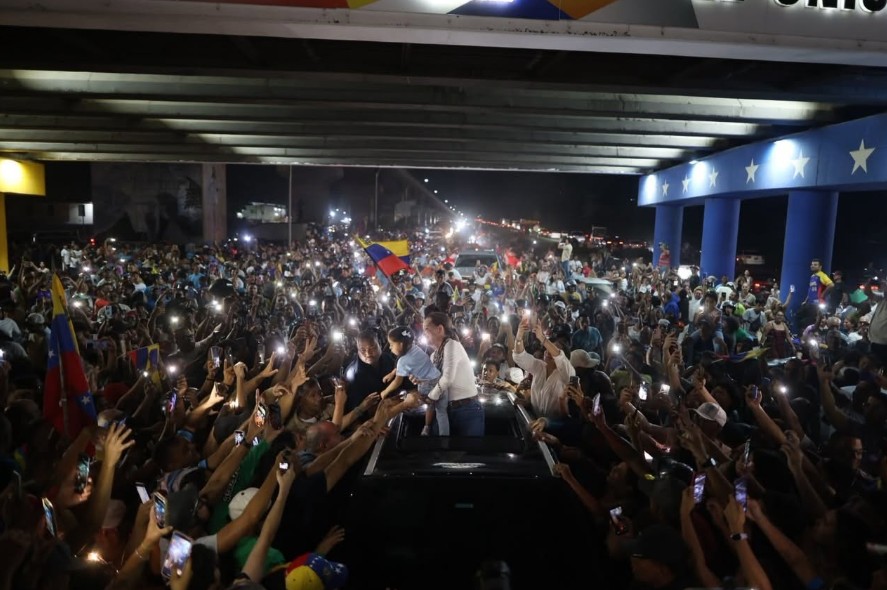
Corina-Machado's arrival in Venezuela
His comments come as discussions continue between Venezuela’s interim government and opposition representatives over a proposed political transition following Maduro’s capture by U.S. forces in January 2026 and his transfer to New York to face criminal proceedings.
The United States is pushing for a timetable that would establish new electoral and judicial institutions before a presidential election takes place.
Under the proposal described by Rubio, Venezuela would appoint a new Supreme Court by the end of 2026, followed shortly afterward by the formation of a new National Electoral Council.
The proposed judicial restructuring would involve the appointment of 32 new justices, representing a major change to the country's highest court.
Another important element of the proposal would remove the electoral council’s authority to disqualify political candidates, a power that has been at the center of longstanding disputes between the Venezuelan government and opposition movements.
The objective would be to establish an electoral framework in which political parties and candidates can compete without arbitrary exclusions.
The transition plan also calls for Maduro’s permanent absence from office to be formally declared once the institutional reforms are completed.
That declaration would trigger a proposed six-month period within which a new presidential election would be held.
Rubio has not announced a specific election date, emphasizing instead that the institutional changes must be completed according to the agreed timetable.
“I think we’re making real progress in that regard,” Rubio told reporters.
However, he warned against attempts to obstruct the transition.
“But if anybody tries to derail that process, they’re doing a great harm to Venezuela,” he said.
The proposed reforms come at a politically sensitive moment for Venezuela, where the future of the country's leadership and democratic institutions remains under discussion.
Opposition leader María Corina Machado has recently returned to Venezuela, adding another important dimension to the political developments surrounding the transition.
The proposed removal of restrictions on political candidates could have significant implications for opposition participation in future elections, although the precise arrangements have yet to be finalized.
For Washington, the central argument is that holding elections without first reforming the institutions responsible for administering them could undermine the credibility of the outcome.
The proposal nevertheless raises important questions about how the new judicial and electoral authorities would be selected, whether the different political factions would accept their legitimacy, and how the transition timetable would be enforced.
For Curaçao and the wider Caribbean, developments in Venezuela remain particularly significant because of the country's geographic proximity and its longstanding economic, political and migration-related connections with neighboring islands.
Although the United States is pressing for rapid institutional changes, the proposed election timetable remains dependent on negotiations and the implementation of the reforms.
Rubio's message is that Venezuela's political transition must involve more than the departure of Maduro. In Washington's view, the institutions that oversee elections must also be fundamentally transformed before the country can hold a credible presidential vote.