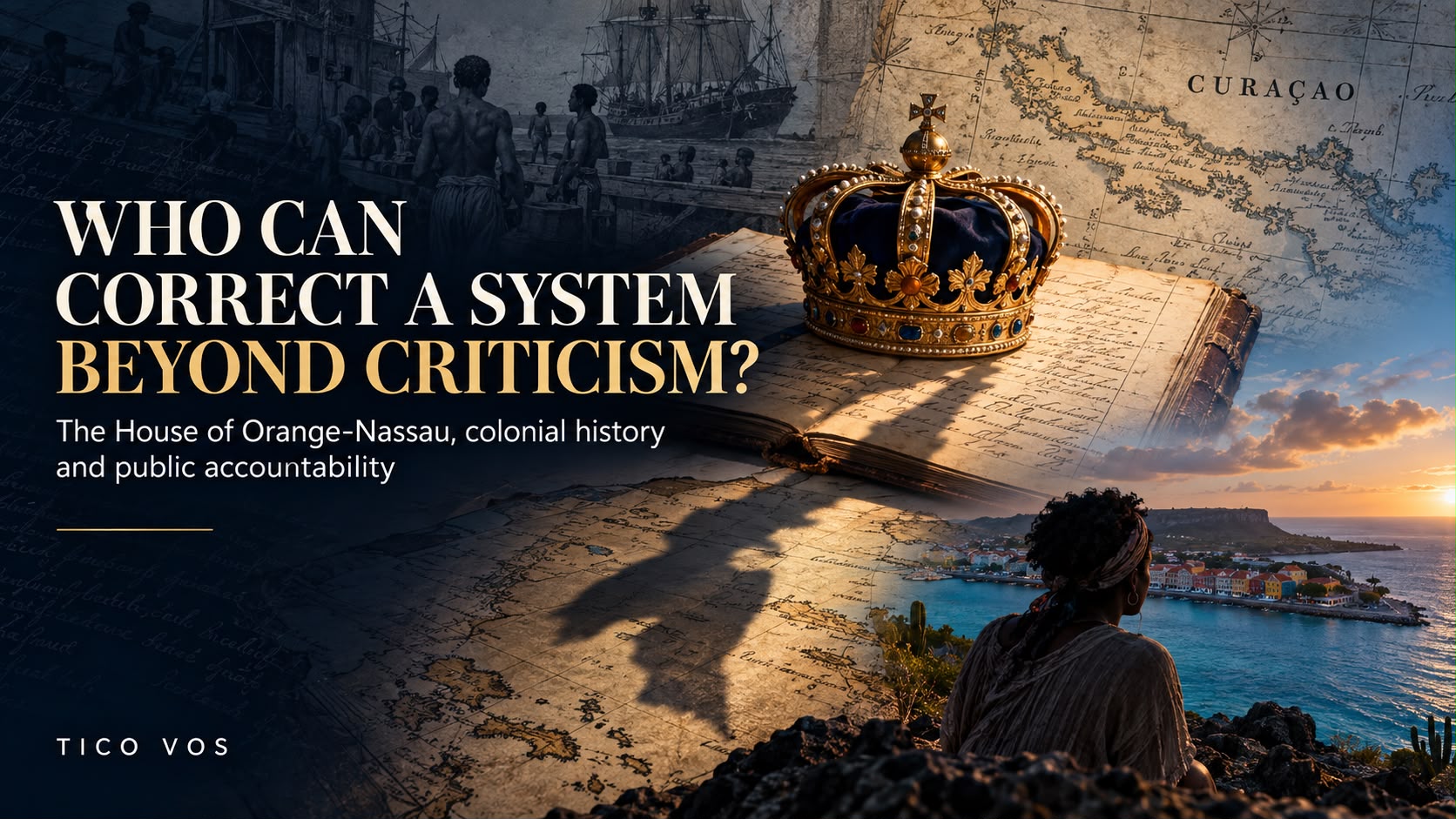
If a system declares itself inviolable, infallible or beyond criticism, who can correct it? And what higher principle applies when laws or official narratives are used to justify the exercise or abuse of power?
A constitutional rule can protect the King from being held politically accountable in the same way as a minister. It cannot determine what the historical record means, nor can it release the rest of the state from its responsibility to examine that record.
That distinction matters following the publication of the independent study into the colonial history of the House of Orange-Nassau. King Willem-Alexander initiated and financed the research, which was conducted by researchers at Leiden University under the supervision of an independent committee that established the framework and oversaw the project.
The study’s independence deserves to be taken seriously. At the same time, it is legitimate to ask how an inquiry financed by the institution being investigated earns and maintains public trust.
The research began from the premise that the House of Orange-Nassau had been actively involved in colonialism and had benefited from it. That was a proposition to investigate, not a conclusion to accept automatically. The researchers tested it against the historical record.
Their findings describe sustained support by the House for colonial rule and slavery, although the degree of influence over day-to-day colonial policy varied considerably over the centuries. At the presentation of the study, King Willem-Alexander acknowledged that his predecessors had actively supported colonialism and slavery and had approved the suppression of resistance.
The financial findings also require precision. The study estimates that the House received the equivalent of nearly €576 million in today’s value from colonial activities, with most of that income connected to the Dutch East Indies, present-day Indonesia.
The researchers found relatively little direct income from the transatlantic slave trade and slavery in the Caribbean. That distinction is important because it identifies more precisely where the money originated. It does not, however, erase the broader political and historical responsibility identified by the study. Nor should the €576 million estimate be confused with the present-day wealth of the House of Orange-Nassau.
The constitutional issue is related but separate.
Under the Dutch Constitution, the King is inviolable and ministers are responsible. This determines where political responsibility lies within the Dutch constitutional system. It does not make the history of the royal family immune from scrutiny. Nor does it prevent Parliament, the government or the public from considering what the historical evidence should mean for policy today.
This distinction becomes particularly relevant following the Netherlands’ vote at the United Nations in March.
On March 25, 2026, the UN General Assembly adopted a resolution describing the trafficking of enslaved Africans and racialized chattel enslavement as the gravest crime against humanity. The resolution was adopted with 123 countries voting in favor, three against and 52 abstaining. The Netherlands abstained.
The Dutch government raised legal concerns, including questions about applying present-day legal concepts to historical events and the resolution’s approach to reparatory justice.
The resolution does not, by itself, impose a binding obligation on the Netherlands to pay reparations. But that does not end the discussion. An abstention is a political decision, and the reasons behind it remain open to public scrutiny.
The Dutch government has already acknowledged the Netherlands’ responsibility for its role in slavery and the continuing consequences of that history. The unresolved question is what such an acknowledgement should require in practice.
Prime Minister Rob Jetten has said that the royal-history study will not lead to reparations. That represents the government’s political position. It is not a conclusion required by the King’s constitutional inviolability, nor does it automatically follow from the researchers’ findings.
The study establishes and interprets historical evidence. What should be done with that evidence is a decision for elected officials and, ultimately, a matter for democratic debate.
Three separate questions must therefore not be treated as if they were one.
Criminal liability concerns whether an individual can be prosecuted under applicable law. Historical responsibility concerns what institutions and ruling families did, supported or benefited from. Political responsibility concerns what governments and institutions today should do in response to that history and its continuing consequences.
Each has different standards and consequences. Answering one does not automatically answer the others.
From Curaçao, this debate cannot be regarded simply as an internal Dutch discussion about the monarchy. The Caribbean was part of the colonial system being examined, and people throughout the region continue to live with its legacy.
Their history, expertise and priorities should therefore have a meaningful place in determining what happens next. Consultation matters, but participation should amount to more than being invited to listen after the most important decisions have already been made.
A historical investigation cannot undo what happened. What it can do is make evasion more difficult.
Its findings should now be debated openly—in Parliament, in schools and museums, and through sustained dialogue with the communities whose histories are involved. That should include further examination of the financial record and an open debate about possible reparative measures, without pretending that one vote, one apology or one research project has settled the issue.
If a system claims that it can answer only to itself, who can correct it?
For me, the answer begins with a principle higher than status or constitutional convention: power must remain answerable to the people who live with its consequences.
Inviolability may determine the constitutional route to accountability. It cannot be the reason accountability ends.
By Tico Vos
Journalist and Columnist