WILLEMSTAD – Economic recovery and inflation explain only about half of the sharp increase in Curaçao’s tax revenues following the COVID-19 pandemic, according to doctoral research by Wim Nijdam. Improvements within the Tax Administration, the elimination of administrative backlogs and better taxpayer compliance also contributed significantly.
Nijdam received his doctorate on Friday, October 2, in Paris from the Business Science Institute, in cooperation with iaelyon School of Management at Université Jean Moulin Lyon 3.
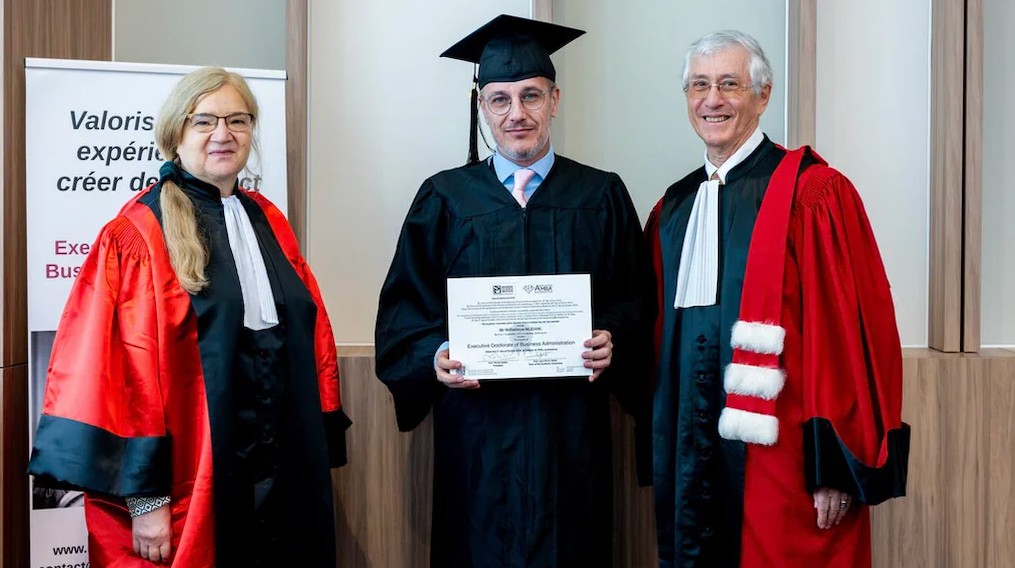
Wim Nijdam (center)
His research examined why Curaçao’s tax revenues increased much faster after the pandemic than could be expected from the island’s economic performance alone.
Between 2021 and 2022, tax revenues increased by more than XCG 240 million, representing growth of 18.2 percent. By 2022, revenues had already surpassed their pre-pandemic level even though the real economy had not yet fully recovered to its pre-COVID level.
Nijdam estimates that economic growth and inflation together accounted for approximately 45 to 50 percent of the increase. That leaves roughly half of the increase requiring other explanations.
His research points to several factors, including the clearing of administrative backlogs, improvements in tax collection and increased compliance with tax obligations.
Changes in tax legislation also contributed. According to the study, the introduction of turnover tax on imports on October 1, 2019 resulted in more than 9 percent additional turnover-tax revenue.
Nijdam cautions against attributing the increase to any single measure. His research instead points to a combination of economic conditions, changes in tax legislation, improvements within the Tax Administration and changes in taxpayer behavior.
The findings are particularly relevant to Curaçao’s public finances because they suggest that increasing government revenue does not necessarily require higher tax rates.
Better registration of taxpayers, modernization of administrative procedures and a more targeted approach to tax evasion and non-compliance can also increase collections.
Nijdam's research highlights further digitalization, stronger compliance-risk management and improved taxpayer services and communication as areas that could strengthen tax administration. Public and business confidence in the Tax Administration is another factor.
The study combined tax and macroeconomic data with interviews and a survey of more than 1,100 entrepreneurs.
According to Nijdam, some of the findings were already applied during the research period to improve working methods and administrative procedures within Curaçao’s Tax Administration.
The longer-term question is whether the higher revenues can be sustained. The research indicates that economic growth alone cannot guarantee this. The effectiveness of tax administration and taxpayers’ willingness to comply with their obligations are also critical.
Nijdam was supervised during his doctoral research by Professor Raymond Gradus, former chairman of the Board of Financial Supervision. Nijdam now works for the Tax Administration of Sint Maarten, where he intends to apply lessons from his Curaçao research to improve tax collection and taxpayer services.