WILLEMSTAD – Prime Minister Gilmar Pisas used Curaçao’s annual May 4 remembrance ceremony to deliver a strong message on the importance of protecting freedom, democracy and human dignity, warning that the lessons of World War II remain highly relevant in today’s increasingly unstable world.
Speaking during the national commemoration honoring those who lost their lives as a result of war, oppression and violence—particularly during World War II—Pisas said remembrance must go beyond ritual and serve as a constant call for reflection and responsibility.
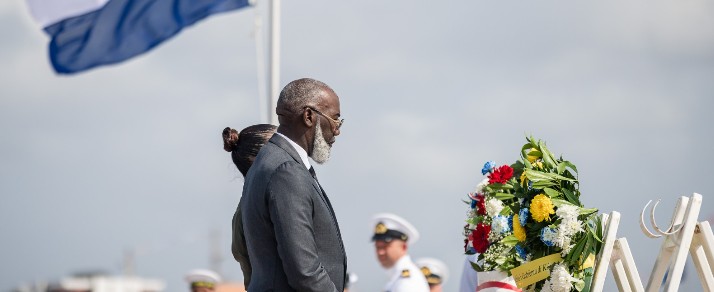
According to the prime minister, remembrance is not only about looking back at history, but about understanding why those events happened and what today’s society must do to prevent them from happening again.
Pisas noted that more than 80 years after the end of World War II, the conflict remains one of the clearest examples of how fragile freedom, the rule of law and human dignity can be.
He said the war exposed what can happen when societies fail to value coexistence and respect for people who are different.
The prime minister also highlighted Curaçao’s own contribution during the war.
He recalled the island’s strategic role through its harbor, refinery and population in supporting the Allied war effort under American leadership, describing Curaçao’s participation as more than logistical support.
According to Pisas, Curaçao was part of a broader international struggle to defend sacred values such as freedom, justice and human dignity.
But the prime minister warned that the global climate today shows troubling similarities.
He pointed to rising geopolitical tensions, deepening international divisions and growing uncertainty, saying those developments are affecting democratic institutions, economies and societies around the world.
He stressed that Curaçao and the wider Caribbean are not immune to those global shifts.
Pisas said the current international climate makes the annual remembrance even more meaningful, because it reminds societies of the consequences of failing to prioritize peace and mutual understanding.
He emphasized that freedom requires active protection—not only by governments, but also by the international community and individual citizens.
Where rights and freedoms are threatened, Pisas said governments have a duty to defend the vulnerable and protect democratic institutions.
He reaffirmed his government’s commitment to strengthening the rule of law, promoting good governance and building an inclusive society where there is space for all races, religions, genders and differing opinions.
The prime minister also stressed the importance of investing in education, opportunity creation and social protection as pillars of a strong and resilient society.
At the same time, he said the responsibility to protect freedom cannot rest solely on government.
It is a collective responsibility shared by every citizen.
Pisas called on the people of Curaçao to focus less on differences and more on what unites them as a society.
He urged citizens to practice respect for one another’s freedoms in daily life—at home, at school, at work and in the community.
The prime minister concluded by reminding the public that remembrance is also a personal responsibility.
During the traditional two minutes of silence, he said, people should not only honor those who paid the ultimate price for freedom, but also ask themselves what freedom means to them and what responsibility they carry to protect it for future generations.
Pisas said true remembrance is ultimately a choice for a better future—one without discrimination, violence and oppression, and built on respect for the freedoms of all.