WILLEMSTAD – Prime Minister Gilmar Pisas has used the presence of regional leaders in Curaçao to promote the island as an emerging center for investment, innovation and economic cooperation, emphasizing that the country has considerably more to offer the Caribbean than its internationally recognized tourism attractions.
On Sunday, October 11, Pisas accompanied an international delegation, including Jamaican Prime Minister Andrew Holness, on a special tour highlighting projects, businesses and locations that the Curaçao government considers examples of the island's economic potential.

Visit to Aqualectra
The visit formed part of the activities surrounding the Caribbean United in Excellence Summit, which brought regional leaders to Curaçao for discussions on economic development, investment, regional connectivity and cooperation.
According to Pisas, Curaçao should not limit its ambitions to being a successful tourism destination. Instead, the country should position itself as an active contributor to economic growth and innovation throughout the Caribbean.
"Curaçao should not merely be part of the Caribbean, but a country that actively contributes to the progress, innovation and development of the entire region," Pisas said during Sunday's tour.
The prime minister emphasized that Curaçao possesses considerable potential for investment and economic diversification and that its development could create opportunities extending beyond its own borders.
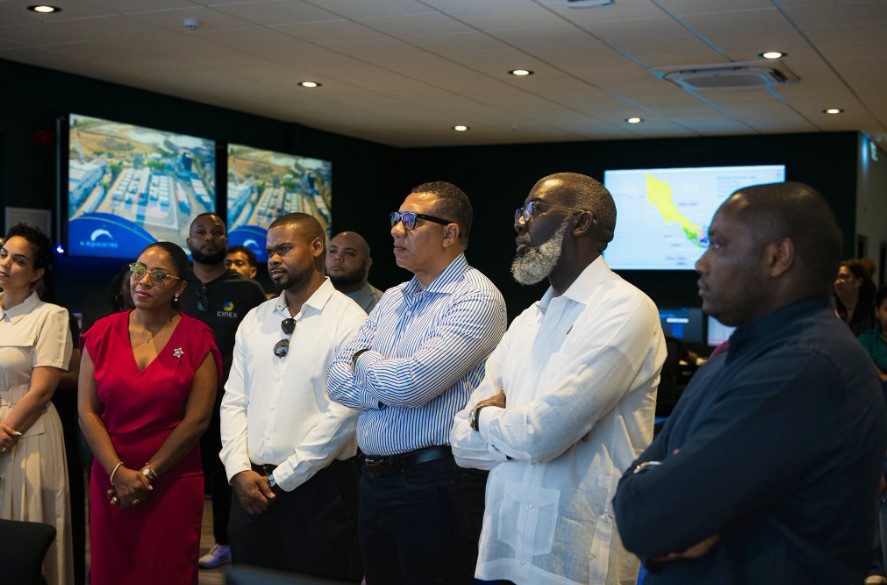
The government described the tour as an opportunity to demonstrate how local projects and enterprises reflect Curaçao's broader ambitions for economic growth.
Although the government did not identify all the businesses and projects visited in its public statement, the initiative was presented as part of a wider effort to strengthen Curaçao's economic relationships with neighboring Caribbean countries.
The visit followed the Caribbean United in Excellence Summit held on Friday, October 9, as part of the celebrations marking Curaçao's 16th anniversary as an autonomous country within the Kingdom of the Netherlands.
Among the regional leaders participating in the summit were Jamaican Prime Minister Andrew Holness, Aruban Prime Minister Mike Eman and Suriname's Vice President Gregory Rusland.
The gathering focused on strengthening cooperation among Caribbean economies, encouraging investment and exploring practical solutions to challenges shared by countries throughout the region.
The summit also provided an opportunity for bilateral discussions.
Local media reported that Pisas and Eman discussed several issues affecting Curaçao and Aruba, including pensions, social assistance, minimum wages and waste management.
The two leaders exchanged ideas about addressing social and economic challenges and strengthening cooperation between the neighboring islands.
The presence of Holness was particularly significant because Jamaica is one of the Caribbean's larger economies and an influential participant in regional cooperation initiatives.
Curaçao welcomed the Jamaican leader on October 9, with Pisas and Minister of Economic Development Roderick Middelhof receiving him upon arrival.
The government presented his participation as an opportunity to explore stronger economic connections and practical cooperation between Curaçao and other Caribbean countries.
However, the discussions also took place against the backdrop of an important economic question: how to ensure that growth translates into tangible improvements in people's lives.
During his visit, Eman emphasized that economic expansion and strong tourism performance do not automatically guarantee that prosperity reaches every segment of society.
He called for greater attention to fair wages, shared prosperity and stronger economic relationships between Caribbean countries.
That concern is also being raised in Curaçao.
In its latest annual report, the Social and Economic Council (SER) emphasized that economic growth should lead to greater financial security, decent employment and accessible public services.
The council argued that economic progress should be measured not only through growth figures but also through improvements experienced by residents in their daily lives.
The SER presented its 2025 annual report to Pisas on October 9, during activities surrounding the regional summit.
The discussion is relevant as Curaçao continues experiencing economic expansion supported by tourism, construction and private investment.
While those sectors are creating economic opportunities, questions remain about the distribution of prosperity and the extent to which economic growth benefits lower-income households.
Pisas recently announced that his government intends to approve a new poverty reduction plan during October, acknowledging that economic development must be accompanied by measures addressing social inequality.
Against that background, Sunday's tour served two purposes: promoting Curaçao's investment potential to visiting leaders and reinforcing the government's ambition to play a larger role in regional economic development.
The Caribbean United in Excellence initiative reflects the government's view that Caribbean countries can benefit from sharing expertise, strengthening commercial connections and developing joint approaches to economic and social challenges.
For Curaçao, this could include attracting foreign investment, encouraging partnerships between businesses, exchanging technical knowledge and developing stronger relationships with regional markets.
However, the government has not yet announced specific investment agreements or financial commitments resulting from Sunday's tour.
The extent to which the initiative produces concrete projects will therefore depend on follow-up discussions and cooperation between participating governments and private-sector representatives.
Pisas nevertheless maintained that Curaçao has both the capacity and the ambition to become a more influential economic partner within the Caribbean.
His message to the visiting delegation was that the island should be recognized not only for its natural beauty and tourism industry but also for its businesses, innovation, investment opportunities and potential contribution to regional development.
For the government, the objective is to build a Curaçao that is increasingly connected to its Caribbean neighbors and capable of participating more actively in the region's economic future.