WILLEMSTAD – Prime Minister Gilmar “Pik” Pisas has sparked debate after stating that government leaders sometimes need the courage to make decisions in the public interest, even when legal regulations may stand in the way.
The remarks were made Wednesday during a ceremony marking a major construction milestone for Aqualectra’s new Salu Power Plant, a project the government considers critical for Curaçao’s future energy security.
According to Pisas, many people believe government decisions must always remain strictly within the boundaries of the law, but he argued that leaders are occasionally required to look beyond legal obstacles when the broader interests of the country are at stake.
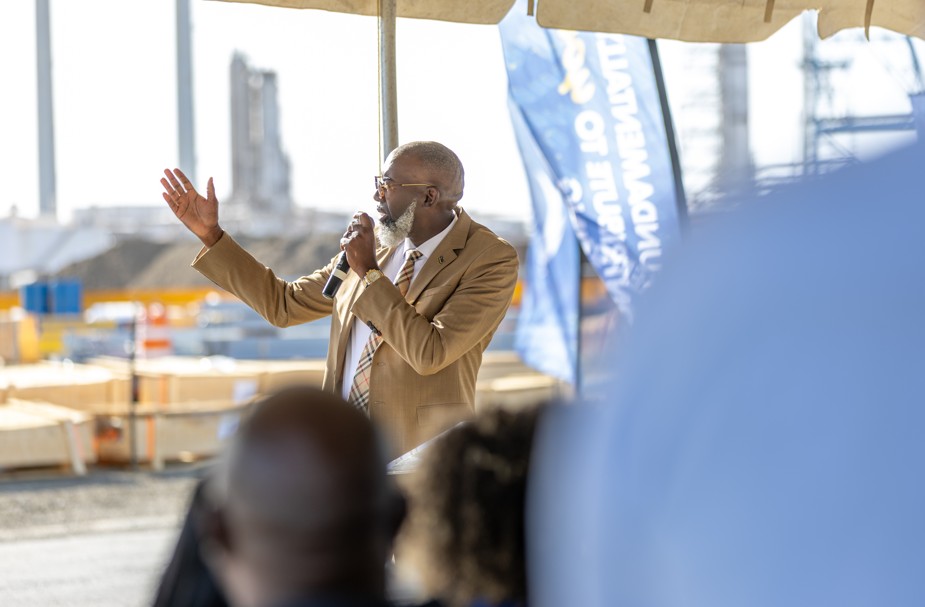
“When it concerns the public interest, you must have the courage to make a decision,” the Prime Minister said.
Pisas added that in several cases judges had later determined that the public interest carried greater weight when evaluating government actions.
Salu Power Plant Delays
The Prime Minister made the comments while discussing the development of the new Salu Power Plant at the 2Bays site.
According to Pisas, the project faced delays because necessary permits were not issued in a timely manner. He said that eventually the required decisions were taken, allowing construction to proceed.
The Salu Power Plant is one of Curaçao’s largest infrastructure projects in recent years. Once completed, the facility will add 40 megawatts of generating capacity to the island’s electricity grid and is expected to play a key role in strengthening the reliability of the power supply.
Pisas argued that projects of national importance require leaders who are willing to take responsibility and make difficult decisions, even when those decisions may face criticism or opposition.
“We need administrators who are prepared to take responsibility for important projects,” he said, stressing that such leadership is necessary to support economic development and prevent Curaçao from falling behind.
Debate Over Rule of Law
The Prime Minister’s comments are likely to attract attention because they touch on the relationship between government decision-making and the rule of law.
Under Curaçao’s constitutional system, government decisions are generally required to comply with existing laws and regulations. Courts routinely review whether public authorities have acted within those legal boundaries.
Pisas, however, pointed to situations where he believes the public interest ultimately proved decisive.
His remarks come at a time when several major development projects on the island have become the subject of legal disputes, including debates over permits, environmental concerns, and administrative procedures.
Strategic Energy Project
The Salu Power Plant is being developed by Aqualectra as part of a broader strategy to modernize Curaçao’s energy infrastructure and meet growing electricity demand driven by economic growth, tourism expansion, and population increases.
The utility company expects the first electricity from the new facility to be generated later this year. In addition to increasing production capacity, the plant is expected to improve grid reliability and provide greater flexibility for maintenance of existing power generation units.
For the government, the project is viewed as a critical investment in Curaçao’s long-term energy security and economic future.
Pisas’ comments suggest that the administration sees major infrastructure projects such as the Salu Power Plant as examples of situations where government leaders must balance legal procedures with what they consider the broader interests of the country.