WILLEMSTAD – Prime Minister Gilmar Pisas and Caryl Monte, President of Curaçao's National Government Reform Commission, appeared before the Curaçao Parliament on Thursday, October 22, to discuss the implementation, challenges, and evaluation of the Landspakket (economic) reform program, as the island approaches a crucial deadline for deciding whether to continue its reform cooperation with the Netherlands.
Pisas, participating in his capacity as Minister of General Affairs, joined Monte in discussions with parliamentarians about the progress achieved under the reform program, obstacles affecting its implementation, and the importance of evaluating the results.
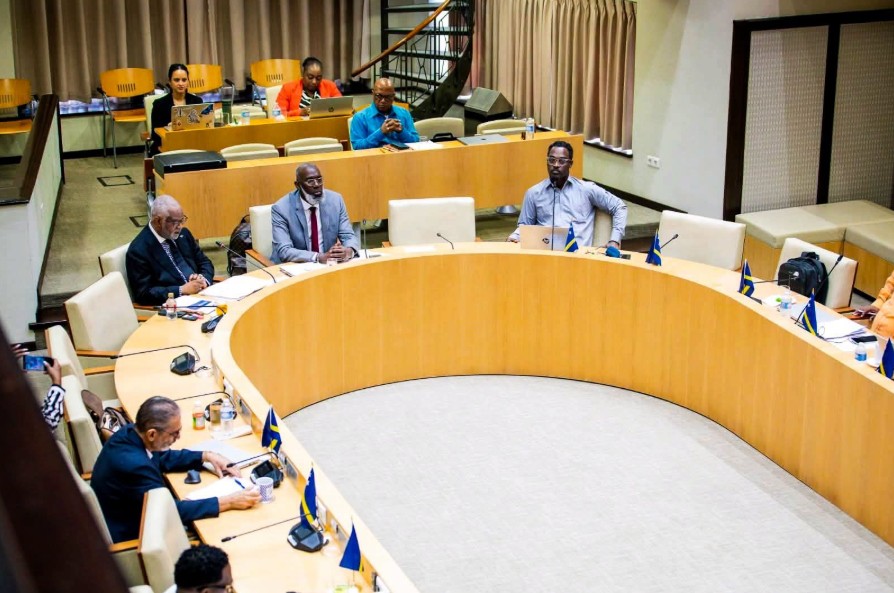
Monte and Premier Pisas during the parliamentary debate
The meeting comes at a significant moment because the current Mutual Arrangement on Cooperation in Reforms, which provides the framework for implementing the Landspakket, is scheduled to expire in April 2027.
Any extension of the arrangement requires the approval of the Curaçao Parliament.
According to local media reports, the Netherlands has already expressed its willingness to continue supporting the reform program, potentially extending cooperation until 2029. However, Curaçao must still determine whether it wishes to continue under the existing framework and which reforms should receive priority.
Parliament Examines Progress and Delays
The parliamentary discussions focused on the implementation of reforms intended to strengthen Curaçao's public administration, financial management, economy, and government institutions.
The Landspakket was introduced as part of the agreements reached between the Netherlands and the Caribbean countries of the Kingdom following the economic difficulties caused by the COVID-19 pandemic.
The reform program covers several areas, including government finances, taxation, public administration, the labor market, social security, healthcare, education, and economic development.
Curaçao remains responsible for implementing the reforms, while the Netherlands provides technical assistance and financial support through the Temporary Work Organisation (TWO).
The parliamentary meeting also provided an opportunity to examine delays and determine whether the reforms are producing the intended improvements.
The Central Committee discussion had previously been requested by parliamentarians Ruthmilda Larmonie-Cecilia, O.A. Martina, S.P. Oserpa, and R.M. Cijntje.
Independent Evaluation Calls for More Time
The debate follows an independent evaluation of the reform cooperation published earlier this year.
The evaluation concluded that cooperation between the Netherlands, Curaçao, Aruba, and Sint Maarten had contributed to initiating important reforms.
However, it also determined that structural reforms require more time than originally anticipated.
For Curaçao specifically, the evaluation highlighted the importance of greater clarity regarding the government's administrative and political commitment, as well as the need to identify which reforms should receive priority.
These findings have increased the importance of parliamentary oversight as the government considers the future of the Landspakket.
Nearly €31 Million Available for Continued Reform Cooperation
The Dutch government has indicated that approximately €30.9 million in previously allocated funding could remain available to support reform cooperation during 2028 and 2029.
According to the Netherlands' 2027 budget documents, €21.3 million would be available in 2028 and another €9.6 million in 2029.
The funding concerns the broader Landspakket cooperation involving Curaçao, Aruba, and Sint Maarten, rather than an allocation exclusively for Curaçao.
The money would be directed toward selected priority reforms, with the intention of supporting projects that require additional time to produce lasting institutional improvements.
However, the continuation of the arrangement is conditional on the necessary parliamentary approvals.
Transparency and Accountability Central to Discussions
According to the information provided by the government, the discussion between Pisas, Monte, and Parliament addressed not only the progress of reforms but also the challenges encountered during their implementation.
The government emphasized the importance of evaluating the process to promote transparency, accountability, and sustainable development.
These considerations are particularly relevant because the Landspakket involves significant institutional changes and financial resources.
Parliamentary scrutiny provides an opportunity to establish which projects have been completed, which remain delayed, and what adjustments may be necessary.
The meeting also comes amid broader discussions about Curaçao's relationship with the Netherlands.
During a meeting with a delegation of the Dutch House of Representatives on October 21, Pisas explained that Curaçao is discussing the expiration of the reform cooperation arrangement with the Dutch government.
The Prime Minister has also emphasized the importance of cooperation within the Kingdom while respecting Curaçao's autonomy.
Decision on Future Cooperation Still Pending
Although the government confirmed that Pisas and Monte participated in the parliamentary discussions, the information released about the meeting did not establish whether a final decision was reached concerning an extension of the Landspakket.
It also did not provide a detailed breakdown of the individual reforms discussed or the specific implementation problems identified.
With the existing agreement scheduled to expire in April 2027, the government and Parliament face an important decision about the future of reform cooperation.
The outcome will help determine whether Curaçao continues receiving Dutch technical and financial assistance for selected reform projects through 2029 and how those projects will be prioritized.
For now, the parliamentary discussions represent another step in evaluating the effectiveness of the Landspakket and determining how Curaçao intends to pursue long-term institutional and economic reforms.