CARACAS – Colombian President Gustavo Petro has traveled to Venezuela, becoming the first foreign leader to visit the country since the U.S.-led operation earlier this year that resulted in the arrest of former Venezuelan president Nicolás Maduro.
Petro met in Caracas with Venezuela’s acting president Delcy Rodríguez to discuss security, defense, trade and border cooperation, in what analysts see as a major diplomatic signal at a time of heightened regional tension.
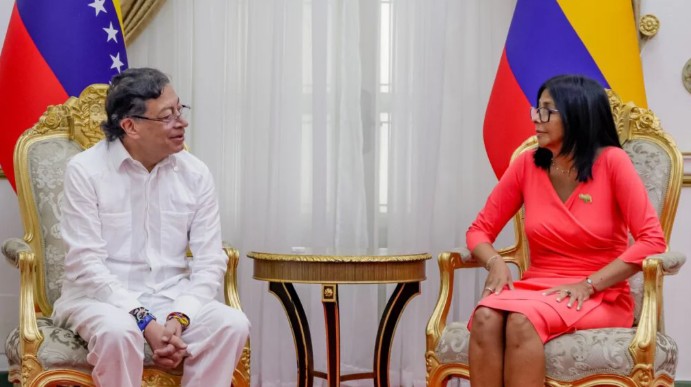
According to reports, the meeting focused heavily on intelligence-sharing and strengthening cooperation against organized crime and smuggling in the volatile border region between Colombia and Venezuela, particularly in Catatumbo, an area long affected by armed groups and drug trafficking.
Petro’s visit marks a significant moment in regional diplomacy following the controversial U.S. operation in January, in which Maduro was captured and taken to the United States to face drug trafficking charges. The operation triggered widespread criticism across Latin America, with several governments questioning its legality and warning about violations of Venezuelan sovereignty.
The Colombian president has openly questioned the legal basis of the U.S. action, arguing that there was no clear international legal framework justifying the operation. His position places Colombia—traditionally one of Washington’s closest allies in the region—at odds with the United States on one of the most sensitive geopolitical issues in Latin America this year.
That criticism has intensified tensions between Bogotá and Washington.
U.S. President Donald Trump responded sharply, accusing Petro of being soft on drug trafficking and suggesting Colombia is failing to control narcotics flows. The exchange has further strained diplomatic relations between the two countries, despite recent efforts to improve communication.
Petro’s visit also has economic implications. Reuters reported that both governments discussed energy cooperation, including electricity supply and gas projects, as Venezuela seeks to rebuild parts of its economy and strengthen regional trade links under Rodríguez’s interim leadership.
For the Caribbean, particularly islands like Curaçao and Aruba, the renewed Colombia-Venezuela dialogue is being watched closely. Stability along the Colombia-Venezuela border could affect migration flows, regional security and trade routes, all of which have direct implications for the southern Caribbean.
The meeting underscores how Venezuela remains central to regional geopolitics even after Maduro’s removal, with neighboring countries now recalibrating their diplomatic and economic strategies under a rapidly changing political landscape.