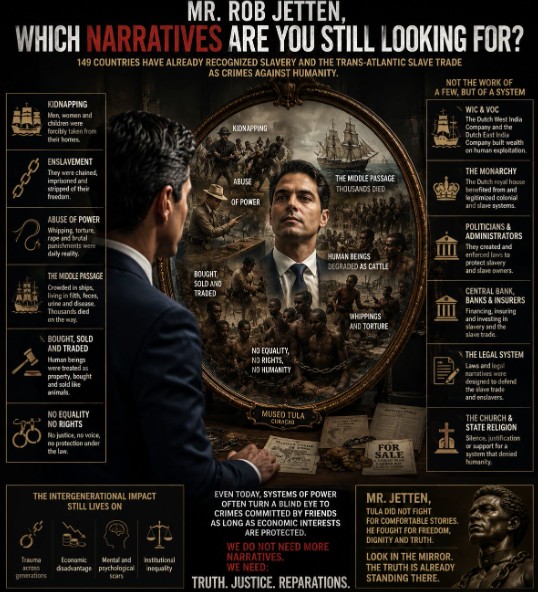
Mr. Rob Jetten,
At Museo Tula in Curaçao, you spoke about the need to seek “other narratives.”
But what exactly does a former slave-trading nation still need to reinterpret?
What alternative narrative exists for slavery?
Was slavery not:
• kidnapping?
• human trafficking?
• abuse of power?
• the violent separation of families?
• the degradation of human beings into property and cattle?
• the legal protection of exploitation?
• organized racial inequality?
• the buying and selling of human lives?
What other narrative is there?
Because history has already documented what slavery truly was.
Men, women, and children were captured and transported in chains.
Human beings were packed into ships so tightly that thousands died surrounded by vomit, blood, urine, disease, and human waste during the Middle Passage.
Women were abused.
Children were stolen.
Men were tortured.
People were whipped, branded, sold, traded, punished, and stripped of dignity.
This was not misunderstanding.
This was a system.
And that system was not created by a few isolated plantation owners.
It involved:
• the Dutch West India Company,
• the Dutch East India Company,
• monarchies,
• colonial governments,
• politicians,
• merchants,
• banks,
• insurance companies,
• courts,
• and religious institutions that often legitimized or tolerated the system.
Laws were written to protect slavery.
Financial structures were built around slavery.
Insurance policies covered slave ships and enslaved people as “cargo.”
Entire economies profited from stolen labor and stolen humanity.
So again:
what narratives are still being searched for?
A softer narrative?
A financially comfortable narrative?
A morally safer version of history?
Because 149 countries have already recognized slavery and the trans-Atlantic slave trade as crimes against humanity.
The world already knows what slavery was.
The deeper question now is whether nations are fully prepared to confront the scale of responsibility behind it.
And what about the intergenerational consequences?
Trauma travels through generations.
Economic inequality travels through generations.
Psychological scars travel through generations.
Institutional disadvantages travel through generations.
Even today, systems of global power often remain silent about crimes committed by allies as long as economic or geopolitical interests are protected.
That is why Museo Tula cannot become merely a symbolic backdrop for political speeches.
It is a mirror.
A mirror asking uncomfortable questions.
Not only to the Netherlands,
but to every system of power that still attempts to manage memory more carefully than truth.
Tula did not fight for comfortable narratives.
He fought for freedom.
For dignity.
For humanity.
For truth.
And perhaps that is why his voice still echoes so strongly today.
Because the struggle against dehumanization did not end in the past.
It simply changed form.
Tico Vos
Journalist, Columnist and Activist