WILLEMSTAD – The Ministries of Education, Science, Culture and Sport (ESKD) and Justice are strengthening their collaboration to improve school safety and ensure better student attendance through a coordinated approach involving schools, law enforcement and social services.
The initiative was highlighted during a recent session of the Safe Schools Platform, which brought together representatives of Curaçao's Compulsory Education Unit (Leerplicht), the Curaçao Police Force (KPC), including youth officers and neighborhood officers, school administrators, social workers and officials from the Ministry of Education.
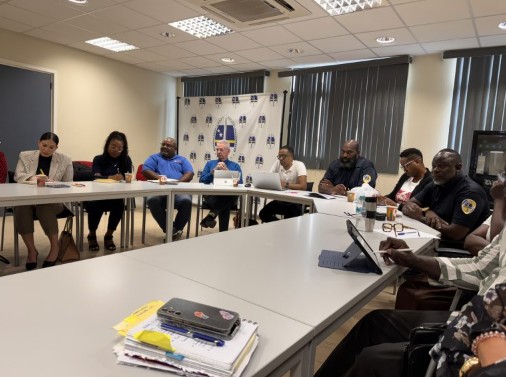
The meeting was opened by Shalini Jansen-van Uytrecht, chair of the Safe Schools Platform and representative of the Ministry of Education. Welcome remarks were delivered on behalf of the KPC management team by Jules Ilario, followed by an address from youth police coordinator Jandira Sophia, who also serves as a member of the platform.
Representing the Ministry of Education, the director of the Education and Science Sector presented the strengthened Compulsory Education Unit, explaining its legal framework and expanded role in fostering cooperation among schools and partner organizations. The unit's coordinator, Kendra Hersilia-Evertsz, also introduced her team. Rodney Mambre, speaking on behalf of the Curaçao Police Force, outlined the police's role in youth protection and cooperation with educational institutions.
The session marked another important step in implementing the Safe Schools Cooperation Protocol, a partnership that includes the Ministry of Education, the Ministry of Justice, the Public Prosecution Service, the Curaçao Police Force, the Youth Care and Protection Agency (UOJZ) and school boards. The protocol is designed to strengthen safe learning environments and improve cooperation in supporting young people who are considered at risk.
The Ministry of Education emphasized that education and safety are inseparable.
"A child can only learn effectively when he or she feels safe, receives proper attention and regularly attends school," the ministry stated.
Officials stressed that the initiative is not only about defining responsibilities but also about strengthening connections between schools, families, compulsory education authorities, police, youth care services and the justice system. The integrated approach aims to identify problems early, guide vulnerable students in a timely manner and prevent more serious social issues from developing.
As part of those efforts, the Compulsory Education Unit was expanded in 2026 from three to six staff members and, for the first time, now has a dedicated coordinator. The unit serves as a central link between schools, families and partner organizations, focusing on enforcement of compulsory education laws, guidance, early intervention, coordination and monitoring of school attendance.
Authorities also reiterated the legal obligation for school attendance in Curaçao. Children between the ages of 4 and 18 are required to attend school until they obtain a recognized diploma, such as a PKL, TKL, HAVO or VWO qualification. Parents and legal guardians are legally responsible for enrolling their children in school, while schools must monitor attendance and report cases of unauthorized absenteeism.
The Curaçao Police Force explained that school safety extends far beyond responding to incidents. Police officers focus on prevention, law enforcement, assistance, early detection of problems and providing guidance to schools. Officials emphasized that schools, social workers, parents, the Compulsory Education Unit, neighborhood officers and youth officers all play an essential role in protecting students.
During the discussions, participants clarified the responsibilities of each organization involved. Representatives of the island's major school boards—including DOS, VPCO, RKCS, FSHP, SCOEBG and SOZDA—together with social workers, shared practical experiences from schools. Their contributions helped establish the foundation for closer coordination, clearer communication channels, responsible information sharing within privacy regulations and more structured cooperation in complex cases.
Participants agreed that schools should remain the first point of contact for students, while the Compulsory Education Unit coordinates support from police and care partners whenever necessary. Cases involving absenteeism, unsafe situations or youth at risk should receive early intervention, while serious incidents involving violence, weapons or major threats must be escalated immediately to safeguard students, school staff and the wider school community.
Through the strengthened partnership, the Ministries of Education and Justice, together with the Curaçao Police Force, school boards and youth support organizations, aim to give practical effect to their shared ambition of creating safer schools where every student has the opportunity to learn and develop in a secure environment.