WILLEMSTAD – The Mi Kas Awor program (My House Now) has reached a historic milestone in Curaçao’s public housing sector, with 16,371 families registered as of January 1, 2026. The figure reflects growing demand for affordable homeownership and places the program at the center of the government’s broader housing and spatial development agenda.
The registrations were processed through the renewed digital portal of Fundashon Kas Popular (FKP), marking a major shift from fragmented, paper-based administration to a centralized and data-driven system. According to FKP, the scale of participation confirms that affordable housing ownership has broad societal support and is no longer a marginal policy objective.
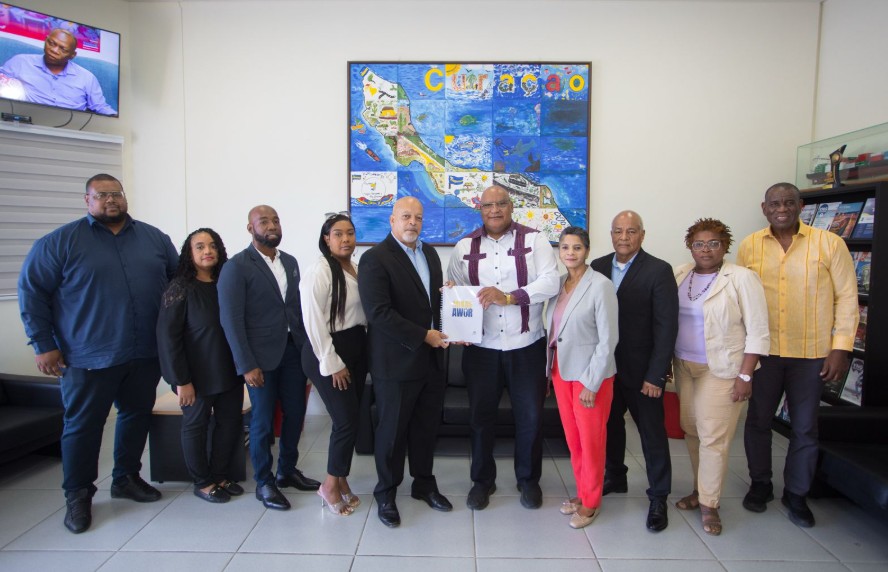
Mi Kas report presented to Minister Charles Cooper
The milestone coincides with key priorities outlined in the government’s Regeerprogramma, which emphasizes the development of a national Master Plan for housing and green infrastructure, the stimulation of affordability and ownership through Mi Kas Awor, the sale of government-owned housing, and a revision of building policy that includes more efficient land use and a strategy for high-rise development. Within this framework, Mi Kas Awor functions as a concrete implementation tool rather than a purely aspirational policy instrument.
Over the past two years, FKP has undergone a significant institutional and digital transformation. Where public housing policy once relied on disconnected databases and manual procedures, the foundation now operates with a fully integrated digital registration system. This allows for detailed segmentation of target groups by income category and neighborhood, real-time insight into purchase intentions, and legally and operationally defined program tracks under the Mi Kas Awor framework. The full policy dossier has been completed and formally submitted, placing the program in a phase where phased execution can begin once the necessary administrative decisions are taken.
The data show that FKP is starting from a position of immediate operational readiness. Of the total registrations, 2,085 household profiles have already been fully validated, including income data and financial substantiation. In addition, there is clear interest in homeownership among the existing tenant base of approximately 5,000 households.
As of January 1, 2026, 863 families had formally indicated their intention to purchase their rental homes. That number has since increased to 949 households, all of whom have explicitly confirmed their interest through the digital platform. These registrations and updates are processed via the Mi Kas Awor portal, where continuous data verification and cleansing take place. The homes involved are spread across designated sales neighborhoods as well as other areas within the FKP housing portfolio.
The combination of validated demand, explicit purchase intentions and available housing stock creates a solid foundation for a gradual transition from rental to ownership. According to FKP, this controlled flow is essential to maintaining social stability while expanding access to property ownership.
Beyond its social function, the program is increasingly being positioned as a strategic data source for policymakers. The collected information provides detailed insight into demand concentration by neighborhood, preferred housing types, income distribution within the target group and the potential for mobility within the existing housing stock. This enables future construction and spatial planning decisions to be more closely aligned with demonstrated societal needs, including decisions on densification, zoning changes and high-rise development.
FKP notes that its modernization was achieved in collaboration with specialized international teams, adapting proven models to Curaçao’s legal, social and economic context. Digital infrastructure, compliance mechanisms, selection procedures and implementation logic have all been integrated into a single operational framework. As a result, the organization considers itself technically and institutionally prepared for controlled execution within existing legal and budgetary limits.
With more than 16,000 families registered, Mi Kas Awor has grown into one of the largest participatory housing initiatives in Curaçao’s recent history. Public interest is demonstrably high, policy frameworks are in place, and the digital infrastructure is operational.
According to FKP, the program now stands at a critical turning point in Curaçao’s housing policy, closely aligned with the ambitions set out in the Regeerprogramma and poised to move from preparation to execution once final political decisions are taken.