209 Years After His Execution
Today marks 209 years since Manuel Carlos Piar was executed by firing squad in Angostura, Venezuela. From Curaçao, the island of his birth, we turn our attention once again to a man whose life forms part of the history of both our peoples. Remembering him invites us to understand his contributions, examine his conflicts, and explore the circumstances that led to his death.
On this anniversary, we share an adaptation of the article “Fin del general en jefe Manuel Carlos Piar, Libertador de Guayana,” published by our friend Antonio José Valdez Medérico on October 13, 2024, in Crónicas de Guayana y Caroní. We thank this chronicler for his dedication to making this history accessible. His text provides the foundation for the account presented here in simpler language, with several clarifications at the end.
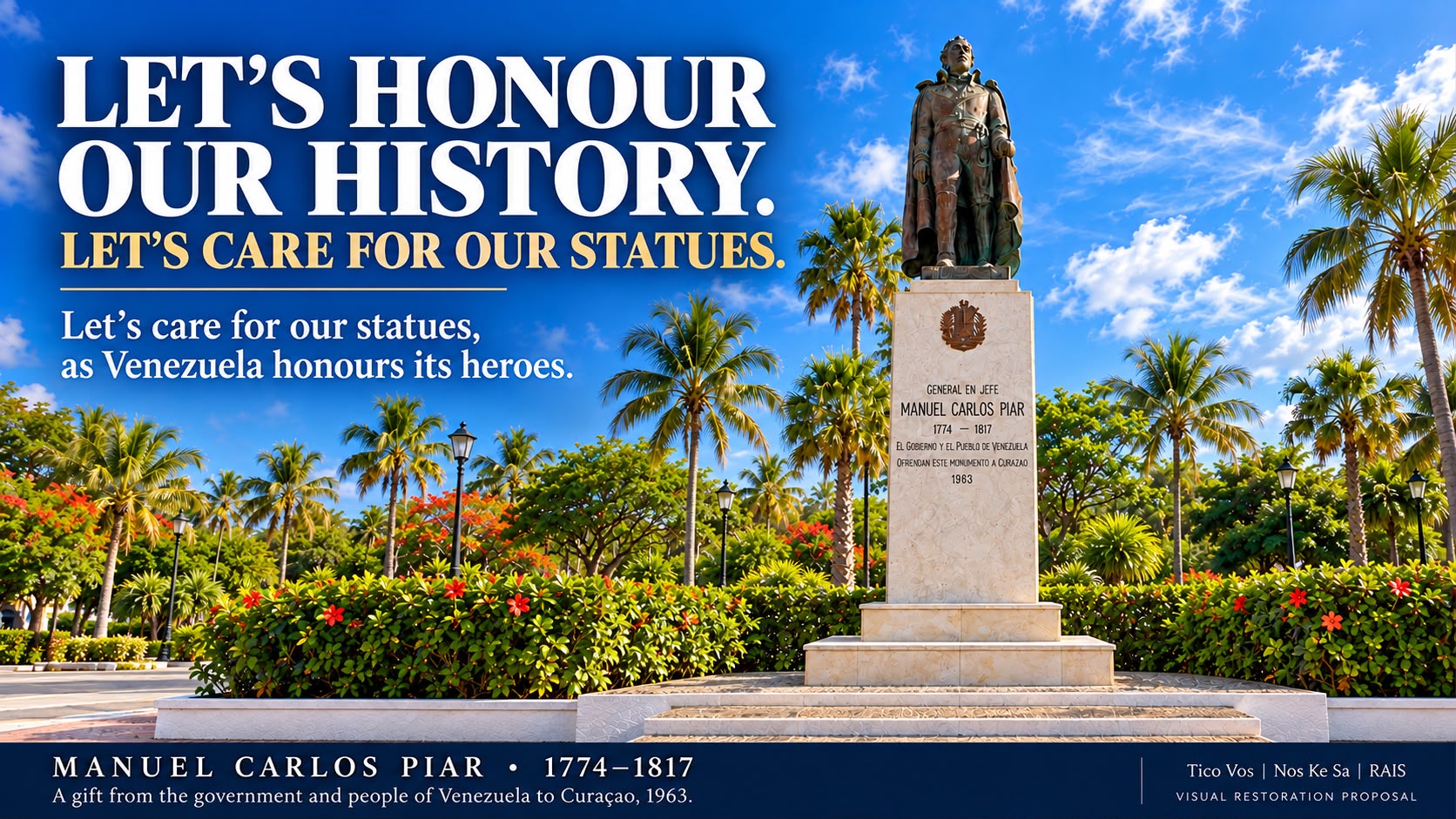
Piar was born in Willemstad and was connected from an early age to the maritime world of the Caribbean. His life unfolded among islands, ports, and territories linked by trade, migration, and political struggles. His move to Venezuela brought him into a cause that would profoundly change his life: the war for independence.
Medérico describes how Piar joined the patriot forces, served under Francisco de Miranda, and participated in military campaigns in eastern Venezuela. It was a difficult journey, marked by victories, defeats, and reorganizations. The independence fighters had to obtain weapons, gather soldiers, and continue fighting after losing ground.
Under these circumstances, Piar established himself as a military leader. He also joined Simón Bolívar in the expedition organized from Les Cayes, Haiti. These movements reveal the Caribbean dimension of Venezuela’s independence struggle. The sea connected places of refuge, sources of supplies, and new opportunities to continue the war.
Yet fighting for the same cause did not eliminate differences among its leaders. The article recalls Piar’s conflicts with other patriot commanders, including Santiago Mariño and José Francisco Bermúdez. Personal rivalries and disputes over command accompanied the struggle against forces loyal to the Spanish Crown.
Guayana would occupy a decisive place in Piar’s military career. There, he led military operations and helped organize territories coming under patriot control. The region offered resources and a strategic position along the Orinoco River, both essential to sustaining the war.
On April 11, 1817, Piar achieved his best-known victory at the Battle of San Félix. That triumph was decisive for the patriots’ advance in Guayana and helps explain his enduring place in the region’s historical memory.
His military successes, however, did not prevent his relationship with Bolívar from deteriorating. According to Medérico, Piar handed over command of more than two thousand soldiers to Bolívar and later requested permission to leave military service. He received permission and a safe-conduct document, but the tensions remained.
The final chapter came only months after San Félix. Piar was captured on September 27, 1817, and taken to Angostura. There, he faced a military trial before a court-martial presided over by Luis Brión. Fernando Galindo undertook his defense.
The court sentenced him to death. Bolívar confirmed the execution but did not approve the stripping of Piar’s military rank, which had also been included in the sentence. On October 16, 1817, Manuel Carlos Piar was executed by firing squad.
The contrast between his military contribution and the end of his life continues to raise questions. Understanding it requires examining the accusations, the defense arguments, the court’s decisions, and the political circumstances. Medérico’s article offers an overview of Piar’s life. The reasons for his conviction, and whether it was just, require a broader examination of the documents.
For Curaçao, this history touches close to home. Piar left our island and came to occupy a prominent place in Venezuela’s struggle for independence. Knowing him requires looking beyond the name of a square or the figure of a monument. It means exploring the person, his decisions, and the world in which he lived.
Today, we remember him with that desire to understand. We thank our friend Medérico for contributing to a historical conversation that crosses the Caribbean Sea and deserves to continue among researchers, readers, and communities in both our countries.
Clarifications Regarding the Original Text
In this adaptation, we use 1774 as Piar’s year of birth rather than 1777. This correction reflects references to historical research and to the baptismal register of Santa Ana Church in Curaçao mentioned within our project. The precise archival reference remains to be added so that readers can verify it. The date of birth and the date of baptism must always be distinguished.
We also correct a typographical error in the final paragraph of the original article: Piar was captured on September 27, 1817, not in 2017.
These observations are offered with respect for the author and with a commitment to continuing to check the information against the sources. Tico Vos takes responsibility for this adaptation and the additional reflections.
Tico Vos | Nos Ke Sa | RAIS
Curaçao, October 16, 2026