WILLEMSTAD – An international team of scientists has developed a new method to assess the vulnerability of coral species worldwide, revealing that 44 percent of the 774 reef-building coral species examined are threatened with extinction. In the Atlantic region, which includes Curaçao, that figure rises to 50 percent.
The findings were published on Thursday, October 15, 2026, in the scientific journal Nature. Curaçao's marine research and conservation organization Carmabi contributed to the development of the methodology used in the study.
The research provides important new insights into which coral species face the greatest risk of extinction and how conservation efforts can be directed toward those most in need of protection.
Coral reefs play a vital role in marine ecosystems. They provide habitats for countless marine organisms, protect coastlines against powerful waves, and support fisheries, tourism and cultural activities.
Around 65 coral species contribute to reef formation in Curaçao, while approximately 1,000 reef-building coral species are found worldwide.
Although the deterioration of coral reefs has been widely documented, scientists have faced difficulties determining whether all coral species are equally vulnerable to environmental pressures such as pollution and climate change.
Understanding these differences is essential because some species may require more urgent conservation measures than others.
One of the greatest challenges in assessing coral extinction risks is the lack of sufficient scientific data for many individual species.
To overcome this limitation, the international research team developed a method combining information about the deterioration of coral reefs with projections of rising ocean temperatures.
By examining how reefs have changed and where future environmental pressures are expected to intensify, scientists can identify regions where particular coral species may face an increased risk of extinction.
Using this approach, the researchers assessed 774 reef-building coral species from around the world, including species found in Curaçao.
The results indicate that 44 percent of the species evaluated are threatened with extinction. In the Atlantic region, the proportion reaches 50 percent.
The extinction risk determined for each species was incorporated into the Red List maintained by the International Union for Conservation of Nature (IUCN), which assesses the conservation status of species worldwide.
According to the study, rising sea temperatures represent the most significant threat to the survival of many coral species.
Higher ocean temperatures can cause coral bleaching, a process in which corals lose the symbiotic algae that provide much of their energy. Prolonged or repeated heat stress can weaken corals and lead to widespread mortality.
Carmabi, which has conducted research on Curaçao's coral reefs for many years, contributed its scientific expertise to the development of the assessment method.
The organization says the findings provide valuable information about the vulnerability of coral species in the Caribbean and can help improve conservation strategies.
However, Carmabi emphasizes that an important distinction must be made between the percentage of species threatened with extinction and the amount of living coral remaining on a reef.
The finding that half of the Atlantic region's reef-building coral species are threatened does not mean that half of Curaçao's living coral has disappeared.
Different coral species contribute to reef formation to varying degrees, and some species that play an important role in Curaçao's marine ecosystems are currently considered less threatened than others.
One example is yellow pencil coral (Madracis mirabilis), a species that contributes significantly to reef formation around Curaçao but is not currently classified as threatened with extinction to the same extent as many other species assessed in the study.
This distinction is important when interpreting the condition of local reefs and determining conservation priorities.
The research also makes it possible to combine international extinction-risk assessments with local information about coral coverage and species distribution.
For Curaçao, such an approach can provide a more detailed picture of reef vulnerability by identifying not only how much living coral is present in a particular area but also the conservation status of the species found there.
Local coral coverage measurements, including surveys conducted at depths of approximately 10 meters, can be evaluated alongside the international findings to better understand the ecological condition of individual reef areas.
According to Carmabi, combining local monitoring data with global scientific research can help authorities, conservation organizations and researchers make better-informed decisions about reef management.
The findings also underline the importance of addressing local environmental pressures, including pollution, while recognizing that rising ocean temperatures remain a major global threat.
For an island such as Curaçao, where healthy coral reefs are closely connected to coastal protection, marine biodiversity, fisheries and tourism, the research highlights the need for continued monitoring and effective conservation policies.
By identifying which species are most vulnerable, scientists hope to improve efforts to protect coral ecosystems before further losses become irreversible.
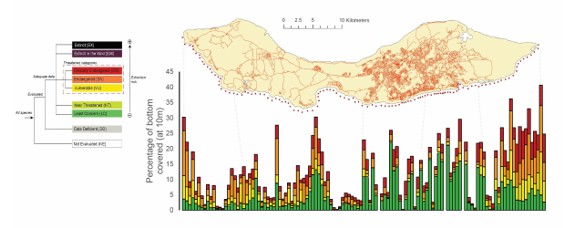
Percentage of the seabed covered by coral at a depth of 10 meters at 121 locations (from west to east) along Curaçao’s southern coast. The different colors indicate whether the coral species found at each location are classified as threatened or not threatened according to the updated IUCN Red List, based on the study discussed in this article.