WILLEMSTAD – Curaçao must strengthen its economic resilience and maintain sound public finances to protect itself against an increasingly unpredictable international economic environment. That was one of the central messages delivered by Professor Paul Hilbers, a former executive director at the International Monetary Fund (IMF) and a member of the Financial Supervision Boards (Cft), during a lecture organized by the Economenclub on October 29, 2026.
Hilbers, who joined the Cft in February 2026, examined the changing international economic and monetary system and its implications for small, open economies such as Curaçao and other Caribbean islands.
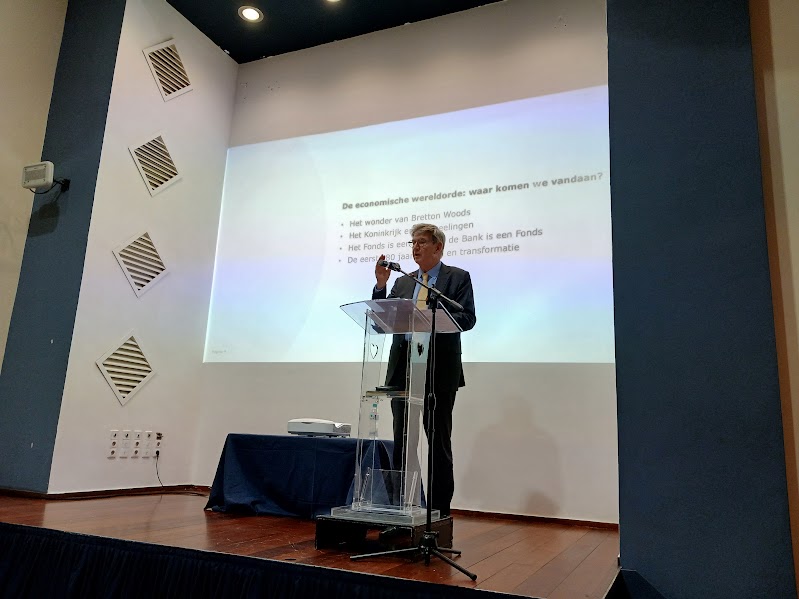
Paul Hilbers
His presentation focused on how geopolitical tensions, rising government debt, climate change, demographic developments, and technological transformations are reshaping the global economy.
According to Hilbers, smaller economies are particularly vulnerable because they depend heavily on international trade, foreign investment, tourism, and imported goods. Unlike larger countries, they have limited capacity to absorb major economic shocks.
To explain the changing global environment, Hilbers introduced a framework consisting of three C's, three D's, one major A, and an even larger M.
The three C's represent Covid, Conflicts, and Climate Change.
The COVID-19 pandemic exposed weaknesses in the global economic system, leaving many governments with higher debt levels, inflationary pressures, and greater economic vulnerabilities.
Geopolitical conflicts, trade disputes, and technological competition have since created additional uncertainty, affecting international supply chains, investment decisions, and economic growth.
Climate change represents another major challenge, particularly for small island economies exposed to extreme weather conditions, environmental damage, and the long-term costs of adapting infrastructure.
The three D's refer to Demography, Digitalisation, and Divergence.
Demographic changes, including aging populations and migration, are increasingly influencing labor markets, healthcare systems, pension arrangements, and government finances.
Digitalization and artificial intelligence offer opportunities to improve productivity and develop new economic activities. However, they also introduce risks related to cybersecurity, technological dependence, and the need for new skills.
Divergence refers to differences in economic development and the distribution of prosperity, both between countries and within societies.
Hilbers emphasized that economic growth does not automatically translate into improved living conditions for everyone.
The major A in his framework represents America.
The United States remains a dominant economic and geopolitical power, but changes in its approach to international cooperation and multilateral institutions are contributing to uncertainty about the future of the global economic order.
The even larger M represents financial markets.
According to Hilbers, financial markets can exert considerable influence over government policies, even in the world's largest economies.
Investors, businesses, and consumers respond to economic decisions, and their confidence can influence interest rates, exchange rates, capital flows, and overall financial stability.
Hilbers placed these developments in historical perspective by referring to the Bretton Woods Conference of 1944, which laid the foundations for the postwar international financial system and institutions such as the IMF and World Bank.
For decades, international agreements, cooperation, and mutual confidence helped support global economic stability.
Today, however, that international framework faces growing pressure.
For Curaçao, the consequences can be substantial.
The island's dependence on imported energy, food, consumer goods, and international tourism means that global disruptions can quickly affect domestic prices, business activity, employment, and government revenue.
Hilbers referred to the COVID-19 crisis as a clear example of this vulnerability.
In 2020, Curaçao's economy contracted by approximately 18 percent as international travel restrictions brought tourism activity to a near standstill.
The economic collapse demonstrated how quickly an external shock can affect a small economy that depends heavily on one major industry.
According to Hilbers, such vulnerabilities make economic preparedness essential.
He stressed the importance of maintaining healthy government finances, sufficient financial reserves, reliable infrastructure, and consistent economic policies.
These measures can help governments respond more effectively when international developments threaten economic stability.
For Curaçao, maintaining financial buffers is particularly important because unexpected shocks can create immediate pressure on public spending and government revenue.
Hilbers also emphasized the importance of good governance and reliable economic information.
Accurate data allows policymakers to identify emerging problems, assess risks, and make decisions based on evidence rather than short-term political considerations.
Another important challenge involves demographic developments.
An aging population can increase pressure on pensions and healthcare spending, while labor shortages may limit economic expansion.
Migration and changes in the workforce can also influence housing demand and the availability of qualified employees.
Meanwhile, technological developments present opportunities for Curaçao to diversify its economy beyond traditional sectors.
Digital services and artificial intelligence could support productivity improvements and new business activities, but realizing these opportunities requires investment in education, digital infrastructure, and cybersecurity.
The overall message of Hilbers' presentation was that Curaçao cannot control international economic developments but can determine how well it prepares for their consequences.
For a small, open economy, resilience depends on responsible financial management, strong institutions, sufficient reserves, and policies that support sustainable long-term development.
Hilbers' warning comes at a time when global economic uncertainty is increasingly affecting government decisions, business investment, and household finances.
His central argument was that smaller economies have less room for policy mistakes and must therefore place economic stability and preparedness at the center of their development strategies.