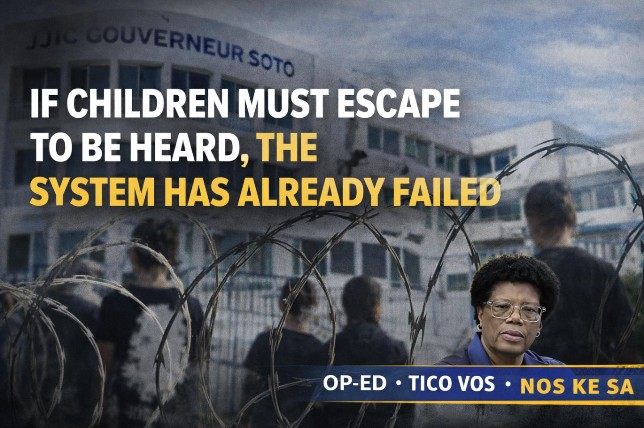
Curaçao is confronting a deeply troubling situation at its youth judicial correction and rehabilitation institution (JJIC)—a facility entrusted with one of the most sensitive responsibilities in our society: the care, guidance, and rehabilitation of vulnerable minors placed under state authority.
In recent days, the institution has come under intense public scrutiny following reports of unrest, complaints from both youth and staff, and growing concern from parents. Allegations regarding living conditions, daily structure, and the overall treatment of young people inside the facility have raised serious questions about whether the environment fulfills its rehabilitative mission.
At the center of this situation stands the director, who has now stepped down from her position in consultation with the Minister of Justice. While no legal conclusions have been reached regarding individual responsibility, her departure reflects the gravity of the concerns and the urgent need for accountability, transparency, and a thorough independent investigation.
This moment is not only about leadership—it is about the integrity of a system designed to protect, correct, and guide the next generation.
Instead, what we have seen is something else.
Children protested.
They resisted.
Some even escaped.
And that alone should shake us.
Because when children in a correctional or rehabilitation center choose to risk everything to be heard, it tells us something fundamental:
The system is no longer working for them.
The system may be working against them.
This is not about one person
Yes, a director has stepped down. Yes, there are allegations, complaints, and public pressure. But if we reduce this crisis to one individual, we will miss the deeper truth—and allow the real problem to survive. This is about a system.
A closed environment where:
* Children depend entirely on the institution
* Parents struggle to access or verify what is happening
* Staff operate under pressure, often without adequate support
* Oversight becomes reactive instead of preventive
In such systems, problems do not begin with scandal.
They begin quietly—with normalization.
The warning signs were there
Reports have pointed to:
* Lack of basic necessities
* Complaints about food and hygiene
* Absence of structured daily programs
* Tensions between staff and youth
* Limited transparency toward parents
Let us be clear:
These are not minor operational issues.
These are early indicators of institutional failure.
And when such signals are ignored, minimized, or delayed…
They grow.
Until one day, the silence breaks—not through reports, but through unrest.
When control replaces care
A youth correctional facility carries a heavy responsibility:
It must balance discipline with dignity.
It must enforce rules without erasing humanity.
It must guide—not dominate.
But when systems drift:
* Discipline becomes control
* Control becomes suppression
* Suppression becomes neglect
And neglect… becomes normalized.
That is when children stop feeling seen.
That is when voices are no longer heard internally.
That is when resistance begins externally.
The most dangerous system is a closed one
The greatest risk in any institution is not visible chaos. It is controlled silence.
When:
* Complaints stay internal
* Staff fear speaking openly
* Parents feel blocked or uninformed
* Leadership manages perception instead of reality
Then the system protects itself … instead of the children inside it.
Accountability must go beyond resignation
A resignation is not a solution. It is a signal. The real questions begin now:
* How long were these complaints known?
* Who documented them?
* Who acted—and who did not?
* What independent oversight existed?
* Why did escalation reach the point of unrest?
And most importantly:
What was the daily lived reality of these children? Because policy documents do not tell that story. Children do.
This is about who we are as a society
We cannot claim to build a future for our youth while failing those already in our care.
A society is not judged by:
* its speeches
* its strategies
* or its public relations
It is judged by how it treats the most vulnerable, especially when no one is watching.
From crisis to turning point
This moment can go two ways:
1. Containment
* Replace leadership
* Adjust procedures
* Move on
2. Transformation
* Open the system
* Strengthen oversight
* Center the dignity of every child
* Rebuild trust with parents and society
Curaçao must choose.
Final word
Let us not wait for another escape.
Let us not wait for another protest.
Because when children must break the system to be heard…the system has already broken them.
Tico Vos
Journalist and Commentator