He Saw It. He Came. He Conquered.
Sometimes people say that nothing changes in Curaçao. Sometimes they believe that articles disappear into silence, complaints drown in bureaucracy, and public frustrations become just another forgotten conversation. But this week proved otherwise.
Only a few days after the publication of my opinion article about the inhumane conditions at the bus stop in Mahaai, near important medical services, something unexpected happened. A professional from Curaçao’s construction and infrastructure sector read the article. The images deeply affected him. The reality shocked him. He could not believe that elderly citizens, patients, workers without cars, and people dependent on public transportation had been forced to wait for almost two years under the burning sun beside a broken and abandoned bus stop.
But unlike many who simply shake their heads and move on, he did something that today feels increasingly rare:
He personally went to inspect the site.
Not for a photo opportunity.
Not for publicity.
Not for political theater.
He came because he immediately understood that this was never just about a bus stop. It was about human dignity.
The man who arrived was none other than Jurandy Basilio.
Ironically, Jurandy had already been involved in improving bus stops in other parts of Curaçao, including Punda. But after personally seeing the situation in Mahaai, something changed. Right there on the spot, he began thinking practically—not bureaucratically.
No outdated concrete structure.
No endless paperwork.
No excuses.
No “mañan.”
Instead, he envisioned a functional, modern, and human-centered design adapted to Curaçao’s climate realities:
more seating, more shade, greater comfort, and an appearance that reflects respect for the people who use the space every day.
And then something happened that many people no longer expect in Curaçao.
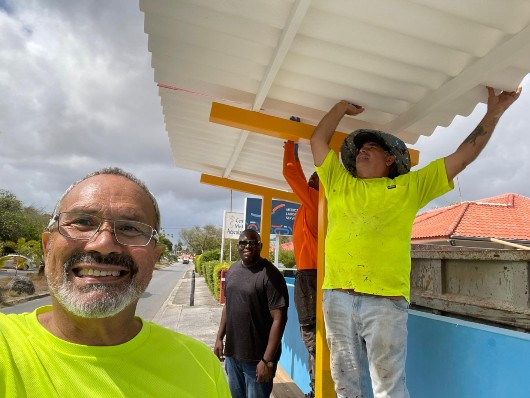
On Tuesday, work began.
By Wednesday, the steel frame was already standing.
Today, the roof and paint were being completed.
The remains of the old broken cement structure were completely removed. The area was properly cleaned. And as if that were not enough, even the asphalt will be replaced with a dignified brick and klinker finish.
What had remained neglected for years suddenly began visibly transforming within only a few days.
And perhaps that is why this story matters far beyond a simple bus stop.
Because this is not only about infrastructure. It is about mentality. About the type of professionals a society needs. People who still feel responsibility when they witness human suffering. People who understand that public service means far more than meetings, reports, and shifting responsibility.
Too often, we hear only stories about what goes wrong in Curaçao. But excellence also deserves recognition.
And this week, that excellence had a name: Jurandy Basilio.
He saw it.
He came.
He conquered.
Not with speeches.
Not with long statements.
But through work.
I personally met Jurandy by chance during the construction works, and I must admit that the encounter filled me with genuine satisfaction. Listening to him speak about his motivation, his practical vision, and the love he has for what he does reminded me that Curaçao still has people who see their work as a responsibility toward the community.
That kind of passion matters.
Because when someone does not see public work merely as a job, but as a form of service to the people, the results become visible immediately.
So, Jurandy Basilio: thank you.
And also thank you to your department and ministry for making this type of practical and human-centered approach possible. Because in the end, thousands of people will use this bus stop in the years ahead. They may never know who made the difference. They will simply arrive, sit in the shade, wait more comfortably, and continue their journey with a little less physical suffering than before.
But perhaps that is exactly what true public service should be:
quietly improving the everyday lives of ordinary people.
This follow-up is therefore not only about a repaired bus stop.
It proves that empathy still exists.
That professionalism still exists.
That vision still exists within public service.
And perhaps even more importantly:
It reminds us that one person who refuses to look away can sometimes be enough to restore humanity to a forgotten place.
Tico Vos is a seasoned journalist and columnist.