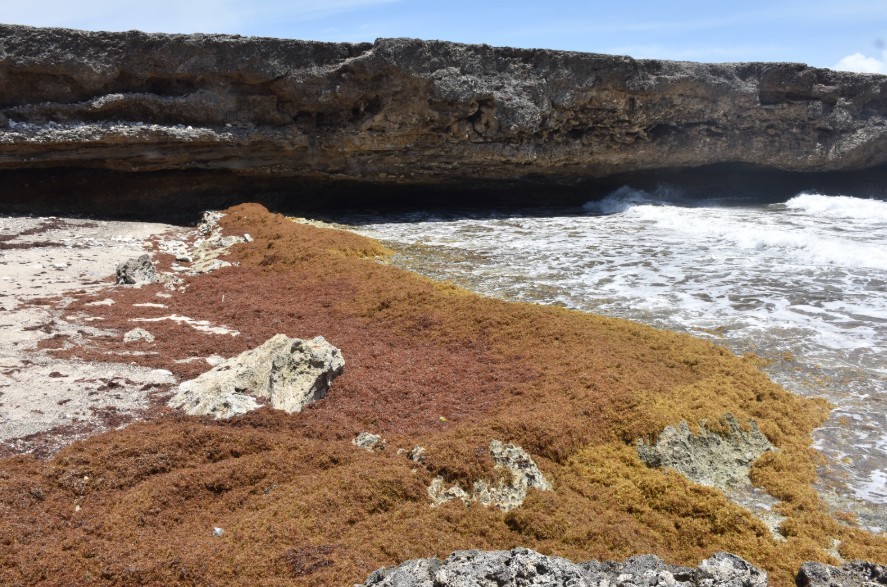
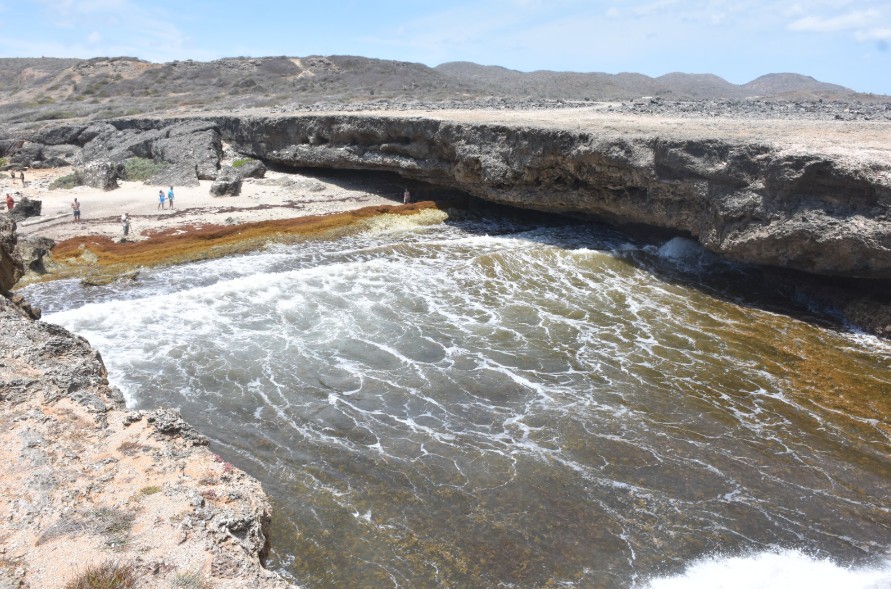
WILLEMSTAD – Large amounts of sargassum continue to wash ashore along Curaçao’s coastline, with the impact becoming increasingly visible at Shete Boka National Park, where thick mats of brown seaweed have accumulated along the shore and in the water.
Visitors and conservationists report that the smell of decomposing sargassum has become difficult to ignore in some coastal areas, a clear sign that the seaweed is not only affecting the landscape but also the delicate marine ecosystems that depend on those waters.
The growing concern is not just about tourism or aesthetics.
Environmental groups warn that the buildup of sargassum can create serious risks for marine wildlife, particularly sea turtles that use Curaçao’s beaches and coastal waters for nesting, feeding and migration.
When sargassum piles up in large volumes, it can trap hatchlings trying to reach the sea, block adult turtles from reaching nesting grounds and reduce oxygen levels in shallow coastal waters as the seaweed decomposes.
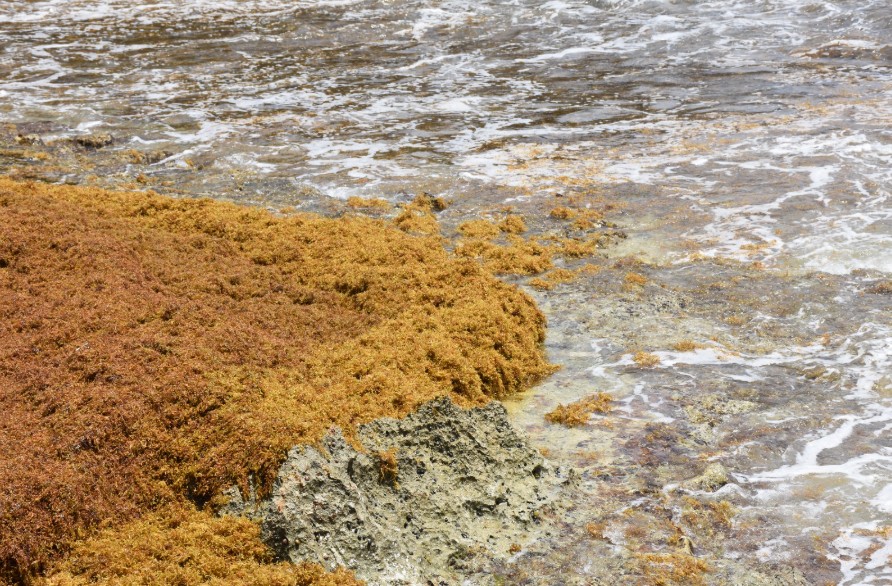
That decomposition process can create low-oxygen “dead zones,” affecting fish, crustaceans and coral reef ecosystems.
The issue has already been documented in several parts of the Caribbean.
Countries such as Barbados, Mexico and the Dominican Republic have introduced organized cleanup operations, monitoring systems and collection barriers to limit the impact on beaches and wildlife.
In Mexico’s Caribbean coast, authorities have deployed offshore barriers and mechanical removal systems to stop sargassum before it reaches sensitive beaches. Similar measures have been tested in Barbados and other eastern Caribbean islands.
On Curaçao, however, questions are growing about whether enough is being done.
Conservationists have warned for years that sargassum influxes are becoming more frequent and more intense, driven by warmer ocean temperatures, changing currents and nutrient pollution in the Atlantic.
At places like Shete Boka, where sea turtles are a major part of the natural ecosystem, the accumulation raises urgent concerns about habitat disruption.
Protected areas like Shete Boka are known for their importance as nesting and feeding zones for sea turtles, including the Green sea turtle, Hawksbill sea turtle and Loggerhead sea turtle.
Environmental advocates say waiting too long to act could lead to avoidable wildlife losses.
The question now being raised more loudly is whether Curaçao needs a structured national response.
Should cleanup efforts begin before the problem worsens?
Should sensitive wildlife zones be prioritized?
And should there be a permanent strategy, rather than reactive intervention?
While sargassum is a natural phenomenon, scientists say the scale seen in recent years is far from normal.
For Curaçao, where tourism and marine biodiversity are both critical pillars of the economy and environment, the growing seaweed invasion is becoming more than a seasonal nuisance.
It is increasingly becoming an environmental management challenge.
As the smell spreads and the seaweed piles higher along key coastal areas, many are now asking the same question: how much longer can Curaçao afford to wait before acting?
Images from Shete Boca National Park (Credit: Donnevan Hermelijn, all rights reserved)