How Cees Luckhardt’s research invites us to look further for the people behind our history
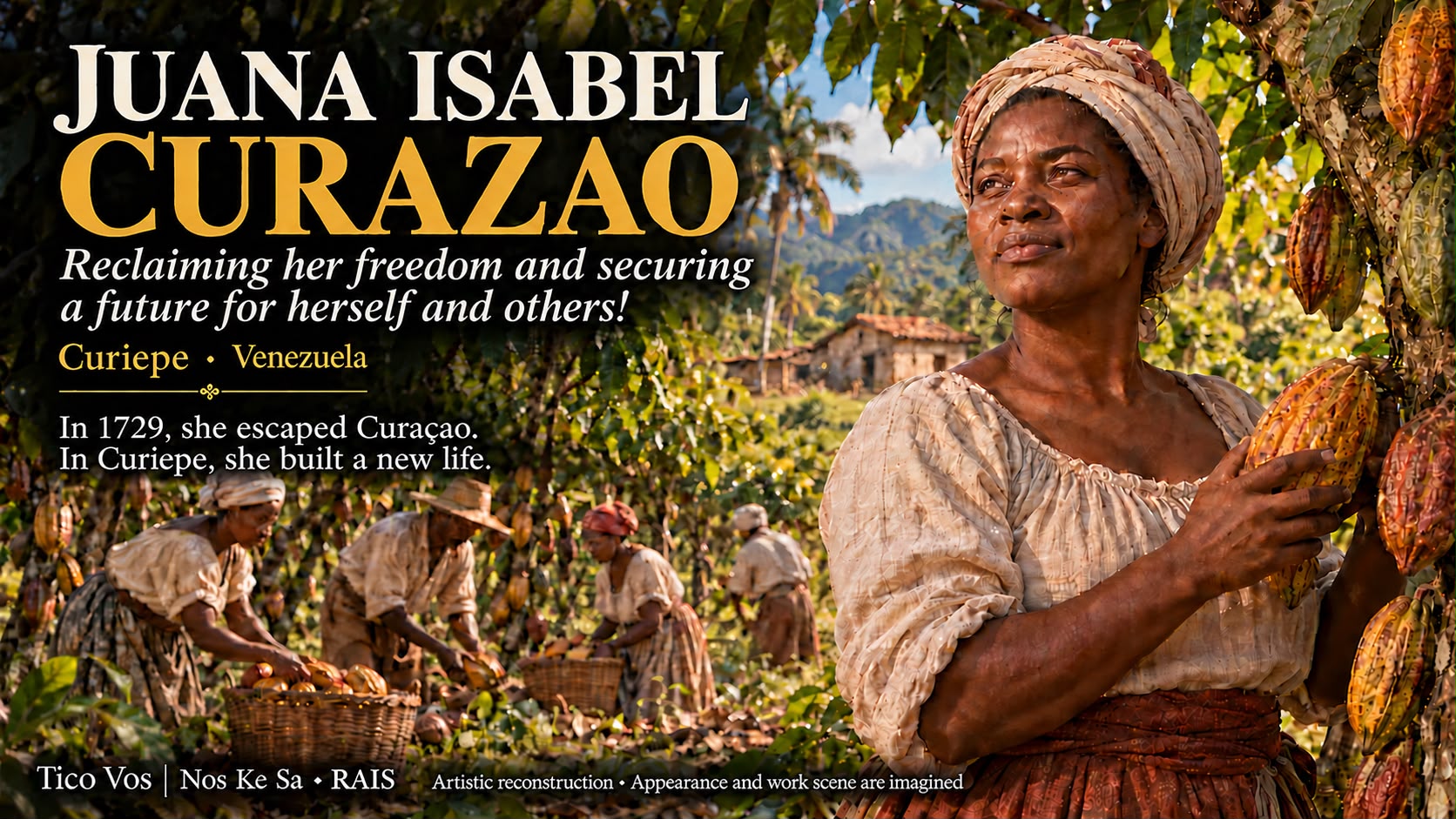
In 1729, a woman escaped slavery in Curaçao. Her name was Juana Isabel Curazao.
Across the water, in what is now Venezuela, she began again. She obtained her freedom, acquired a small plot of land and planted cacao. A woman who had been treated as property in Curaçao was building a life there with property of her own.
That change alone deserves our attention. Who was she? How did she manage to leave? Who helped her? And how did her name survive while finding so little space in our collective memory?
These are precisely the questions that show why historical research deserves support.
Cees Luckhardt’s investigation into the Catholic mission under Martinus Joannes Niewindt provides a valuable starting point. His six-part study covers the period from 1824 to 1860 and invites us to reconsider religion, slavery and the formation of our society. Behind familiar names and institutions, questions emerge about people who have remained much less visible.
For Nos Ke Sa and RAIS, this is an invitation to keep searching. To encourage researchers, make documents accessible and restore names to the stories we tell about ourselves.
Juana Isabel Curazao is one such name.
From fugitive to cacao grower
Historian Linda M. Rupert recounts her story in Contraband Trade and the Shaping of Colonial Societies in Curaçao and Tierra Firme.
According to Rupert, Juana Isabel fled Curaçao for the nearby Spanish-controlled coast in 1729. Following a reported conversion to Catholicism, she obtained her freedom and a small plot of land in Curiepe. Rupert qualifies that conversion with a note of uncertainty. The account therefore gives us no certainty about Juana Isabel’s personal faith or motives.
Spanish authorities had founded Curiepe in 1721 as a settlement for free Black people, intended to help protect the coast against foreign privateers. There, Juana Isabel planted cacao, a crop for which Europe’s growing interest in chocolate offered new commercial opportunities.
The cited source does not show us her face. We have no words of her own. Yet the outlines of a life become visible: an escape, freedom obtained, access to land and the building of a livelihood.
Giving her a face begins with taking those actions seriously. We do not need to invent thoughts, conversations or heroic deeds.
The water connected two worlds
Rupert places her story within a broader history of trade between Curaçao and the Venezuelan coast.
Despite Spanish prohibitions on trade with foreigners, cacao was sold clandestinely to Curaçaoan traders. They included small-scale Sephardic Jewish merchants and seafarers of African descent. Through Curaçao, the cacao continued to Dutch processing firms. Enslaved dockworkers loaded the cargo for that crossing.
This trading network reveals a painful interdependence. On one side of the water, people who had escaped slavery could build a new livelihood. Elsewhere in the same trading chain, unfree labour remained indispensable.
The cited passage does not separately establish that Juana Isabel herself engaged in smuggling. It does, however, reveal the economic world surrounding her cacao holding. Curaçao and the opposite coast were closely connected through people, goods and interests.
An inheritance that had to be defended
In 1765, a second woman enters the story: Ana María Mohele, Juana Isabel’s niece and heir.
By then, the grove had grown to approximately one thousand cacao trees. But the transfer of the land brought no security. Spanish colonial authorities challenged the validity of both Juana Isabel’s manumission and her land grant.
Ana María began a prolonged legal struggle to retain the inheritance. Eventually, half the property was confiscated. She was allowed to keep the other half.
Here, history acquires a second face. Beside the woman who escaped and built a livelihood stands the woman who defended what her family had acquired.
The challenge also shows how vulnerable freedom and property could remain. Even an established grove and an inheritance offered no complete protection against the exercise of colonial power.
Research that brings other lives into view
Juana Isabel’s escape took place almost a century before Niewindt’s mission began. Her history therefore provides no evidence about his conduct. The connection with Luckhardt’s research lies in the questions we learn to ask.
Who receives a name in our historical accounts? Whose actions are described in detail? And who appears only as property, labour or a number?
Research into religious institutions must also make room for the people who encountered them. What opportunities did they find? What restrictions did they experience? How did they try to shape their own futures within unequal relations of power?
We must remain careful. A recorded conversion does not tell the whole story of someone’s faith. A colonial deed does not tell the whole story of a human life. But such documents can mark the beginning of a reconstruction.
The silence also deserves investigation. Sometimes deliberate suppression may have occurred. Sometimes the explanation lies in neglect, inaccessible archives or a historical tradition that repeatedly centres the same officials and prominent families. We must investigate which explanation applies.
That is why Luckhardt’s work deserves encouragement: as a reason to read sources critically, deepen our questions and involve others in the research.
Juana Isabel Curazao shows what this can yield. Behind a name emerges a woman who escaped slavery and acquired land. Beside her appears Ana María Mohele, who fought for her inheritance.
Their lives call for further research in the archives of Curaçao and Venezuela, for cooperation and for the resources that will allow researchers to continue this work.
Giving someone a face begins with a name. Then comes our responsibility to discover the life behind it and give that life a lasting place in our history.
Source basis: the supplied passage from Linda M. Rupert’s “Contraband Trade and the Shaping of Colonial Societies in Curaçao and Tierra Firme”, and the supplied description of Cees Luckhardt’s research.
By Tico Vos | Nos Ke Sa · RAIS