Subject: Year-End Payments, December Bonuses, and Financial Assistance | Curaçao
Initial Important Finding
The document provided is a signed decision of the Council of Ministers dated October 7, 2026. It contains seven numbered decisions, the last of which is divided into three implementation provisions.
The decision shows that the government did not merely approve an 8% year-end payment for civil servants. At the same time, it adopted decisions concerning education personnel, subsidized institutions, social assistance recipients, recipients of the General Old Age Pension (AOV), and the financing and implementation of these payments.
One particularly important detail is that ministers and Members of Parliament are not explicitly identified as separate beneficiaries in the visible text of the decision. However, the broader wording "other persons included on the payroll of the Country of Curaçao" is used.
This distinction is legally essential. It is not immediately clear which individuals fall under this wording or whether the decision was also intended to create financial entitlements for political officeholders.
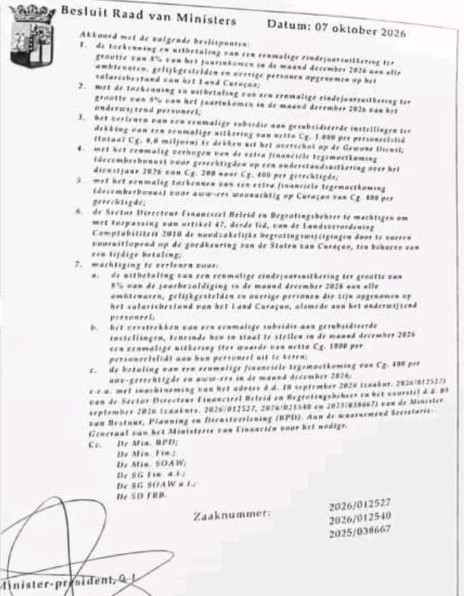
1. Transcription of the Decision
Based on the photograph provided. The original numbering has been preserved. Unclear words and passages are indicated in square brackets. This is the most complete transcription possible, but it is not a certified verbatim copy.
Decision of the Council of Ministers
October 7, 2026
Agreement with the following decisions:
- To approve the granting and payment of a one-time year-end allowance amounting to 8% of annual income in December 2026 to all civil servants, persons with equivalent status, and other individuals included on the payroll of the Country of Curaçao.
- To approve the granting and payment of a one-time year-end allowance amounting to 8% of annual income in December 2026 to teaching personnel.
- To provide a one-time subsidy to subsidized institutions to cover a one-time payment of XCG 1,000 net per employee (totaling XCG 8.8 million), to be financed from the surplus of the Ordinary Service budget.
- To approve a one-time increase in the additional financial allowance (December bonus) for recipients of social assistance for the 2026 financial year, from XCG 200 to XCG 400 per recipient.
- To approve a one-time additional financial allowance (December bonus) for a category of beneficiaries [unclear] residing in Curaçao, amounting to [probably XCG 150] per recipient.
- To authorize the Sector Director of Financial Policy and Budget Management, pursuant to Article 47, paragraph 3, of the National Ordinance on Government Accounting 2010, to implement the necessary budget amendments in anticipation of approval by the Curaçao Parliament, to ensure timely payment.
- To grant authorization for:
a. The payment of a one-time year-end allowance amounting to 8% of annual remuneration in December 2026 to all civil servants, persons with equivalent status, and other individuals included on the payroll of the Country of Curaçao, as well as teaching personnel.
b. The provision of a one-time subsidy to subsidized institutions, enabling them to pay their employees a one-time allowance of XCG 1,000 net per employee in December 2026.
c. The payment of a one-time financial allowance of XCG 400 per [category of beneficiaries insufficiently legible] in December 2026.
The document subsequently refers to supporting advice and documents from September 2026, including documents from the Sector Director of Financial Policy and Budget Management. The complete reference cannot be read reliably.
Case numbers:
2026/012527
2026/012540
2025/038667
Signed: Prime Minister.
At the bottom of the document, there is also a distribution list for various ministers and government officials. Several abbreviations are insufficiently clear to reproduce reliably.
The transcription includes all seven decisions. In particular, the exact wording of decision 5 and decision 7(c) must still be verified against the original document.
2. Legal, Financial, and Administrative Analysis
A. The Greatest Legal Risk: Article 47, Paragraph 3
In my assessment, this is the most remarkable aspect of the decision.
In decision 6, the government invokes Article 47, paragraph 3, of the National Ordinance on Government Accounting 2010.
Under certain conditions, this article permits the use of available funds allocated for unforeseen expenses when unexpected urgent needs arise, before a budget amendment has been formally adopted.
However, the article does not provide general authority to implement budget amendments without parliamentary approval.
Article 47, paragraph 6, also establishes a procedure requiring the Minister of Finance to prepare a draft budget amendment and submit it to Parliament through the Governor.
Source: minfin.cw.
The fundamental question is therefore:
How can a year-end bonus approved on October 7 for payment in December be classified as an unexpected urgent need?
This requires a specific justification.
The mere fact that the government wishes to pay the bonuses before Christmas does not automatically make the expenditure unexpected or urgent within the meaning of Article 47.
This raises a potentially serious issue under public financial management law.
B. The Decision Does Not Specifically Mention Ministers and Members of Parliament
The decision uses the wording "other persons included on the payroll of the Country of Curaçao."
It cannot automatically be concluded from this wording that ministers and Members of Parliament are entitled to the payment concerned.
Even if they appear administratively on a government payroll, their legal status is regulated separately.
Article 37 of the Constitution of Curaçao establishes that the financial benefits of ministers must be regulated by national ordinance.
Article 52 establishes the same requirement for Members of Parliament, with a special two-thirds majority required for the adoption and amendment of the relevant national ordinance.
Source: Constitution of Curaçao, July 13, 2010.
The relevant implementing legislation consists of Official Gazette 2021, No. 77, and Official Gazette 2021, No. 78.
Administrative inclusion on a payroll cannot replace these statutory provisions.
My assessment: Based solely on the decision presented, it cannot be proven that the Council of Ministers explicitly approved a separate bonus for ministers and Members of Parliament.
The underlying proposals, legal advice, and any additional decisions would be necessary to establish this.
C. The Financial Coverage Is Insufficiently Transparent
Decision 3 refers to approximately XCG 8.8 million for subsidized institutions, to be financed from the surplus of the Ordinary Service budget.
This raises important questions.
A budget surplus may provide financial room, but it does not independently constitute a legal basis for additional expenditure.
Parliament holds the power of the purse. The government must therefore demonstrate that the expenditure has been properly authorized and incorporated into the budget.
According to news reports published on October 9, approximately XCG 47.7 million had been allocated to the broader compensation package.
This amount must still be reconciled with the individual components of the Council of Ministers’ decision.
Source: Altijd het laatste nieuws.
A detailed financial justification and the corresponding budget amendment are therefore necessary.
D. A Notable Repetition Within the Decision
The substance of decisions 1, 2, and 3 largely reappears in decision 7, subsections (a) and (b).
It appears that the initial decisions provide policy approval, while decision 7 authorizes implementation.
This is not unusual in itself.
However, the question remains whether sufficient legal and financial justification existed before authorization for implementation was granted.
Of particular importance is the fact that, according to a statement by Prime Minister Pisas on November 5, the government was still analyzing the decision and awaiting advice.
Source: Antilliaans Dagblad.
This raises the question of why the decision had already been approved on October 7.
3. The Connection With the Governor’s Letter
The Governor’s letter discussed previously is dated November 4, 2026.
The chronology is important.
October 7, 2026
The Council of Ministers approves the year-end payments and other financial allowances.
November 4, 2026
The Governor sends a letter to Prime Minister Pisas concerning the decision-making process.
November 5, 2026
Pisas states that analyses are still being conducted and that advice is being awaited.
November 11–12, 2026
Pisas clarifies that the proposed bonuses for ministers and Members of Parliament will not be paid because there is no legal basis for them. Uncertainty also remains about the implementation of other payments.
Source: nu.CW and related reporting.
This sequence of events provides serious grounds for examining whether the original decision-making process was conducted with sufficient care.
However, the Governor’s letter is not yet fully legible. Therefore, it is not currently possible to establish definitively which specific objections the Governor raised.
4. The Most Important Parliamentary Questions
From a legal, financial, and administrative perspective, I would prioritize six questions.
1. Legal Basis
Which specific national ordinances and implementing regulations formed the legal basis for each of the decisions adopted on October 7?
2. Article 47
What unexpected urgent need justified invoking Article 47, paragraph 3, of the National Ordinance on Government Accounting 2010?
3. Ministerial Responsibility
Which legal and financial opinions were available before October 7, and which opinions were requested or received only afterward?
4. Political Officeholders
On which decision or interpretation was the intention to grant bonuses to ministers and Members of Parliament based, given that they are not separately mentioned in the decision presented?
5. Budgetary Authority
Which budget allocations would be used, which amendments were submitted to Parliament, and how was Parliament’s budgetary authority respected?
6. Governor’s Letter
What specific objections did the Governor raise in his November 4 letter, and which formal decisions were subsequently withdrawn, amended, or maintained?
5. Final Assessment
My assessment is that decision 6, particularly when considered alongside the other decisions, warrants an in-depth parliamentary investigation.
From a legal perspective, it is insufficient merely to state that the government ultimately decided not to pay bonuses to political officeholders.
It must also be established whether the original decision-making process was lawful and whether the proper budgetary procedures were followed.
At the same time, the distinction between the different categories of beneficiaries must be maintained.
An unlawful payment to political officeholders does not automatically make every payment to civil servants or financially vulnerable households unlawful.
The central question is therefore:
Did the Pisas government adopt a financially significant decision on October 7, 2026, without first establishing that the necessary legal authority, budgetary funding, and parliamentary authorization were actually in place?
This is a matter of legality, budgetary discipline, ministerial responsibility, and good governance.
The photograph provided offers important grounds for further examination. However, the underlying advice, the complete Council of Ministers’ file, and the Governor’s full letter are necessary before a definitive conclusion can be reached.
Luigi Faneyte, with thanks to the advancing capabilities of Artificial Intelligence (AI).