WILLEMSTAD – Food security and the future of local agriculture will take center stage on Wednesday evening when Benjamin Visser, Chairman of the SISAPERE Foundation, delivers a public lecture at the University of Curaçao Dr. Moises da Costa Gomez (UoC) on the Food Security Roadmap 2040.
The lecture comes on the heels of the publication of the first comprehensive baseline study on local food production in the Dutch Caribbean, which provides new insights into the opportunities and challenges facing Curaçao’s agricultural sector.
The study, commissioned by the newly established CariFoodFund and conducted by consultancy firm Greengrounds, offers a detailed overview of food production on all six islands of the Dutch Caribbean. For the first time, it maps agricultural enterprises, production areas, and water and energy consumption across categories such as vegetables, leafy greens, fruit, eggs, poultry, fish, and beef.
Debate Over Food Self-Sufficiency
One of the study’s headline conclusions is that complete food self-sufficiency, particularly when meat production is included, would require far more land than is realistically available on several islands.
According to the report, achieving full food independence would theoretically require almost four times Aruba’s total land area, roughly twice Curaçao’s land area, and about one-third of Bonaire’s territory. Beef production alone accounts for approximately 90 percent of the required agricultural land in those calculations.
Visser argues, however, that the findings should not be interpreted as evidence that greater food self-sufficiency is unattainable.
“The question is whether we choose to see self-sufficiency as possible, share that vision, and ultimately make it a reality,” he believes.
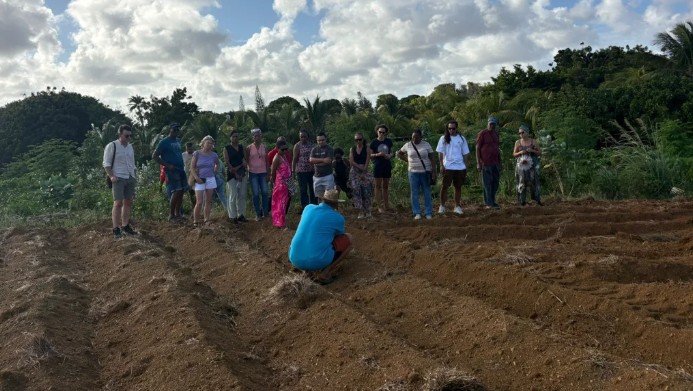
Different Perspective on Local Production
The SISAPERE Foundation, established in 2024, takes a different view of the data by focusing on crops and food products that can be produced more efficiently on the island.
According to Visser, excluding beef from the equation significantly changes the picture. The Curaçao Development Plan identifies approximately 4,000 hectares of agricultural and grazing land on the island. The baseline study estimates that producing all of Curaçao’s vegetables, fruit, mushrooms, and eggs locally would require about 2,330 hectares — roughly five percent of the island’s total surface area.
Such an agricultural footprint could potentially generate 42 million kilograms of fresh food annually, equivalent to about 43 percent of Curaçao’s total food consumption, estimated at 97 million kilograms per year.
Rethinking Protein Sources
Visser also points to the environmental and land-use challenges associated with beef production. He notes that cattle require substantially more resources than other protein sources.
According to SISAPERE, producing one kilogram of beef requires approximately 31 kilograms of feed, while fish requires only about two kilograms and poultry approximately four kilograms. As a result, the foundation believes future food security strategies should place greater emphasis on fish and poultry production.
That approach aligns with findings from academic research examining the environmental impact of food systems in Aruba, Bonaire, and Curaçao.
Challenges Facing Farmers
Despite the technical potential for expanding local food production, Visser says significant obstacles remain.
Local farmers have long complained about outdated pricing structures, with some agricultural pricing schedules reportedly dating back to 1993 without adjustment for inflation. Access to agricultural land is another challenge, with waiting lists for leasehold farmland extending for decades.
Competition from imported products also remains a major concern. Imported dairy products, potatoes, frozen fries, and processed foods often dominate supermarket shelves, making it difficult for local producers to compete on price and visibility.
According to Visser, discussions about food security frequently focus on greenhouse agriculture and high-tech growing systems. While acknowledging their value, he argues that such technologies are often better suited for supplying the tourism and hospitality sectors than for achieving broader food self-sufficiency.
The public lecture is expected to contribute to the growing national debate on how Curaçao can strengthen its food security, support local farmers, and reduce vulnerability to disruptions in global supply chains.