For years, Curaçao has looked at Venezuela mainly through the lens of crisis.
Economic collapse. Hyperinflation. Political instability. Migration pressure. Sanctions. Crime. Humanitarian breakdown.
That image has dominated the relationship between Curaçao and its largest neighbor for more than a decade.
But history teaches us something important: Venezuela is not a poor country. It is a country that went through a devastating collapse.
And there is a difference.
Venezuela remains one of the richest countries in natural resources in the world. It holds some of the largest proven oil reserves on earth. It has vast agricultural land, mineral wealth, industrial potential and, most importantly, a strategic economic weight in northern South America that simply cannot be ignored.
The question is no longer whether Venezuela can recover.
The real question is whether Curaçao will be ready when it does.
Recent developments suggest that change is already happening.
The new strategic cooperation agreement between Venezuela and Barbados should be a wake-up call for Curaçao.
Barbados is positioning itself as a logistics hub for Venezuelan food exports to the Caribbean and Africa. Maritime links are being restored. Trade corridors are being designed. Energy cooperation is back on the table. Tourism packages are being discussed. Oil and gas investments are returning.
Barbados sees opportunity.
And Barbados is moving.
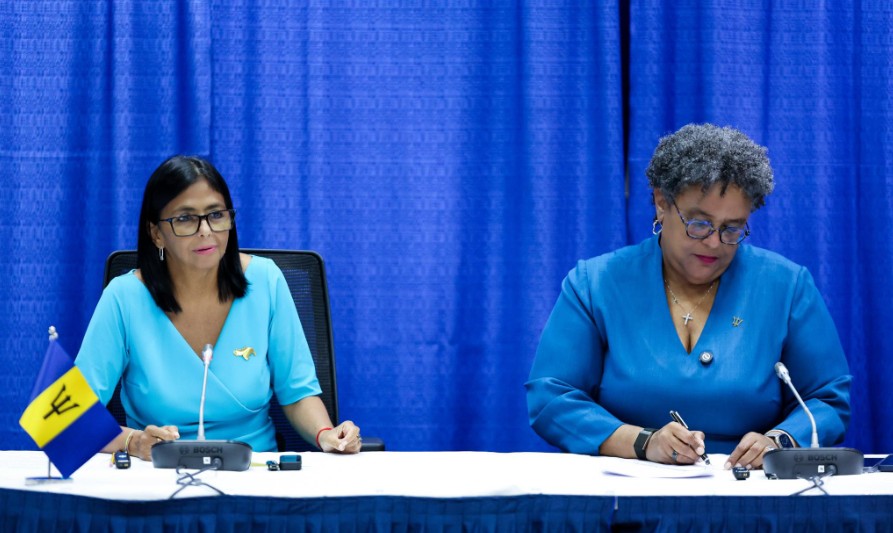
Venezuelan President Delcy Rodriguez signs agreement with Barbador Prime Minister Mia Mottley
Meanwhile Curaçao, which historically had far deeper economic, commercial, family and logistical ties with Venezuela than Barbados ever had, remains largely frozen.
That should concern us.
There was a time when Venezuela was Curaçao’s most important economic market.
Our ports depended on Venezuelan trade.
Our economy depended on Venezuelan commerce.
Our retailers, wholesalers, shipping companies, financial services sector and tourism industry all benefited directly from that relationship.
Geography made it natural.
History made it profitable.
And reality made it essential.
Then Venezuela collapsed.
Curaçao adjusted, survived and diversified.
But diversification should never mean abandoning strategic opportunities.
The Dutch government itself now openly recognizes this.
In its new Kingdom Relations policy letter, the Netherlands explicitly identifies developments in Venezuela as both a risk and an economic opportunity for Curaçao.
That recognition is important.
Because it confirms what Curaçao has always known: what happens 65 kilometers away matters.
A stable Venezuela changes everything.
Trade changes.
Food security changes.
Energy dynamics change.
Shipping routes change.
Regional logistics change.
And whoever positions themselves early wins.
That is exactly what Barbados understands.
Barbados is not waiting for perfect conditions.
It is building the bridge now.
Curaçao should be doing the same.
But here lies the problem.
Curaçao does not fully control its own foreign economic policy.
As part of the Kingdom of the Netherlands, geopolitical decisions involving Venezuela are heavily influenced by The Hague, often shaped by broader European and transatlantic interests.
That may be understandable from a diplomatic standpoint.
But economically, Curaçao’s reality is different.
Curaçao lives in the Caribbean.
Curaçao trades in the Caribbean.
Curaçao survives through regional integration.
And Curaçao knows Venezuela better than anyone in the Kingdom.
That is why the Netherlands must open the door.
Not for political recognition.
Not for geopolitical positioning.
But for economic pragmatism.
Curaçao must be given room to rebuild its own trade channels, logistics partnerships, food supply agreements and maritime routes with Venezuela when conditions allow.
The island cannot remain dependent solely on decisions made thousands of kilometers away.
Economic opportunity cannot be delayed until international politics become convenient.
Because if Curaçao waits, others will move first.
Barbados already is.
And others in CARICOM will follow.
Curaçao has the port.
Curaçao has the infrastructure.
Curaçao has the location.
Curaçao has the historical ties.
What Curaçao needs now is the political space to act.
The reality is simple.
Venezuela will recover.
Maybe not overnight.
Maybe not without setbacks.
But it will.
Countries with that much resource wealth always find a path back.
And when that rebound gains speed, the Caribbean trade map will be redrawn.
The only question is whether Curaçao will be at the center of that map again — or watching from the sidelines while others claim the opportunity.
This is not the time for hesitation.
This is the time for preparation.
The future of Curaçao’s economy may once again be tied to the future of Venezuela.
And this time, we cannot afford to be late.