The escalating conflict between former Minister of Finance and current Member of Parliament Javier Silvania and Prime Minister Gilmar Pisas raises questions that extend far beyond the internal affairs of Movementu Futuro Kòrsou (MFK).
At the heart of this dispute lies a fundamental issue for Curaçao’s democracy: where does loyalty to a political party end and responsibility to the electorate begin?
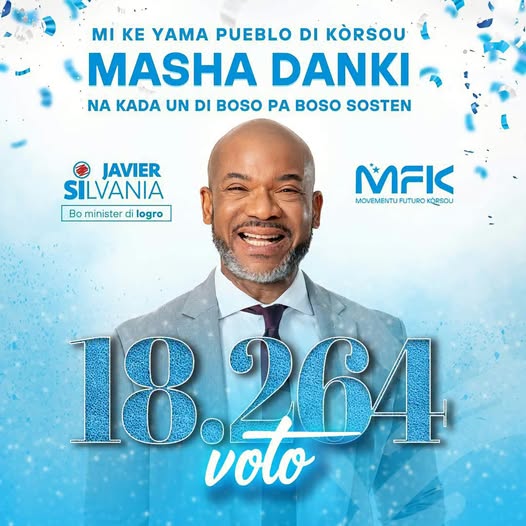
The image accompanying this editorial, circulated following the March 2025 parliamentary elections, carries a significant number: 18,264 votes.
That was the number of preferential votes Silvania received, making him the largest individual vote-getter in Curaçao during those elections, surpassing even his own party leader.

Javier Silvania
Those votes deserve to be understood in their proper political context. They represent substantial personal electoral support, while also contributing to the collective electoral success of the MFK and its parliamentary majority.
There is a difference, however, between acknowledging that electoral achievement and suggesting that it places any politician above accountability.
Giving Credit Where Credit Is Due
“E parlamentario ku ta duna kontenido na e trabou real di Parlamento: kontrolá, hasi pregunta, guia i informá pueblo. Honor na berdat!”
The statement captures a sentiment that deserves consideration in the present debate: the work of a parliamentarian involves scrutinizing government, asking questions, providing direction and informing the population.
Silvania has demonstrated a willingness to raise uncomfortable questions, both during his tenure as minister and in his current position as a parliamentarian.
His interventions concerning alleged irregularities within the tax collection system and the recent controversy surrounding QuickPromo are examples of issues he has brought into the public debate.
Even the Antilliaans Dagblad, in an analysis published this week that was highly critical of aspects of Silvania’s conduct, acknowledged his willingness to draw attention to alleged wrongdoing and sensitive matters that others have avoided.
His political style is undoubtedly unconventional. His public appearances, extensive use of social media and sometimes confrontational manner have generated both appreciation and criticism.
Some people value that directness. Others consider his approach excessive and at times counterproductive.
Neither assessment, however, should substitute for an examination of the actual work performed, the results achieved and the merits of the questions raised.
Parliamentary Oversight Is Not the Same as Party Disloyalty
One of the most important dimensions of the current conflict is the relationship between Parliament and the government.
Curaçao’s Parliament is not an extension of the Council of Ministers. Its constitutional responsibilities include scrutinizing the executive, examining legislation and holding ministers accountable for their decisions.
These responsibilities apply equally to parliamentarians belonging to the governing party and those sitting in the opposition.
When a member of the governing faction questions a minister from his own party, that action is not inherently an act of political disloyalty. It can be an expression of parliamentary independence.
At the same time, parliamentary independence does not exempt an elected representative from the responsibility to communicate accurately, substantiate accusations and respect the rights of others.
There is an essential distinction between legitimate scrutiny and personal confrontation. That distinction must apply consistently to every parliamentarian, regardless of political affiliation.
The Prime Minister's Position
Prime Minister Gilmar Pisas has expressed frustration over Silvania’s repeated public criticism and his claims regarding personal responsibility for several major government achievements.
In particular, Silvania has claimed that he played a decisive role in preventing the establishment of the Caribbean Body for Reform and Development (COHO).
Pisas disputes that interpretation, pointing out that the COHO negotiations, the financial challenges surrounding the Curaçao Medical Center and the rescue of pension insurer ENNIA involved numerous individuals and experts.
That is a relevant distinction. Government achievements are rarely the exclusive work of one individual. Ministers, civil servants, advisers and other institutions frequently contribute to complex political and financial outcomes.
Recognizing collective accomplishments does not require disregarding individual contributions. Conversely, recognizing individual achievements does not mean assigning exclusive credit for collective work.
Silvania has also stated that he has not had a personal conversation with Pisas since leaving his ministerial position more than a year ago, despite requesting discussions and proposing mediation.
Pisas, for his part, has indicated that he no longer believes their relationship can be repaired and wants Silvania to leave the MFK, even if he retains his parliamentary seat.
These contrasting accounts illustrate how severely their working relationship has deteriorated.
The Unanswered Questions Surrounding Silvania
Acknowledging Silvania’s political contributions does not mean overlooking the controversies surrounding him.
There are legitimate questions concerning decisions made during his tenure as minister, allegations involving the tax collection system and aspects of his conduct in public office.
Those matters require proper investigation, transparency and, where appropriate, judicial determination.
Allegations are not convictions. Political popularity is not proof of innocence, just as political isolation is not proof of guilt.
The presumption of innocence and the independence of the authorities responsible for investigating possible wrongdoing must be respected.
The same standards of accountability must apply to Silvania, Pisas and every other public official, without exceptions based on political popularity, personal relationships or party membership.
What Do 18,264 Votes Mean?
Silvania occupies one parliamentary seat. His preferential votes do not entitle him to additional seats or special constitutional powers.
Nevertheless, the electoral system means that votes received by individual candidates also contribute to determining the total number of seats obtained by their political party.
The 18,264 votes cast for Silvania therefore contributed to the MFK’s electoral performance and helped establish the parliamentary majority from which the party currently governs.
It would be impossible to determine with certainty how many MFK parliamentarians would have been elected had Silvania not participated in the elections. What is clear is that his personal electoral contribution was substantial.
The present conflict consequently raises an important question about the relationship between party membership and an elected representative’s mandate.
Political parties have legitimate interests in maintaining internal cohesion, enforcing organizational rules and implementing their electoral programs. Parliamentarians, meanwhile, have an independent responsibility to represent the population and scrutinize the government.
These two responsibilities can coexist, but tensions arise when party discipline and parliamentary independence come into conflict.
Curaçao Is Bigger Than Any Political Party
The dispute comes at a particularly sensitive moment, as Parliament deliberates on the national budget for 2027.
Curaçao continues to face significant challenges involving healthcare, poverty, education, housing, public finances, security and the rising cost of living.
The MFK leadership's concern about political stability is understandable. A functioning government requires cooperation, while a functioning democracy requires meaningful scrutiny of that government.
Neither objective should automatically come at the expense of the other.
The public interest in this dispute extends beyond whether Javier Silvania remains a member of the MFK or whether Gilmar Pisas succeeds in restoring unity within his party.
It involves the quality of parliamentary oversight, the integrity of public administration, the transparency of political decision-making and the extent to which elected representatives can fulfill their responsibilities independently.
Curaçao Chronicle remains independent of political parties and individual politicians. Recognizing a politician’s contributions does not constitute an endorsement, just as examining allegations or criticizing conduct does not constitute political opposition.
The work, the results, the controversies and the unanswered questions all belong in the same public conversation.
Honor na berdat — give the truth its due.
That principle applies to everyone, without exception.