WILLEMSTAD – The Schottegat area has significant potential to become an important new economic pillar for Curaçao, driven by maritime services, ship repair, logistics, industrial activities and oil storage. However, realizing that potential will require investment, cooperation and a government capable of making timely decisions, according to the Association of Dutch Caribbean Economists.
For the fifth consecutive year, the association, commonly known as the Economenclub, organized an excursion to examine an area of economic importance to Curaçao. On Saturday, August 29, the group focused on developments and investment plans in and around the Schottegat, visiting five organizations to assess whether harbor-related activities could help diversify the island’s economy.
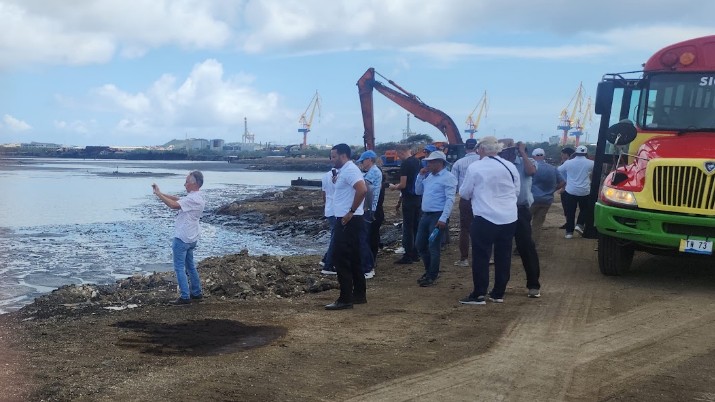
Economist Club visiting the harbor
At the former Isla refinery site, the economists met with 2Bays CEO Patrick Newton. According to Newton, a conventional refinery will not return to the property. Instead, the future of the industrial site is expected to include specialty products such as asphalt and graphite, together with storage and maritime activities.
2Bays is repairing and upgrading docks and jetties to improve the services it can offer. Management expects demand for these facilities to increase significantly in the coming years.
One example of the new activity is Navel Caribbean Dockyard, a ship-repair company that will work on vessels of up to 400 gross register tons. A solar park is also being developed on land heavily contaminated with asbestos.
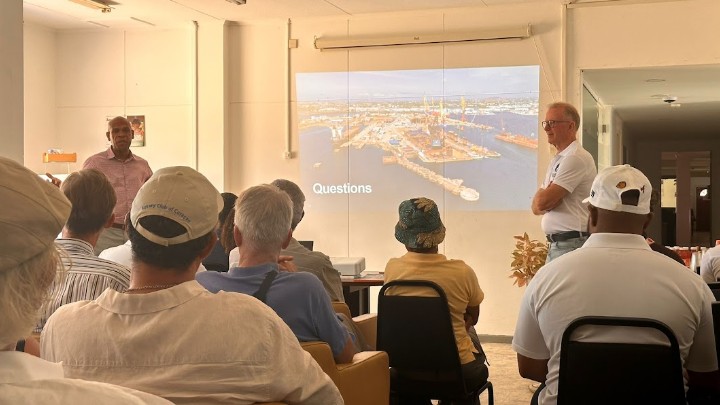
2Bays Asset Development Manager Gerald Lijde highlighted the potential for oil storage at both Bullenbaai and the former Isla site. According to the company, major international players have shown interest in storage capacity as they anticipate potentially favorable geopolitical developments surrounding Venezuela.
Storage tanks that are currently out of service are gradually being repaired, allowing available capacity to increase over time.
The economists also visited C.D.M. Holding, where director Augustin Diaz outlined investments made in recent years to address deferred maintenance and safeguard the operational continuity of Curaçao’s shipyard.
Much larger investments could follow. A development and expansion program known as CAPEX 2.0, valued at more than €100 million, is under consideration.
The expected expansion of offshore oil and gas activities in Guyana and Suriname is seen as an important opportunity for Curaçao. Those industries require growing numbers of offshore support vessels, many of which could potentially undergo maintenance and repairs on the island.
Venezuelan vessels could also provide additional business for the shipyard if economic restrictions continue to ease. C.D.M. Holding expects major investments in the shipyard to generate additional economic activity throughout the Schottegat area.
Damen Shiprepair Curaçao CEO Surldric Rojer confirmed that the regional outlook for ship repair and maintenance is favorable. According to the Economenclub, Damen’s headquarters in the Netherlands also recognizes Curaçao’s potential.
Implementation of CAPEX 2.0 is considered important for expanding ship-repair and maintenance capacity. At the same time, Damen is developing another activity through Damen H&V Carib known as “afloat jobs.”
This allows certain repairs to be performed while vessels remain afloat instead of entering a dry dock. Work could be carried out in open water or at locations such as Caracasbaai, potentially expanding the number and type of vessels Curaçao can service.
Another major development discussed during the excursion is Buskabaai.
The Programmatische Maritieme Tafels (PMT), a partnership between major private and public organizations around the Schottegat, sees the redevelopment of Buskabaai as an important component of Curaçao’s future maritime infrastructure.
According to PMT secretary Peter Martens, development of the area could increase available harbor capacity in terms of docks, piers and industrial land by approximately one-third. Studies are underway, with the first results expected to become visible around the beginning of 2030.
Buskabaai itself presents both an environmental challenge and an economic opportunity. The approximately 80-hectare site was used during World War II as a dumping area for petroleum products that could not be used.
Buskabaai director Ramsas Martina explained that Asphalt Recovery Company is gradually emptying the asphalt lakes and processing the recovered oil residues into usable products.
Approximately 15 hectares have already been cleaned and filled, making the reclaimed land available for future industrial or logistics activities.
After completing the tour, the Association of Dutch Caribbean Economists concluded that the developments around the Schottegat demonstrate considerable potential for Curaçao to build a stronger maritime and industrial sector.
The economists cautioned, however, that economic diversification will not happen automatically. Developing a new economic pillar requires time, investment, energy and a government with a clear vision and the ability to make decisions.
They also stressed the importance of cooperation between Curaçao’s public and private sectors.
Their message was one of urgency: projects must begin now, concrete action must be taken and start-ups and scale-ups must be given the conditions to develop.
Otherwise, the economists warned, Curaçao risks missing an important opportunity to capitalize on the economic transformation taking place in the Caribbean and northern South America.