WILLEMSTAD – Curaçao's rapidly expanding tourism industry is generating economic growth, employment, and foreign exchange earnings, but the island must pay closer attention to how much of that prosperity actually benefits local residents. That was one of the central issues raised by Professor Paul Hilbers during a lecture organized by the Economenclub on October 29, 2026.
Hilbers, a former executive director at the International Monetary Fund (IMF) and a member of the Financial Supervision Boards (Cft) since February 2026, examined the opportunities and risks associated with Curaçao's economic development.
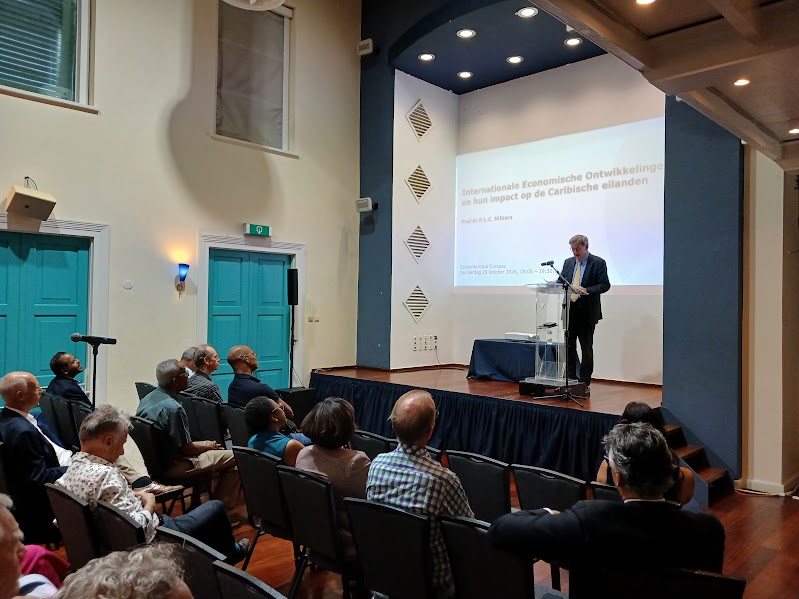
Paul Hilbers during his lecture
Although tourism remains one of the island's most important economic engines, Hilbers questioned whether continued growth in visitor numbers and hotel capacity automatically produces proportional benefits for the local population.
His analysis highlighted the need to distinguish between overall economic expansion and the actual value that remains within Curaçao's economy.
Tourism generates employment, supports businesses, attracts foreign investment, and contributes to government revenue.
However, increasing visitor numbers also place additional pressure on public infrastructure and essential services.
More tourists and accommodation facilities mean greater demand for roads, electricity, water, waste management, and housing.
These pressures can create costs that are not always fully reflected in the economic indicators used to measure tourism's success.
Hilbers also drew attention to the possibility that a significant portion of tourism revenue may flow out of Curaçao through imports and foreign-owned businesses.
Hotels, restaurants, and other tourism-related companies frequently depend on imported food, equipment, materials, and services.
When businesses purchase goods and services from abroad, part of the money generated by tourism leaves the local economy rather than circulating among local producers and households.
Foreign ownership can also influence how much of the sector's profits remain on the island.
As a result, a growing tourism industry does not necessarily mean that local businesses and residents benefit to the same extent.
The key question, according to the analysis presented by Hilbers, is not simply how many tourists visit Curaçao or how much the economy grows, but how much local value is created and what social costs accompany that growth.
This distinction is particularly important as Curaçao continues expanding its tourism capacity.
Additional hotel rooms and tourism facilities may generate new employment opportunities, but they can also increase demand for housing, infrastructure, and public services.
If infrastructure development fails to keep pace with tourism growth, residents may experience greater congestion and pressure on essential utilities.
The housing market is another area requiring attention.
Tourism-related development and changing demand for accommodation can affect the availability and affordability of housing for local residents.
Hilbers' presentation therefore raised the broader question of how economic growth should be managed to ensure that the benefits outweigh the costs.
Rather than focusing exclusively on visitor numbers, policymakers should consider local economic participation, infrastructure capacity, environmental sustainability, and the distribution of income.
The discussion also extended beyond tourism to the broader concept of prosperity.
Hilbers emphasized that strong macroeconomic performance does not automatically mean that all population groups experience improvements in their standard of living.
An economy can expand while certain households continue struggling with living expenses, limited opportunities, or inadequate access to essential services.
This makes the distribution of economic growth an important consideration for public policy.
The lecture also addressed the impact of demographic changes on Curaçao's development.
An aging population, migration, and labor shortages can influence the availability of workers needed to sustain economic expansion.
At the same time, demographic developments create additional demands on healthcare, pensions, and housing.
A growing economy must therefore be supported by policies that consider both labor market needs and the long-term well-being of residents.
Digitalization and artificial intelligence were also identified as potential opportunities for economic diversification.
By developing new activities outside traditional sectors, Curaçao could reduce its dependence on tourism and strengthen its ability to withstand international economic shocks.
However, these opportunities require investment in education, technological skills, cybersecurity, and reliable digital infrastructure.
The broader challenge is to ensure that economic development produces improvements in productivity, employment opportunities, and living standards rather than growth concentrated in a limited number of sectors.
Hilbers' presentation also placed Curaçao's tourism dependence within the context of global economic uncertainty.
Small island economies are particularly exposed to changes in international travel demand, energy prices, geopolitical developments, and financial markets.
The COVID-19 pandemic demonstrated these risks when Curaçao's economy contracted by approximately 18 percent in 2020.
The collapse of international tourism during that period exposed the consequences of relying heavily on a sector vulnerable to external disruptions.
For this reason, economic diversification and financial resilience remain important components of sustainable development.
The central message of the lecture was that Curaçao needs greater direction and coordination in managing its economic growth.
Government policy should not only encourage investment and expansion but also evaluate the consequences for infrastructure, the environment, public finances, and the local population.
The Economenclub meeting concluded with a discussion among participants and invited guests.
The issues raised by Hilbers present an important question for Curaçao's economic future: Is the island pursuing growth primarily to increase economic activity, or is it managing that growth to create lasting prosperity for its residents?
The answer will depend on how effectively policymakers balance tourism expansion, local economic participation, infrastructure investment, and the broader interests of Curaçao's population.