WILLEMSTAD – Every day, cruise ships, oil tankers, cargo vessels and luxury yachts move in and out of Curaçao’s waters with remarkable precision. But behind that carefully coordinated movement is a 24-hour operation led by the Harbour Master’s office, one of the least visible but most critical institutions in the island’s economy.
That reality is highlighted in a new interview published by the Curaçao Maritime Association, featuring Harbour Master Marlon LaRoche and Senior Pilot and Deputy Harbour Master Michael Comenencia.
Their work, often unnoticed by the public, forms the backbone of Curaçao’s maritime safety system.
From cruise ships entering the narrow channel of Sint Annabaai to private yachts anchoring in Spanish Water, every movement on the water is monitored, authorized and coordinated.
LaRoche’s maritime journey began in 1993 and reflects the long and demanding path required to reach the top of the profession.
He studied maritime sciences in the Netherlands for four years and then spent two full years at sea before even qualifying to apply as an aspiring pilot in Curaçao.
According to the interview, it takes approximately 18 years of training and field experience to become a Senior Pilot capable of handling all types of vessels.
That expertise is essential.
The Harbour Master’s office assigns docking stations, determines what tugboats and pilots are required for each vessel and manages the Harbour Management System, the digital platform used by shipping agencies to report incoming vessels.
The office also regulates yacht anchoring permits, conducts harbour safety inspections and works closely with the Dutch Caribbean Coast Guard.
By law, every vessel on Curaçao must be registered and inspected for seaworthiness.
Captains must carry valid marine licenses, and dangerous cargo such as fuel, gas and oil requires special protocols.
Ships over 50 tonnes are legally required to use a local pilot when entering port.
The reason is simple: Curaçao’s shallow waters and narrow channels demand local expertise.
The Harbour Master oversees five major port zones: Fuikbaai, Caracasbaai, Sint Annabaai, Sint Michielsbaai and Bullenbaai.
Beyond logistics, the office also serves as the first responder in maritime emergencies, including storms, collisions and onboard medical emergencies.
For an island economy deeply dependent on imports, exports, cruise tourism and fuel logistics, the Harbour Master’s office remains one of Curaçao’s most essential institutions — even if most people never see it.
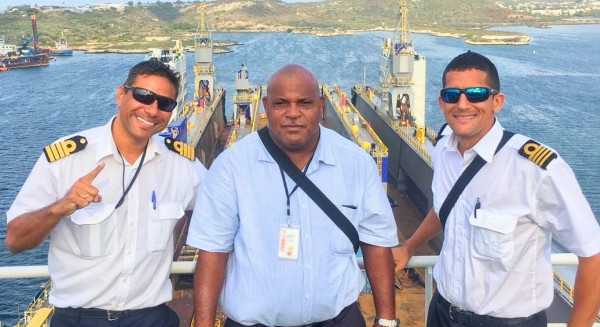
Image: Michael Comenencia, Marlon LaRoche and Casper Neuman