AMSTERDAM – Nearly eleven years after his death, Curaçao's celebrated author, poet and language scholar Frank Martinus Arion has received a permanent place among the most influential figures in Dutch literature. But the memorial unveiled in Amsterdam on Friday, October 9, represents something more than recognition of an accomplished writer: it brings the Papiamentu language into one of the Netherlands' most prominent literary monuments.
The memorial stone, installed in the floor of De Nieuwe Kerk in Amsterdam, was unveiled by Curaçao's Minister Plenipotentiary in the Netherlands, Errold Bishop, in the presence of relatives, literary representatives and other invited guests.
The ceremony took place one day before Curaçao celebrated the 16th anniversary of becoming an autonomous country within the Kingdom of the Netherlands.
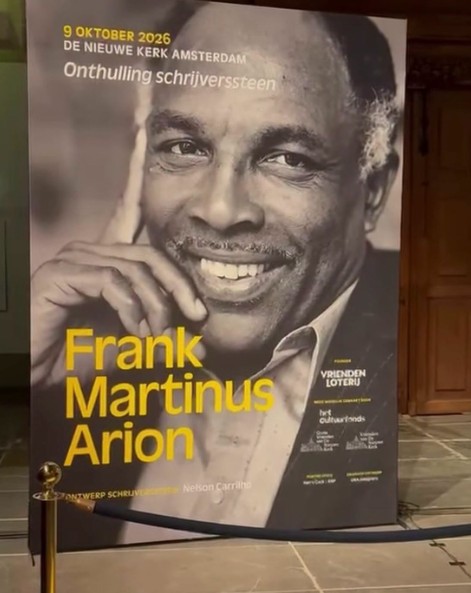
Arion's memorial now stands alongside those honoring literary figures such as Multatuli, Annie M.G. Schmidt, Hella Haasse, Louis Couperus and Anton de Kom.
However, what distinguishes the Curaçao author's memorial is not simply his inclusion among these writers, but the language and symbolism incorporated into its design.
A Papiamentu Poem in the Heart of Amsterdam
The memorial features a poem written by Arion in Papiamentu, accompanied by a bronze footprint.
The poem comes from his 1961 collection Ta amor so por and reflects the writer's determination to pursue his ambitions beyond the horizon.
The design was created by Curaçao-born sculptor Nelson Carrilho, who died in July 2026 at the age of 73, before the memorial could be unveiled.
Carrilho had already completed the design and made arrangements with the stoneworker and bronze foundry.
Unlike the other literary memorials in De Nieuwe Kerk, Arion's stone incorporates a bronze element.
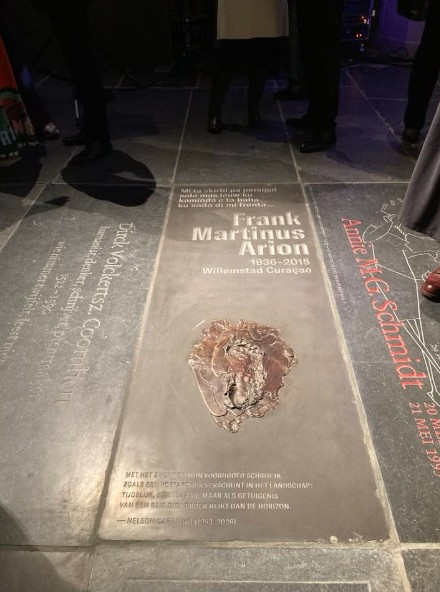
The footprint symbolizes a journey that continues beyond the visible horizon, reflecting the connection between the writer's words and Carrilho's artistic interpretation.
The memorial therefore brings together two Curaçao artists whose work addressed identity, human dignity and the historical relationship between the Caribbean and the Netherlands.
A Writer Who Challenged the Language Hierarchy
Born in Willemstad in 1936, Frank Martinus Arion belonged to a generation of Caribbean intellectuals who challenged the cultural and political assumptions inherited from colonial rule.
He moved to the Netherlands as a young man to pursue his education, eventually establishing himself as a writer and academic.
His international breakthrough came in 1973 with the publication of Dubbelspel (Double Play).
The novel uses a domino game on Curaçao as the setting for a complex examination of relationships, racial inequality, social divisions and the political realities of Caribbean society.
The book became one of the most widely recognized works of Dutch Caribbean literature.
In 2006, it was selected for the national Nederland Leest reading campaign, during which approximately 725,000 copies were distributed through Dutch libraries.
In 2025, Dubbelspel was included in the canon of Dutch-language literature, further consolidating Arion's position in the literary history of the Kingdom.
Yet Arion's contribution extended far beyond his novels.
He was a passionate advocate for Papiamentu at a time when the language's position in education and academic institutions remained contested.
For Arion, Papiamentu was not merely a language spoken in homes and neighborhoods. It was a language capable of expressing sophisticated literary, philosophical and scientific ideas.
He devoted considerable academic attention to its origins and development, completing a doctoral dissertation on the history of Papiamentu in 1996.
He also supported the establishment of Papiamentu-language education on Curaçao and was involved in the creation of a secondary school where the language occupied a central position.
In 2003, he was appointed professor of Papiamentu grammar at the university in Curaçao.
Recognition From a Country He Frequently Criticized
Arion's relationship with the Netherlands was complicated.
Although he wrote extensively in Dutch and developed an important readership in the Netherlands, he also challenged Dutch attitudes toward colonial history, racial discrimination and the cultural position of the Caribbean islands.
His literary work frequently examined the consequences of colonialism and the struggle for cultural independence.
He also believed that the Netherlands needed to confront its historical involvement in slavery more directly.
Together with Dutch writer Adriaan van Dis, Arion helped initiate efforts toward the establishment of the National Slavery Monument in Amsterdam's Oosterpark.
That monument was unveiled in 2002.
Arion's advocacy reflected his conviction that recognition of the past was necessary for a more equal relationship between the Netherlands and its former colonies.
His criticism was not directed exclusively at the Netherlands. Through his writing and public interventions, he also questioned social inequalities and political attitudes within Curaçao itself.
The installation of his memorial in De Nieuwe Kerk therefore carries particular historical significance.
A writer who spent much of his life questioning the cultural and political relationship between Curaçao and the Netherlands is now permanently represented within one of the Netherlands' most established literary traditions.
Nelson Carrilho's Final Artistic Contribution
The memorial also represents one of the final artistic contributions of Nelson Carrilho.
Born in Willemstad in 1953, Carrilho became known for sculptures addressing social justice, racial discrimination and human dignity.
Among his most recognized works is Mama Baranka, installed in Amsterdam's Vondelpark in 1984 in memory of Kerwin Duinmeijer, a teenager killed in a racist attack the previous year.
Carrilho's work frequently explored the experiences of people whose histories and identities had been marginalized.
His involvement in the memorial for Arion created a connection between two artists who used different forms of expression to address similar concerns.
Arion used literature, poetry and language. Carrilho used sculpture and public monuments.
Both sought to give greater visibility to Caribbean experiences within Dutch society.
Carrilho died before the project was completed, making the unveiling a posthumous tribute to both men.
More Than a Literary Honor for Curaçao
For Curaçao, Arion's recognition raises a broader question about the place of Caribbean literature and languages within the cultural history of the Kingdom.
Dutch literature has traditionally been associated primarily with writers and institutions in the European Netherlands.
However, Dutch-language literature also developed in the Caribbean, where writers explored different historical experiences, cultural identities and political realities.
Arion was among those who demonstrated that literature originating in Curaçao could contribute to international discussions about colonialism, identity, language and social justice.
His work also challenged the assumption that literary recognition required Caribbean writers to distance themselves from their own languages and cultural backgrounds.
The presence of Papiamentu on his memorial is therefore particularly meaningful.
It places a language historically associated with Curaçao's everyday life and cultural identity within a Dutch institution dedicated to preserving literary heritage.
A Legacy That Continues Beyond Literature
The unveiling comes during a year of renewed attention to Arion's life and work.
Born in 1936, the writer would have celebrated his 90th birthday in 2026.
His biography, Uit baldadig hout ben ik gesneden, written by Mineke de Vries, was published shortly before the unveiling, providing new insights into his personal history, intellectual development and literary career.
Arion died in Curaçao in 2015, leaving behind novels, poetry, essays and academic work that continue to influence discussions about Caribbean identity and language.
His memorial in Amsterdam ensures that future visitors to De Nieuwe Kerk will encounter his name alongside writers who helped shape the Dutch literary tradition.
But perhaps the most significant aspect of the recognition is that Arion's place in literary history is now acknowledged without separating him from the language and culture he defended throughout his life.
For Curaçao, the stone represents more than the memory of one writer.
It is a reminder that the island's literary and intellectual contributions form part of a much larger history, one that extends beyond geographical boundaries and the political structures of the Kingdom.
And through a Papiamentu poem carved into a memorial in Amsterdam, Frank Martinus Arion continues to make the language of Curaçao visible in a place where generations of readers will encounter it.