WILLEMSTAD – The recently signed Letter of Intent between Curaçao and El Salvador outlines plans for closer cooperation in combating organized crime, gang-related violence, cybercrime, and migration-related security challenges. However, a closer examination of the document reveals that the agreement does not create legally binding obligations for either government and leaves the practical implementation of the cooperation to future arrangements.
The document, signed by Curaçao's Minister of Justice Shalten Hato and El Salvador's Minister of Public Security and Justice Héctor Gustavo Villatoro, establishes a framework through which both countries intend to exchange expertise, strengthen their security institutions, and explore coordinated approaches to common criminal threats.
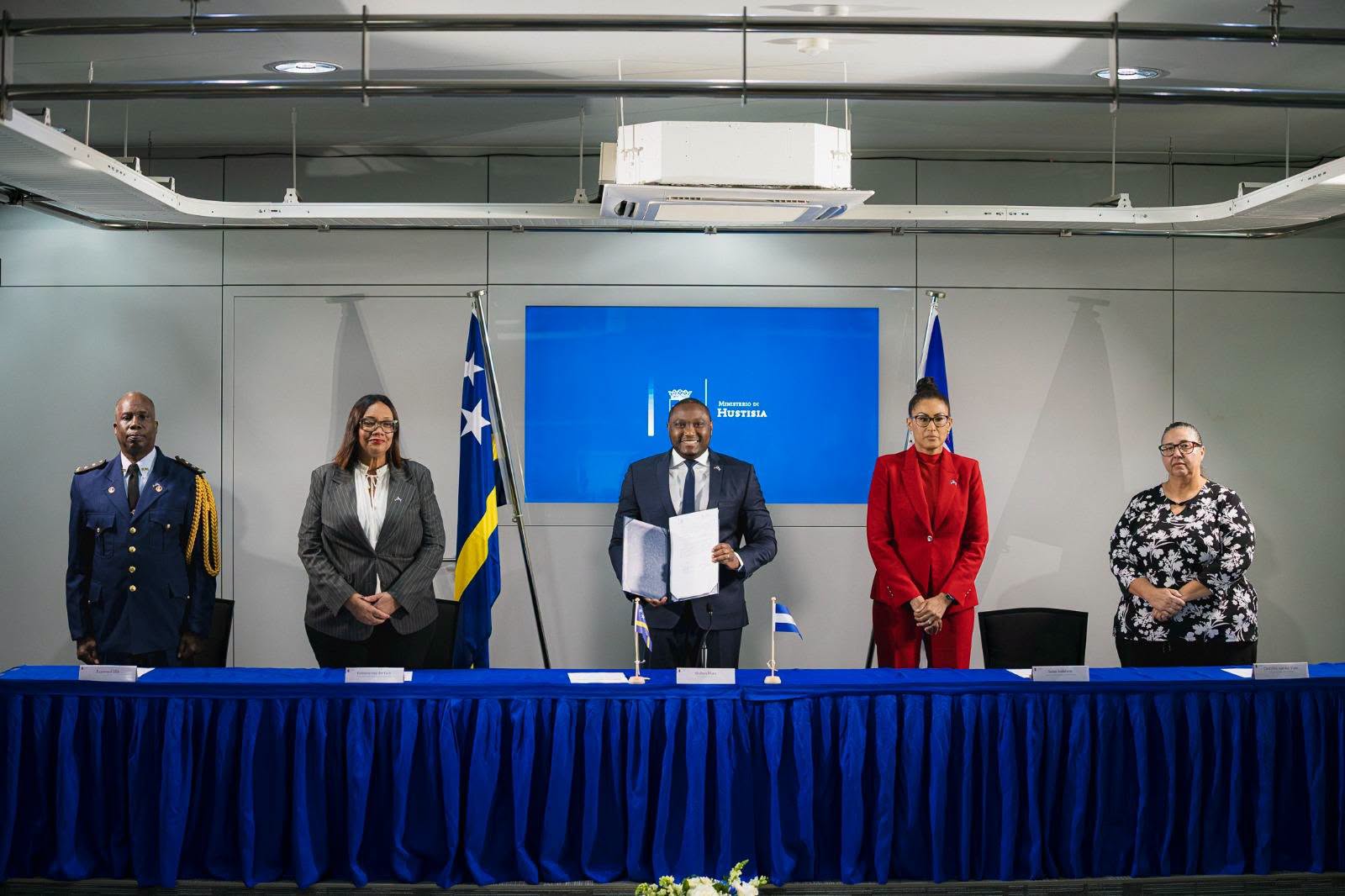
While the agreement signals a willingness to expand international cooperation, its wording makes clear that it is primarily a declaration of political and institutional intent rather than an enforceable treaty.
The distinction is important because the document does not establish specific operational commitments, financial contributions, implementation deadlines, or measurable objectives.
Focus on Transnational Organized Crime
One of the central elements of the agreement is the intention to strengthen cooperation against transnational organized crime and criminal organizations associated with gangs and cross-border violence.
Both ministries recognize that organized criminal networks operate across national borders and that cooperation between law enforcement institutions can contribute to more effective responses.
The document identifies several areas in which collaboration could be developed, including strengthening police institutions and other security services, improving migration management, and preventing cybercrime.
The agreement also provides for the possible establishment of technical and operational coordination mechanisms between the competent institutions of both countries.
However, these mechanisms must respect the responsibilities and legal powers of each ministry and comply with existing national and international legal frameworks.
The document does not authorize foreign law enforcement officers to conduct operations in Curaçao or establish any automatic exchange of confidential police information.
Any such arrangements would require an appropriate legal basis and further agreements between the relevant authorities.
Exchange of Expertise Rather Than Immediate Joint Operations
Another important aspect of the Letter of Intent concerns the exchange of knowledge and professional experience.
The two ministries intend to create opportunities for officials and specialists to share information about judicial procedures, legal frameworks, investigative approaches, and operational practices.
This cooperation could take the form of official visits, consultation meetings, and training activities.
The document also leaves open the possibility of developing joint strategies in areas where both countries identify common security concerns.
For Curaçao, these exchanges could provide opportunities to learn from another country's experience in addressing complex criminal challenges, while allowing local authorities to share their own expertise.
However, the agreement does not specify which agencies will participate, how frequently meetings will take place, or when the first activities are expected to begin.
No Legally Binding Obligations
Perhaps the most significant provision appears in the general conditions of the agreement.
The document explicitly states that the Letter of Intent does not generate legally binding obligations between the participants.
This means that neither government is legally required under this document alone to implement a particular security program, provide financial assistance, or establish a joint operational structure.
Instead, the agreement creates a basis for future discussions and cooperation, subject to the willingness of both parties and the applicable legal requirements.
The document also emphasizes mutual respect, reciprocal trust, equality, mutual benefit, and the preservation of sovereignty.
These principles indicate that the proposed cooperation is intended to complement, rather than replace, the authority of each country's existing justice and security institutions.
Questions Remain About Practical Implementation
Although the agreement identifies several important areas of cooperation, it provides limited detail about how the proposed initiatives will be translated into concrete activities.
It does not specify a budget, establish a timetable, identify particular projects, or create a formal mechanism for evaluating results.
The document also does not indicate whether Curaçao intends to adopt specific security practices used in El Salvador.
That distinction is relevant because the agreement refers to cooperation on gang-related violence and organized crime without committing Curaçao to any particular criminal justice model.
Any future measures would have to be assessed within Curaçao's own legal framework and applicable international obligations.
The effectiveness of the initiative will therefore depend largely on the follow-up arrangements developed by the two ministries and the extent to which their intentions result in practical cooperation.
A First Step Toward Closer Security Relations
The Letter of Intent reflects a shared recognition that public safety, effective justice institutions, and cooperation against international criminal networks are important for economic development and the well-being of both populations.
It also acknowledges the historical relationship between Curaçao and El Salvador and expresses the desire to strengthen that relationship through closer institutional cooperation.
The document was prepared in English and Spanish, with both versions considered equally authentic.
For Curaçao, the agreement creates an opportunity to expand its international justice network and explore additional cooperation in areas such as cybercrime prevention, police training, and organized crime investigations.
Nevertheless, the signing itself does not guarantee new programs or operational changes.
The next important development will be whether the Ministry of Justice announces specific initiatives, identifies participating institutions, and establishes a timetable for implementing the cooperation outlined in the document.
Until then, the agreement remains a statement of intent that could serve as the foundation for more concrete security cooperation between Curaçao and El Salvador.