WILLEMSTAD – Curaçao intends to make poverty reduction a national priority during the first Kingdom Summit, scheduled for November 17 and 18, 2026, in Sint Maarten, where the governments of the four countries of the Kingdom of the Netherlands will discuss security, climate change, and economic development.
Prime Minister Gilmar Pisas confirmed Curaçao's position following discussions with Dutch State Secretary for the Interior and Kingdom Relations Eric van der Burg on Thursday, October 15.
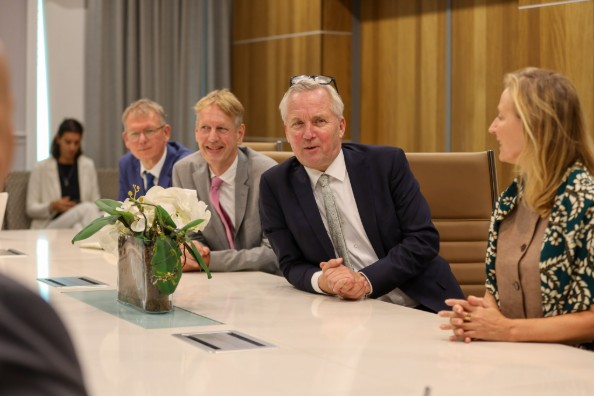
State Secretary Van den Burg during his meeting with the Curaçao government
The meeting also addressed food security, agricultural development, access to European Union financing, and preparations for a separate Kingdom Conference that Curaçao plans to host during the first quarter of 2027.
The November gathering will bring together the governments of Curaçao, Aruba, Sint Maarten, and the Netherlands in what organizers describe as the first Kingdom Summit.
According to an announcement published by the Dutch government on October 1, each country will present its own State of the Nation address, outlining national achievements, challenges, and opportunities for closer cooperation.
The summit is intended to strengthen relations between the four governments and establish greater continuity in consultations on matters of common concern.
Among the principal subjects identified for discussion are national security, including protection against cyberattacks, the effects of climate change on small islands, and the financial and economic development of the countries.
Curaçao now intends to add poverty reduction to the discussions as one of its national priorities.
The government's announcement did not specify which poverty reduction measures Pisas intends to propose or whether Curaçao will seek financial commitments from the Netherlands and the other countries.
Nevertheless, placing poverty reduction on the agenda creates an opportunity to connect social policy with broader discussions about economic resilience and development.
Food security was another subject raised during the October 15 meeting.
The governments discussed agricultural development and a project in the Sint Joris area intended to strengthen Curaçao's agricultural sector.
The announcement did not provide details about the project's budget, implementation schedule, or expected agricultural production.
However, the discussions come as the Netherlands is developing a broader financing initiative intended to support food production in the Caribbean part of the Kingdom.
According to Dutch government budget documents, an independent foundation known as CariFoodFund was established in 2026 to administer a revolving financing facility for agricultural entrepreneurs.
The initiative is intended to improve access to financing for businesses involved in agriculture and food production, including through loans that can support investment in the sector.
The Dutch government expects lending activities to begin around the transition from 2026 to 2027.
No agreement was announced linking the Sint Joris project directly to CariFoodFund, but the two initiatives reflect a growing emphasis on strengthening local food production and reducing vulnerabilities in the regional food supply.
Curaçao and the Netherlands also discussed possible administrative cooperation to attract financing from the European Union.
Such cooperation could provide opportunities to explore external funding for development projects, although the government did not identify specific EU programs, applications, or funding commitments.
Beyond the November summit, Curaçao has agreed to organize a Kingdom Conference during the first quarter of 2027.
Unlike the upcoming summit, which will concentrate on practical cooperation and shared policy challenges, the proposed conference is expected to address constitutional and institutional issues within the Kingdom.
Among the subjects identified are the democratic deficit, the proposed dispute settlement mechanism, and the functioning of the Charter for the Kingdom of the Netherlands.
The democratic deficit refers to concerns about the limited influence of the Caribbean countries over certain decisions and legislative processes at the Kingdom level.
The dispute settlement proposal seeks to establish a formal mechanism for resolving disagreements between the countries over the interpretation and application of Kingdom arrangements.
A legislative initiative submitted in September 2025 by the Caribbean countries proposes allowing certain disputes to be referred to the Council of State of the Kingdom for binding decisions.
The proposal has not yet become law.
The planned 2027 conference could therefore provide another opportunity for the countries to discuss how cooperation can be strengthened while respecting their constitutional positions.
Following Thursday's discussions, Pisas emphasized that Curaçao remains committed to cooperation within the Kingdom, provided it is based on equality and respect for the autonomy of the countries.
“We exchanged views on a wide range of topics. Curaçao remains committed to cooperation within the Kingdom, but on the basis of equality and with respect for each other's autonomy,” the prime minister said.
The coming months will show whether the discussions lead to concrete agreements, particularly regarding poverty reduction, agricultural investment, European financing, and the future functioning of the Kingdom.