WILLEMSTAD – Curaçao produces less than 9 percent of its own food in the categories examined by a recent study, highlighting the island’s continued dependence on imports at a time when international conflicts, climate change and rising transportation costs are putting pressure on food prices.
Member of Parliament Ishahier Monte of the MFK faction has submitted written questions to Minister of Economic Development Roderick Middelhof about the government’s plans to strengthen local food production and improve Curaçao’s food security.
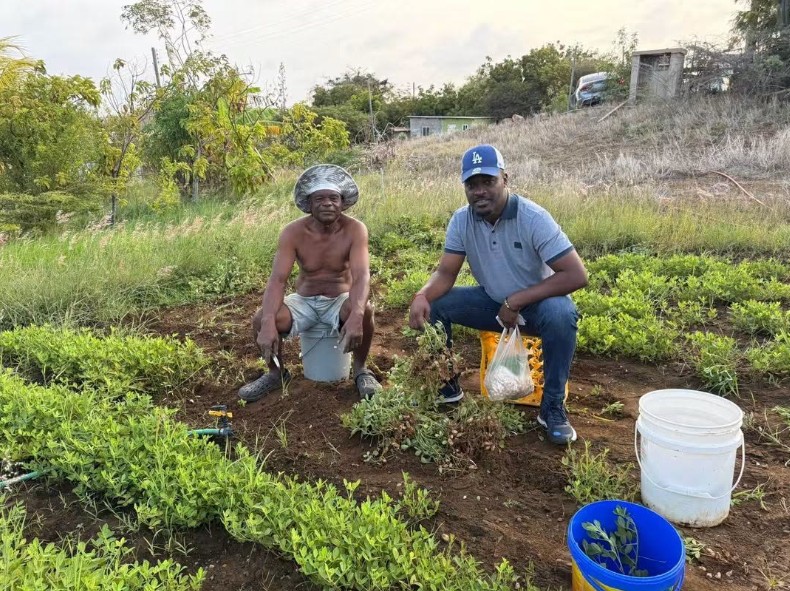
Monte (right) on food security
Monte points to the Dutch report “Nulmeting Lokale Voedselproductie,” which estimated Curaçao’s self-sufficiency rate at just 8.78 percent for the food categories included in the study.
The actual share could be somewhat higher because small-scale farming, informal production and household agriculture are not fully reflected in official statistics. However, Monte says this also exposes another problem: Curaçao still lacks complete and reliable information about the size of its domestic food production.
The MP argues that the issue has become more urgent because Curaçao remains highly exposed to developments abroad. Geopolitical conflicts, climate change, disruptions to global supply chains and higher logistics and transportation costs can quickly translate into more expensive imports on the island.
According to figures cited by Monte, Curaçao recorded overall inflation of 2.0 percent in 2025, while food prices increased by 2.2 percent. Prices for potatoes, vegetables and fruit rose by 2.5 percent, following an increase of 3.3 percent in 2024.
For households already struggling financially, he says, continued increases in basic food costs place additional pressure on purchasing power.
Monte argues that increasing domestic production should therefore not be viewed solely as an agricultural policy. He connects food security to poverty reduction, public health, employment and Curaçao’s ability to withstand international disruptions over which the island has little or no control.
The MP welcomed the creation of an interministerial group led by the Ministry of Economic Development to coordinate policies related to food security. Curaçao and the Netherlands have been working together on efforts to strengthen the local food system.
However, Monte wants the government to explain what concrete measures will follow and how Parliament can contribute to policies aimed at increasing production.
He is particularly interested in the position of small farmers and livestock producers, whom he describes as an important but sometimes overlooked pillar of Curaçao’s food supply.
Monte says conversations during visits to farms and agricultural projects repeatedly brought up three obstacles: insufficient access to water, limited access to land and difficulty obtaining financing.
In many cases, according to the MP, producers do not need large investments. Relatively modest financing could allow them to buy seeds and equipment, repair a windmill, fence agricultural land or repair a trailer used to transport crops.
Monte has asked Middelhof whether the government formally recognizes the importance of these smaller producers to national food security and what policies are being developed to help them increase production.
He also wants to know how the government intends to ensure that economic growth and new financing opportunities translate into greater domestic food production rather than leaving Curaçao as heavily dependent on imports as it is today.