WILLEMSTAD – Curaçao will develop a comprehensive national energy policy that includes a National Energy Vision for 2050 and a roadmap for the island’s energy transition, according to the government’s priorities for the 2026–2027 parliamentary year.
The plans were presented by Governor Mauritsz de Kort during the opening of the new parliamentary year. The government says its central objective is to build a “prosperous, resilient and sustainable Curaçao” while preparing the country for economic, geopolitical, technological and climate-related challenges.
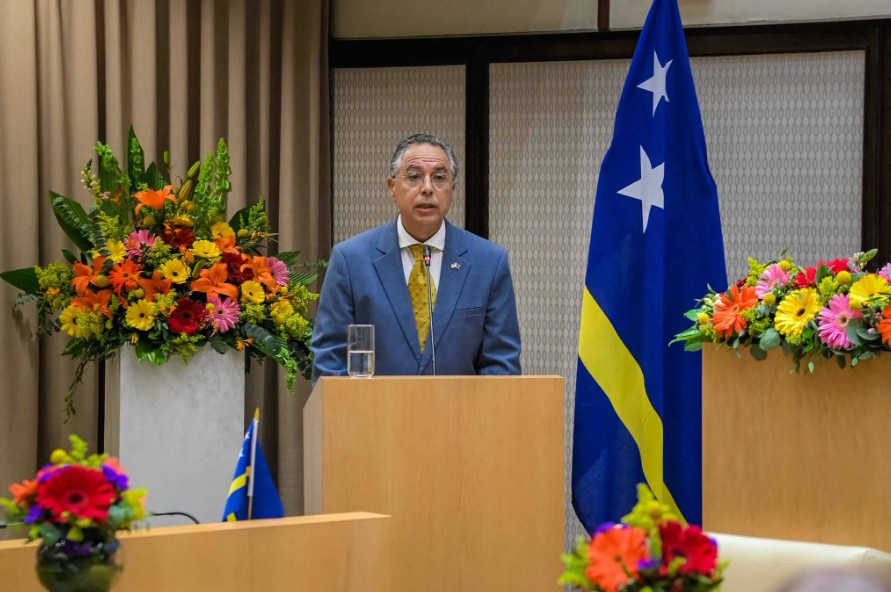
Governor De Kort during the opening of Parliament
The energy policy is expected to be developed in the short term and will establish the direction for the development, regulation and transformation of Curaçao’s energy sector. The government did not specify in the speech when the final documents will be completed.
Implementation will require close cooperation between the government, Integrated Utility Holding/Aqualectra, Curoil and 2BAYS, with coordination by regulator RAC. Energy companies, major consumers, the private sector and social organizations are also expected to participate in consultations.
The government says the objective is to create an energy system that is more reliable while keeping tariffs affordable and sustainable. Energy policy is also being linked directly to Curaçao’s competitiveness and future economic development.
The initiative forms part of a broader effort to reduce Curaçao’s dependence on a limited number of economic sectors. While tourism will remain important, the government says the next phase of economic growth cannot be based simply on attracting more visitors. Instead, tourism should generate greater added value while maintaining a better balance between economic activity, the island’s capacity and quality of life.
Economic diversification will therefore focus on maritime and logistics activities, the energy transition, local food production, industry, technology, fintech and the creative industries.
The government also intends to clean up and develop the eastern Buskabaai area and introduce a special economic zone to accommodate new commercial activities. Its industrial strategy seeks to position Curaçao as a regional center for assembly and production, with emphasis on exports, import substitution and technological innovation.
Another major initiative will be a Strategic Investment Agenda designed to direct public investment toward projects capable of generating economic value, improving infrastructure and reducing risks for private investors. The Dok–Buskabaai Economic Development Corridor and Agri Park Curaçao are specifically identified as projects intended to create business activity, employment and local production.
The government says its role will not be to replace the private sector, but to create the conditions under which entrepreneurs and investors can expand economic activity.