WILLEMSTAD – The Curaçao Parliament has expressed reservations about the conditions attached to a Dutch government proposal to extend the Landspakket reform agreement for another two years, raising questions about who should determine the priorities for future reforms on the island.
The Netherlands has offered Curaçao, Aruba, and Sint Maarten the opportunity to extend the existing Mutual Arrangement on Cooperation in Reforms until April 2029. However, the proposal requires formal approval from the parliaments of the three Caribbean countries.
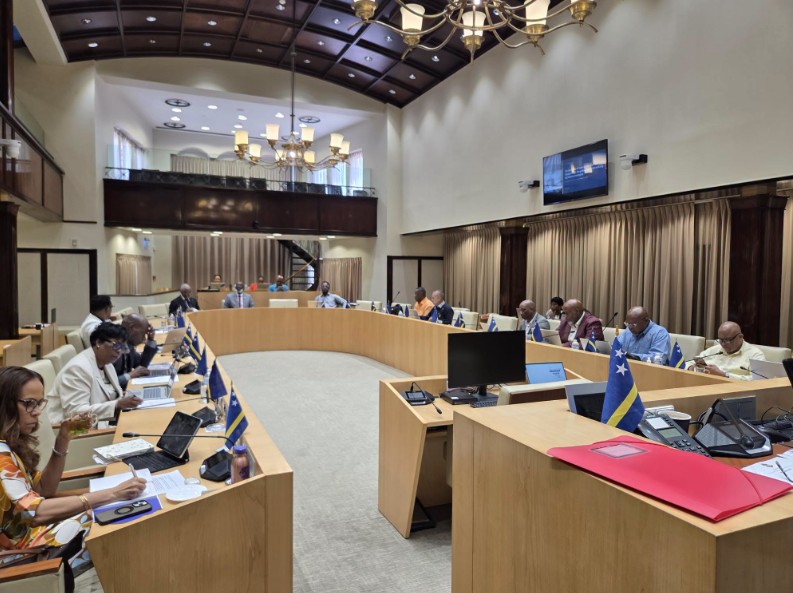
Curaçao Parliament during the economic reforms meeting
While the prime ministers of Aruba and Sint Maarten have indicated their willingness to continue participating in the arrangement, Curaçao's Parliament has raised concerns about the conditions attached to the Dutch offer.
The main disagreement concerns which reforms should receive priority during the proposed extension and how the available Dutch funding should be allocated.
Curaçao Wants Greater Control Over Reform Priorities
According to information from The Hague, Curaçao parliamentarians are critical of the Dutch government's approach to selecting the reforms that would receive financial support over the next two years.
The Curaçao Parliament wants the country to determine its own priorities rather than accept a list of reforms selected by the Netherlands.
The disagreement highlights the continuing debate over Curaçao's autonomy in determining domestic policy while receiving Dutch financial and technical assistance.
The Landspakket was introduced as part of the financial assistance arrangements established during the COVID-19 pandemic. It includes reforms intended to strengthen public finances, government administration, taxation, economic development, healthcare, education, and other areas.
Although Curaçao is responsible for implementing the reforms, the Netherlands provides support through the Temporary Work Organisation (TWO).
The proposed extension would allow selected reform projects to continue beyond the current agreement's expiration in April 2027.
Netherlands Insists on Achievable Reforms
The Dutch Ministry of the Interior and Kingdom Relations (BZK) has made clear that it wants to concentrate its financial support on reforms that can realistically be completed within the proposed two-year extension.
According to the ministry, Dutch funding must be spent efficiently and effectively.
The ministry stated that the Netherlands is willing to continue supporting only those ongoing Landspakket reforms that have a realistic prospect of completion by April 2029 and for which there is a clear commitment from the responsible authorities.
This position suggests that the Dutch government does not intend to finance every reform currently included in the Landspakket.
Instead, it wants to prioritize projects that can produce tangible results within the available period.
For Curaçao, this approach raises questions about whether the Dutch government or Curaçao's own institutions should have the decisive voice in selecting those projects.
Aruba and Sint Maarten Willing to Continue
The prime ministers of Aruba and Sint Maarten have already indicated that their governments want to make use of the possibility of extending the Mutual Arrangement and their respective Landspakket programs.
However, their decisions are not sufficient to finalize the extensions.
Under the terms of the arrangement, the parliaments of the participating countries must also formally approve continued cooperation.
This requirement gives the Curaçao Parliament an important role in determining whether the island will remain part of the existing reform framework beyond April 2027.
Deadline Set for November 30
The Netherlands has given the Caribbean countries until November 30, 2026, to communicate whether they agree to the proposed extension.
The deadline leaves Curaçao's government and Parliament just over a month to determine their position.
The issue comes as Prime Minister Gilmar Pisas and Caryl Monte, President of Curaçao's National Government Reform Commission, have been discussing the implementation and evaluation of the Landspakket with parliamentarians.
Those discussions have focused on the progress of reforms, difficulties encountered during implementation, and the need to evaluate whether the program is delivering the intended results.
The disagreement over the proposed extension adds another dimension to those discussions.
Future of Reform Cooperation Remains Uncertain
The central question is whether Curaçao and the Netherlands can reach an understanding about the selection of reform priorities while respecting the responsibilities of both governments.
For the Netherlands, the emphasis is on ensuring that public funds support achievable reforms with measurable results.
For Curaçao parliamentarians, the concern is maintaining sufficient authority over decisions affecting the country's institutions, economy, and public administration.
The information available does not indicate that Curaçao's Parliament has formally rejected the Dutch proposal. Rather, parliamentarians have expressed reservations about its conditions.
With the November 30 deadline approaching, further discussions will be necessary to determine whether Curaçao can agree to an extension and under what conditions.
The outcome will determine whether the existing Landspakket cooperation continues until April 2029 or whether Curaçao and the Netherlands will need to consider a different approach to supporting the island's reform agenda.