From a colonial coat of arms to a people’s emblem
A national symbol is never just a drawing. It tells a people who they are, what they honour, what they remember, and what they choose to place at the centre of their identity. It appears on official letters, schools, public buildings, awards, uniforms, websites and documents. Quietly, it tells every child: this is your country; this is your story.
That is why Curaçao must finally complete the work it began years ago: replacing the old coat of arms with a simple, dignified and original national emblem.
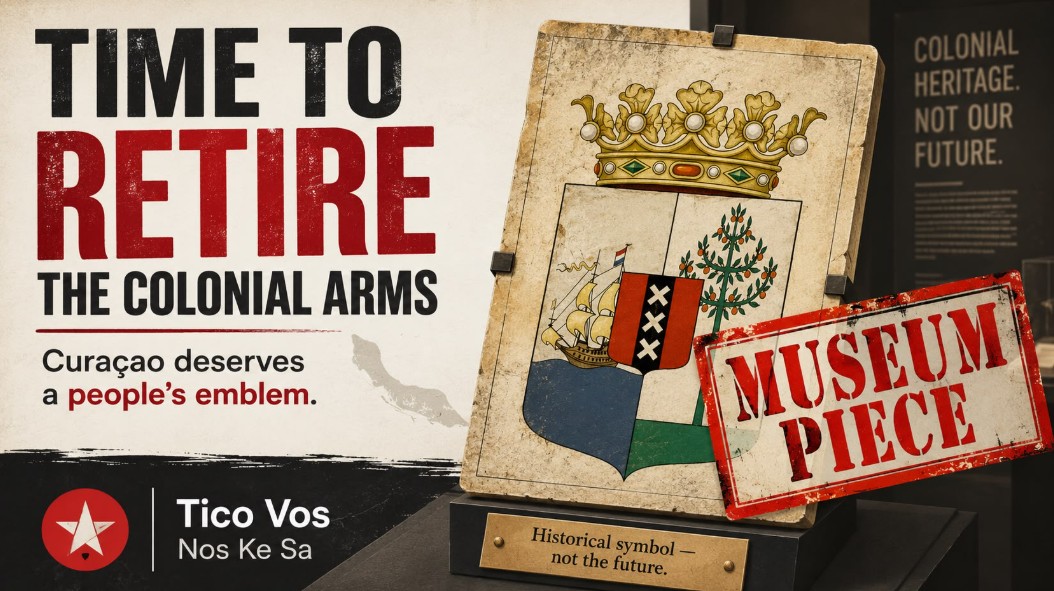
The present coat of arms was adopted in 1964, when Curaçao was still an island territory within the Netherlands Antilles. Its visual message is clear. A European crown stands above the shield. Amsterdam’s three crosses occupy the centre. A ship and an orange tree complete the picture.
But who is missing from that picture?
Where are the people of Curaçao?
Where are the African ancestors who survived enslavement? Where are the Caquetío roots? Where is Papiamentu? Where are the mothers, dockworkers, fishermen, teachers, artists, musicians, workers, entrepreneurs, elders and young people who built this country, generation after generation?
The ship in the coat of arms cannot be presented only as a beautiful reminder of maritime trade. It is linked to the West India Company and the colonial Atlantic world. Curaçao became a major hub in the Dutch slave trade after the loss of Brazil, while Amsterdam’s WIC chamber coordinated much of the transport of enslaved African men, women and children. People were resold from Curaçao to other colonies, while others were forced into labour on the island.
History must not be erased.
Amsterdam belongs to our history. The Netherlands belongs to our history. The WIC, slavery, migration, trade, resistance, faith, family and survival all belong to our history.
But history does not have to remain the face of the nation.
There is a difference between remembering a colonial past and placing colonial power in the middle of our national identity. A mature people can study every chapter of its history without continuing to wear the symbols of former rulers above its own head.
This is not anti-Dutch.
It is pro-Curaçao.
It is about asking a simple but profound question: Who stands at the centre of our story?
In 2021, the government itself recognized that the time had come for change. The official decree establishing the Komishon Emblema pa Kòrsou spoke about nation-building, self-confidence, unity, shared responsibility and the need for a symbol proposed by the Curaçaoan people to replace the old arms. The plan included public information, citizen participation, selection criteria, up to ten finalists, expert support and public voting.
The intention was correct.
But the process did not reach a secure conclusion.
The 2022 competition produced a winning concept, yet questions followed about stock imagery, originality, copyright and the transparency of the process. The designer denied plagiarism, while the government moved toward validation by the Bureau for Intellectual Property and further professionalization of the concept. Official advice reportedly stressed the need for stronger transparency and documentation.
That episode should not become a permanent punishment for one artist.
The deeper lesson is institutional.
A national emblem cannot be handled like a campaign logo, a tourist poster or a social-media design. It must survive generations. It must work in black and white, in a tiny official seal, on a passport, a school uniform, a government website, a medal, a monument and a football shirt. Above all, it must be legally safe, culturally honest and recognizably ours.
The last reported public discussion indicated that the Cabinet still had to decide whether to continue with the proposed concept, retain the old arms, or restart the process.
Curaçao should now choose a wiser road: not a rushed new competition, but a true second phase.
Its name can be:
NOS EMBLEMA
Nos Historia, Nos Dignidat, Nos Futuro
And it should begin not with designers, but with the people.
The first national question should be asked in every barrio, school, church, sports club, cultural centre and public meeting:
“Ken ta den sentro di nos historia?”
Who stands at the centre of our history?
Before drawing symbols, Curaçao must agree on values.
Dignity. Freedom. Resilience. Unity. Respect for land and sea. Papiamentu. Creativity. Memory. Courage. Shared responsibility. A future beyond dependency.
Only then should artists translate those values into visual language.
The first failed attempt must guide the second one. Every finalist should submit original sketches, source files and a documented creative process. Any use of generative technology must be openly declared; it may never be used to hide borrowed work. An independent copyright and reverse-image audit must take place before public voting, not after public embarrassment.
The evaluation criteria must be published in advance: historical honesty, Curaçao identity, originality, simplicity, dignity and practical usability. Political-party imagery, corporate brands, colonial-company symbols and foreign-state symbols should not enter the competition. The public conversation must be led first in Papiamentu, because this is not only a design exercise; it is an exercise in national self-definition.
The final choice must then be legally adopted, expressly replacing the 1964 arms and accompanied by a clear manual for use on seals, passports, schools, government platforms, sport, tourism and cultural representation. The selected artist or design team must receive fair compensation, recognition and a transparent agreement on rights.
Curaçao does not need another complicated coat of arms.
Nor does it need a shallow tourism logo full of predictable clichés.
It needs a people’s emblem: simple enough for a child to draw, strong enough to endure, and deep enough to carry the dignity of a nation.
The old coat of arms can remain in our archives and museums as evidence of an important chapter.
But Curaçao’s future deserves its own face.
Not a crown above the people.
A symbol rising from the people.
Tico Vos
Columnist