WILLEMSTAD – Increasing controls and introducing tougher measures will not automatically make Curaçao’s schools safer, according to three government ministers who say school violence must also be addressed as part of broader social problems affecting children and young people.
The position was emphasized Tuesday during a meeting between the government, the Curaçao Police Force and education unions concerning school safety.
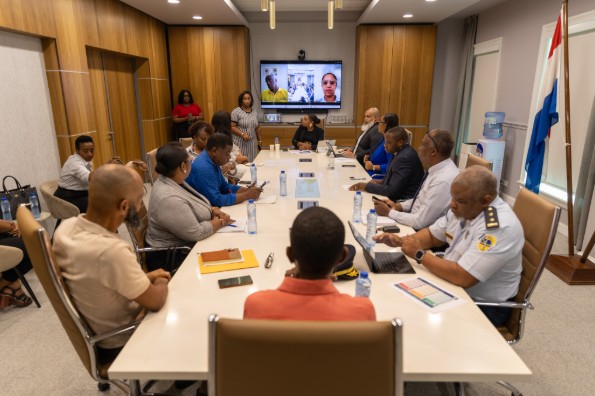
Ministers of Justice and Education meeting with the teachers' unions
Justice Minister Shalten Hato, Social Development, Labor and Welfare Minister Charetti America-Francisca and Education Minister Sithree van Heydoorn stressed that the seriousness of recent concerns requires action but warned against transforming schools into environments dominated by fear and control.
“More controls and more repressive measures do not automatically mean more safety,” the government said.
According to the ministers, schools must remain environments characterized by peace, respect and trust.
Controls should be introduced where necessary, protocols should be adjusted when required, and police or judicial authorities should intervene when circumstances demand it. However, the government said maintaining the right balance is essential.
Schools must continue to be places for education, personal development and preparing young people for their futures.
The ministers also warned against treating school violence in isolation from the social circumstances in which many children are growing up.
Behavior that becomes visible at school can sometimes be connected to conflicts at home or in neighborhoods, social pressure, difficult family circumstances, insufficient guidance or other problems affecting young people.
The government emphasized that such circumstances do not excuse violence, threats or other unacceptable behavior. They do, however, demonstrate why schools cannot be expected to solve these problems alone.
According to the ministers, schools cannot simultaneously function as educational institutions, police stations, child-care institutions and substitutes for the upbringing children should receive at home.
Teachers and non-teaching employees should therefore not be made responsible for solving every social problem that eventually manifests itself in the classroom or on school grounds.
Prevention and awareness will consequently form an important part of the government's approach.
Students must be made aware that violence, threats and carrying weapons can have serious consequences for themselves, other people and their future.
Meanwhile, proposed legislation concerning mandatory school safety plans has reached its final stage.
The government cautioned, however, that legislation alone will not make schools safe. A law can establish responsibilities, procedures and obligations, but everyday safety must ultimately be built through cooperation among schools, families, authorities and the wider community.
During Tuesday’s meeting, union representatives shared experiences and concerns reported by people working in education on a daily basis.
The government said those accounts will help determine where existing measures need to be strengthened and what additional steps are required.
A joint working group of representatives from the ministries and education unions will now develop further proposals, while immediate measures including incident registration, prevention programs, bag checks, increased visibility at selected schools, staff training and emergency drills are being pursued.
The government said school safety remains a shared responsibility requiring cooperation not only inside schools but also at home and throughout the community.