WILLEMSTAD – Curaçao could lose access to XCG 16 million in proposed Dutch reform funding if the government decides not to extend its current cooperation agreement with the Netherlands, forcing the island to determine how unfinished reforms will be financed and implemented independently.
Prime Minister Gilmar Pisas has presented the Curaçao Parliament with two possible scenarios as the government prepares to decide whether to continue the Mutual Arrangement for Cooperation on Reforms beyond its scheduled expiration on April 4, 2027.
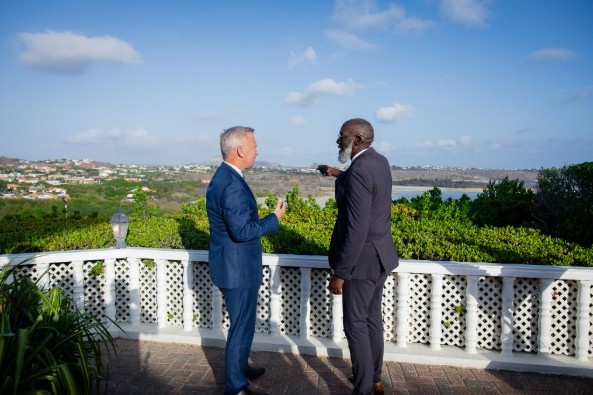
Prime Minister Pisas in a relaxed setting with the State Secretary of Kingdom Relations Van den Burg.
The Netherlands has offered to extend the agreement until April 1, 2029, with EUR 8 million, approximately XCG 16 million, reserved for selected reform projects.
However, Pisas has expressed reservations about the conditions and priorities included in the proposal.
In his October 21 letter to Parliament, the prime minister explained that accepting the offer would allow Curaçao to continue receiving Dutch financial and technical support for the reforms selected under the proposed extension.
The arrangement would also preserve the existing framework for cooperation between the two governments.
Rejecting the proposal, on the other hand, would mean allowing the current agreement to expire in April 2027.
In that case, Curaçao would not receive the additional funding reserved for the proposed two-year extension.
However, the termination of the agreement would not necessarily mean that all Dutch-funded reform activities would stop immediately.
According to the government's assessment, existing subsidy agreements for projects initiated before the expiration date could continue under their established conditions.
The main challenge would involve reforms that remain incomplete or have not yet entered implementation.
Curaçao would have to determine how those projects should be organized, financed, and supervised without the current bilateral cooperation framework.
The government could choose to allocate its own financial resources or explore alternative forms of external assistance.
The decision comes at a time when several reforms have progressed more slowly than originally anticipated.
According to the prime minister's assessment of the Landspakket, limited implementation capacity, complex administrative procedures, and the scale of the proposed changes have contributed to delays.
Among the areas identified as incomplete or only partially implemented are modernization of the civil service and the introduction of a higher retirement age.
These outstanding reforms add another dimension to the decision about whether to extend cooperation with the Netherlands.
The government must consider not only the availability of additional funding, but also whether Curaçao has sufficient administrative capacity and financial resources to complete the remaining work independently.
Pisas has asked Parliament to express its position on the proposed continuation of the agreement and the conditions attached to Dutch support.
The Netherlands has established November 30 as the deadline for Curaçao to respond to the offer.
Parliamentary approval is required for an extension, making the upcoming discussions an important step in determining the future of the reform program.
The government will ultimately have to decide whether to accept continued cooperation under the proposed Dutch conditions or allow the agreement to expire and assume greater direct responsibility for financing and implementing the remaining reforms.