WILLEMSTAD – Curaçao has donated three Fish Aggregating Devices (FADs) to Sint Maarten as part of cooperation between the two Caribbean countries within the Kingdom of the Netherlands. The devices are intended to support the development of Sint Maarten’s local fishing industry while sharing Curaçao’s experience with its own FAD program.
Curaçao has expanded its use of FADs considerably in recent years. According to the government, 23 devices were installed in Curaçao waters during 2025 and 2026.
The donation follows a request from Sint Maarten’s Minister of Tourism, Economic Affairs, Transport and Telecommunication (TEATT), Grisha Heyliger-Marten. Prime Minister Gilmar Pisas, who is responsible for agriculture, environment and nature within the Ministry of Health, Environment and Nature (GMN), agreed to provide three devices.
The Curaçao government described the donation as an example of practical cooperation between the countries of the Kingdom, particularly in agriculture and fisheries.
The FADs were prepared starting in November 2025, while the buoys were manufactured locally in Curaçao earlier this year. Sint Maarten has since provided the locations, water depths and Maritime Mobile Service Identity (MMSI) numbers needed to program the equipment.
Fish Aggregating Devices are floating or anchored structures designed to attract pelagic fish. Fish naturally gather around floating objects, making FADs useful locations for fishermen seeking species found in deeper offshore waters.
The devices being sent to Sint Maarten are equipped with navigation lights for nighttime visibility, radar reflectors and Automatic Identification System (AIS) equipment. These safety measures are intended to make the FADs visible to passing vessels and reduce the risk of collisions.
AIS allows vessels and coastal stations to exchange information such as identification, position, speed and direction. Each AIS transmitter uses a unique MMSI number.
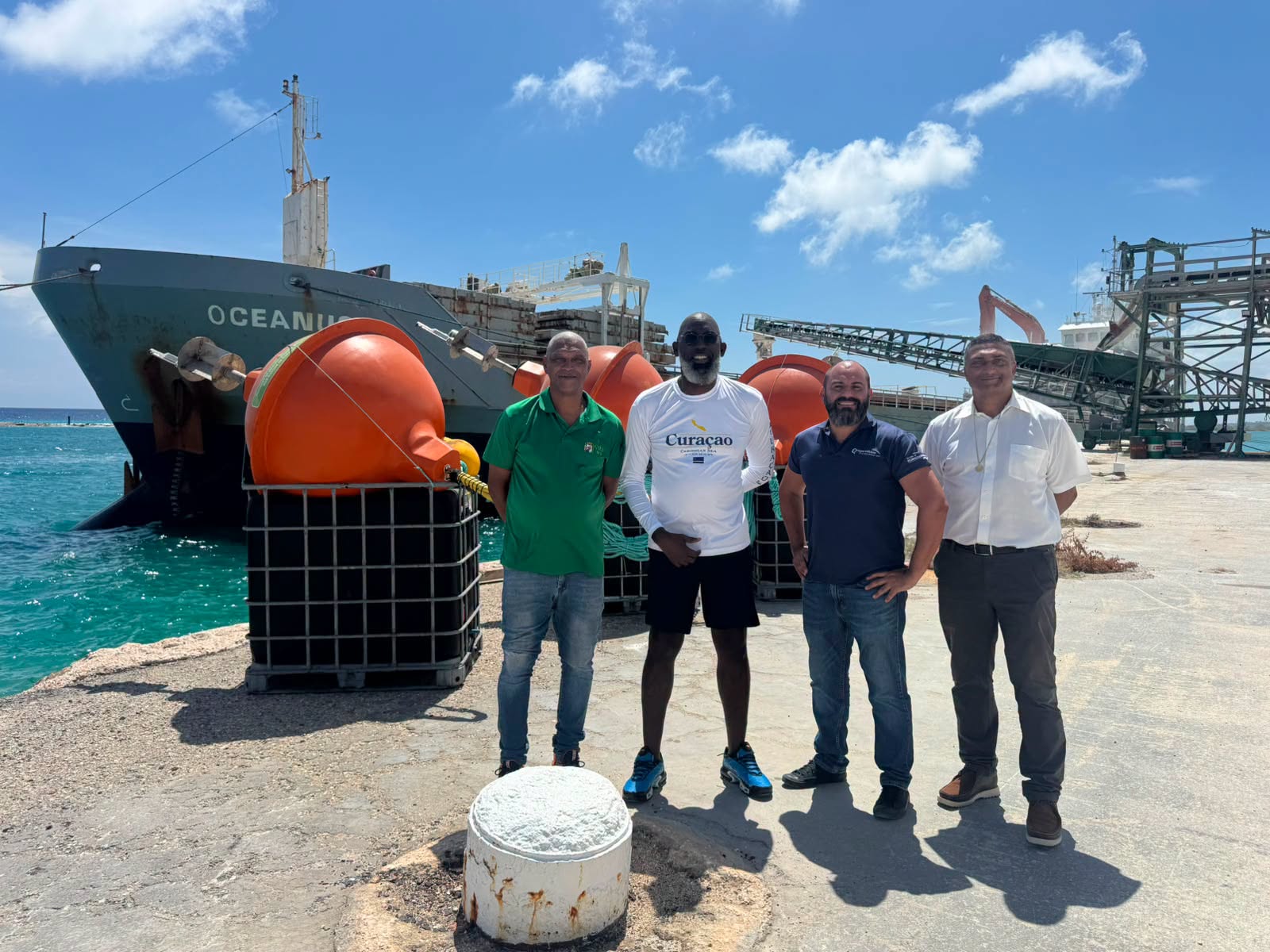
On July 16, the three FADs were transported from the government depot at Mathey Werf to Mijnmaatschappij New Port at Fuik Bay by employees of the Department of Agriculture and Fisheries Management (AVB).
The equipment was loaded onto a vessel on Sunday in the presence of Pisas. The ship, which is normally used by Mijnmaatschappij to transport sand and gravel, is expected to deliver the FADs to Sint Maarten on August 28.
The cooperation will continue after their arrival. A team of specialists from Curaçao is expected to travel to Sint Maarten in the near future and work alongside a local team to deploy the three FADs at sea.
According to the Curaçao government, the project is intended not only to stimulate Sint Maarten’s fishing sector but also to transfer knowledge and strengthen cooperation between the Caribbean countries of the Kingdom in fisheries and agriculture.