WILLEMSTAD – Professionals from Curaçao and Bonaire have brought Caribbean expertise in climate adaptation, affordable housing, and sustainable construction to the Netherlands, demonstrating how solutions developed on the islands can help address growing environmental challenges in Europe.
The delegation participated in the Climate Summit for the Built Environment (Klimaattop Gebouwde Omgeving), held on November 4 and 5, 2026, in Utrecht. Organized by the Future Islands Foundation, the Caribbean delegation contributed to discussions about climate-resilient development while establishing new connections with Dutch professionals, government representatives, and institutions.
The initiative aims to create lasting cooperation between the Caribbean islands and the European Netherlands, with both regions sharing knowledge and developing practical solutions to common challenges.
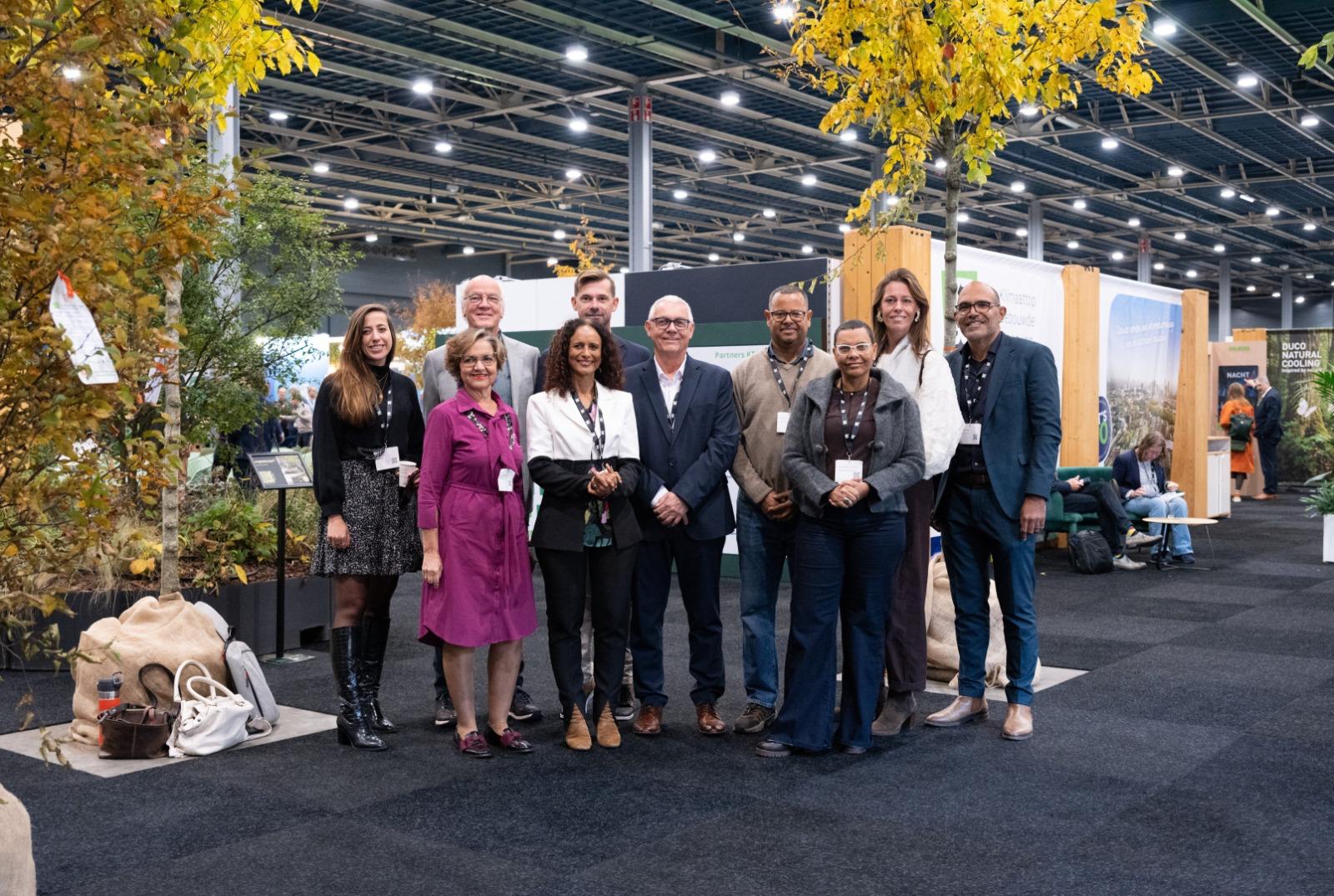
Dutch Caribbean delegates
Caribbean Experience Offers Valuable Lessons
For decades, Curaçao and other Caribbean islands have had to adapt their buildings and infrastructure to high temperatures, prolonged drought, intense rainfall, and limited available land.
These environmental conditions have shaped local approaches to architecture, water management, and urban development.
As the European Netherlands increasingly experiences extreme temperatures, heavy rainfall, and other climate-related challenges, Caribbean expertise is becoming more relevant to Dutch policymakers, architects, and urban planners.
During the summit, participants discussed practical solutions such as natural ventilation, building designs that maximize shade, rainwater collection and storage, and the more efficient use of existing buildings.
Architects Lyongo Juliana and Zarja Garmers emphasized the importance of designing buildings according to local climatic conditions rather than relying on standardized approaches that may not be suitable for every environment.
Historical water management practices used in Curaçao also attracted attention as potential sources of inspiration for Dutch efforts to address flooding and urban heat.
Affordable Housing and Climate Adaptation
Future Islands organized two panel discussions focusing on challenges shared by Caribbean communities and the European Netherlands.
The first, titled "Climate Adaptation from Island to Dutch Neighborhood," explored how climate-resilient design and environmental planning can be applied in different geographical settings.
The second panel, "An Affordable Home for Everyone," examined housing affordability and the need to develop practical, sustainable solutions for communities facing increasing housing costs.
Discussions addressed not only construction techniques but also the reuse of existing properties, financing options, and the challenges of turning development plans into projects that can actually be implemented.
The delegation stressed that sustainable development must remain financially accessible and responsive to local needs.
Cooperation Must Work in Both Directions
While Caribbean professionals shared their experiences, they also used the summit to learn from Dutch approaches to circular renovation, housing development, financing, and cooperation between public institutions and private businesses.
Caroline Manuel, representing Curaçao's Ministry of Traffic, Transport and Spatial Planning (VVRP), contributed insights into the relationship between government policy and practical implementation.
Felix Greving of Fundashon Mariadal in Bonaire emphasized the importance of cooperation across different sectors.
According to Greving, challenges involving climate change, healthcare, energy, and quality of life are closely connected and cannot be addressed effectively in isolation.
Future Islands representative Els Steenhagen stressed that meaningful cooperation requires recognizing Caribbean professionals as equal knowledge partners.
"Equal cooperation begins with recognizing each other as knowledge partners," Steenhagen said.
She explained that the Caribbean islands should not be viewed solely as recipients of Dutch expertise because they also possess valuable knowledge and practical experience.
According to Steenhagen, Caribbean professionals should be involved from the beginning when new projects and initiatives are developed, allowing both regions to determine together which solutions are most appropriate.
Plans for a Caribbean Climate Summit in 2027
Future Islands is now exploring ways to transform the contacts established in Utrecht into concrete collaborative projects.
Potential areas of cooperation include climate adaptation, affordable housing construction, and the renovation and reuse of existing buildings.
The foundation is also considering organizing a Caribbean edition of the Climate Summit in 2027, potentially on Bonaire.
Such an event could bring together professionals, government representatives, researchers, and businesses from across the Caribbean and the European Netherlands.
The proposal remains under consideration, and no final decision regarding the location or dates has been announced.
Future Islands emphasized that any future summit should build on the relationships and initiatives developed during the Utrecht gathering rather than becoming an isolated event.
Building a Long-Term Knowledge Network
The Caribbean delegation included Caroline Manuel, Carlos Pourier, Emma Heinhuis, Felix Greving, Kasper Lendering, Lyongo Juliana, Maghalie George-van der Bunt, and Zarja Garmers.
The group was accompanied by Future Islands representatives André Hagendijk and Els Steenhagen.
Through its activities, Future Islands seeks to connect professionals, organizations, and knowledge institutions across the Caribbean and the European Netherlands to promote sustainable development and long-term cooperation.
The foundation believes that combining Caribbean experience with Dutch research, technology, and institutional resources can produce solutions that benefit both regions.
The participation of Curaçao and Bonaire at the Utrecht summit highlighted a broader message: the Caribbean islands are not only vulnerable to climate change but also possess valuable knowledge about adapting to its effects.
For Future Islands, the next challenge is ensuring that the conversations initiated in Utrecht lead to lasting partnerships and practical improvements in housing, infrastructure, and climate resilience.