WILLEMSTAD – Curaçao's Ministry of Economic Development (MEO) has allocated XCG 2 million for preliminary studies related to the proposed development of the Dok–Buskabaai–Nieuwe Haven maritime-industrial area, according to Augustin Diaz, Director of CDM Holding.
The funding is intended to support the preparation of future investments rather than finance the entire development project, which aims to transform the area into a broader center for maritime services, industrial activities and logistics.
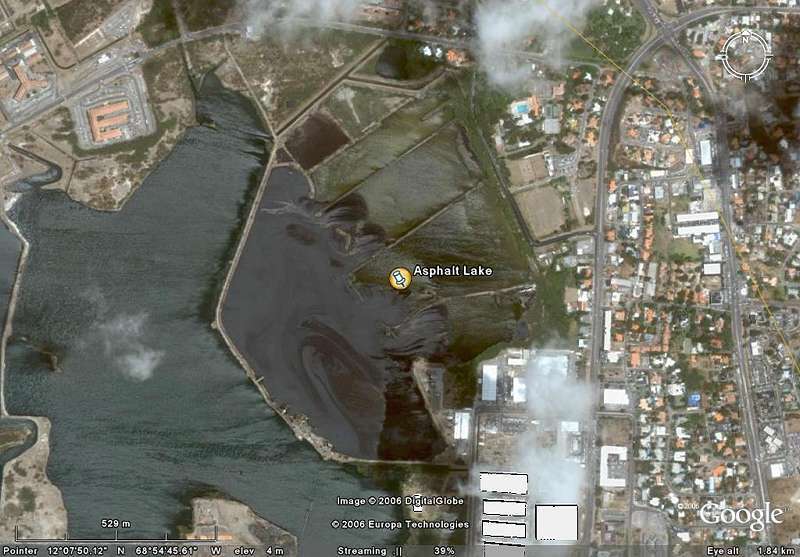
Asphalt Lake (Buskabaai)
In an economic essay, Diaz explained that the initiative is based on cooperation between government, private companies and potential international financiers.
The approach is being developed through the Programmatische Maritieme Tafel (PMT), a collaborative framework focused on the future of the Dok–Buskabaai–Nieuwe Haven area.
Rather than treating the shipyard, harbor facilities and surrounding industrial sites as separate infrastructure projects, the program seeks to connect them into a coordinated maritime-industrial development strategy.
Diaz believes this approach could help Curaçao create new economic activities while making better use of its existing infrastructure.
Shipyard Modernization at the Center of Development
A major component of the proposed development is the modernization of Curaçao's shipyard through the CAPEX 2.0 investment program.
The broader strategy also identifies opportunities in ship maintenance, offshore services, logistics, maritime supply chains, vocational training and waste processing.
The planned development of Buskabaai, including a proposed open connection and new industrial functions, forms another part of the initiative.
According to Diaz, the objective is to create an economic environment in which different maritime and industrial activities reinforce one another.
For example, ship repair operations could generate demand for local technical suppliers, specialized maintenance companies, logistics providers and vocational training institutions.
This could help expand economic opportunities beyond individual infrastructure investments.
However, the success of the program will depend on identifying commercially viable projects and securing the necessary investment commitments.
XCG 2 Million Intended to Attract Larger Investments
Diaz explained that the XCG 2 million allocated by MEO is intended to finance the initial studies and preparations needed to advance the development program.
The amount is not sufficient to implement the entire project and is not being presented as construction financing.
Instead, the funds are expected to help identify investment opportunities, prepare projects and coordinate the involvement of public and private stakeholders.
The expectation is that public spending on planning and preparation could eventually attract substantially larger investments from private companies and international financial institutions.
Diaz emphasized that an important next step will be establishing clear arrangements for managing and spending the program's financial resources.
These arrangements must allow projects to move forward efficiently while ensuring transparency, accountability and proper oversight of public funds.
Without clear financing and governance structures, he warned, promising development plans could face delays before reaching implementation.
Local Businesses Must Play a Greater Role
Diaz also raised broader concerns about Curaçao's current economic development model.
Although the island continues to attract foreign investment, particularly in tourism, he believes these investments do not automatically translate into sufficient growth in local production capacity and entrepreneurship.
He argues that Curaçao needs a model in which local businesses participate more directly in developing, financing and implementing economic projects.
Under this approach, companies would not simply be invited to comment on government proposals. They would become active partners in identifying opportunities, developing projects and making investments.
Diaz acknowledged that such cooperation requires changes in the traditional relationship between government and the private sector.
Ministries and government-owned enterprises would need to look beyond their existing administrative responsibilities and individual budgets to support broader economic programs.
He also identified administrative reluctance as a possible obstacle, particularly when new forms of cooperation require institutions to share responsibilities or adjust established decision-making procedures.
According to Diaz, this does not mean reducing government accountability. Instead, it requires organizing public responsibilities differently to facilitate investment and economic growth.
From Planning to Implementation
The proposed development comes at a time when Caribbean countries are investing heavily in port infrastructure, offshore services and maritime logistics.
Diaz believes Curaçao has the infrastructure, technical expertise and geographic position to participate in this expanding regional market.
However, he emphasized that these advantages will only generate economic benefits if they are connected to concrete investment projects.
Potential cooperation with international institutions, including the European Commission and Invest International, could play a role in mobilizing additional financing.
Diaz sees the Dok–Buskabaai–Nieuwe Haven program as more than a maritime development initiative.
If the cooperation between government, businesses and financiers proves successful, he believes it could establish a model for economic development that can also be applied in other sectors of Curaçao's economy.
For now, the immediate priorities are completing the necessary studies, establishing clear financing arrangements, securing administrative decisions and moving the proposed projects toward actual implementation.
The XCG 2 million allocation represents an initial step, but the scale and timing of future investments will depend on the outcome of those preparations and the willingness of public and private partners to commit resources.