BELIZE CITY – The Central Bank of Curaçao and Sint Maarten (CBCS) participated in the 67th Bi-Annual Meeting of CARICOM Central Bank Governors, held from November 19 to 20, 2026, in Belize City, Belize. The CBCS was represented by Ference Lamp.
Hosted by the Central Bank of Belize and chaired by Governor Kareem Michael, the meeting brought together governors, deputy governors and senior central bank officials from across the Caribbean to discuss regional economic developments, financial resilience and initiatives aimed at supporting sustainable economic growth.
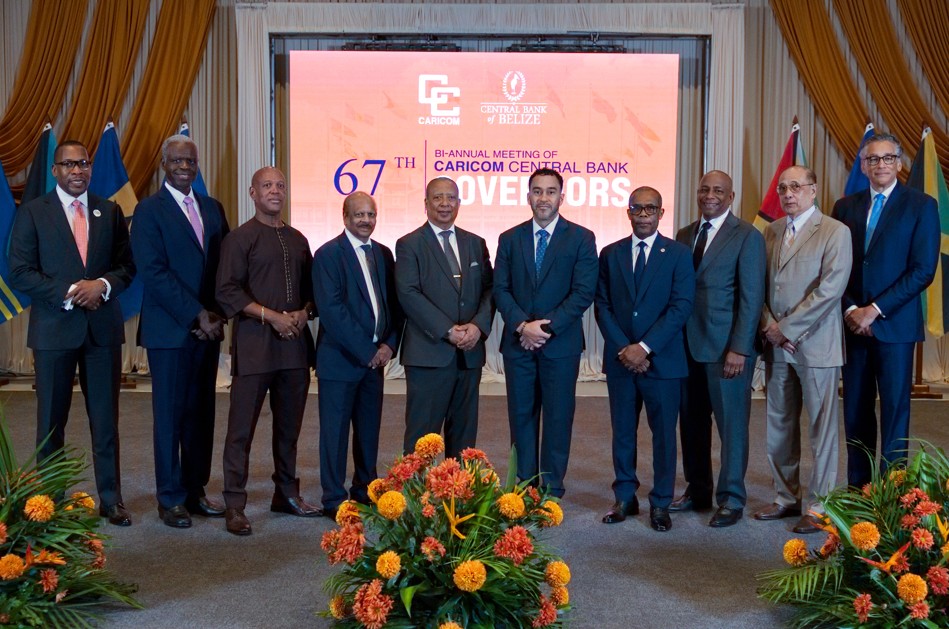
The CBCS was represented by Ference Lamp (right)
The meeting was held under the theme “From Vulnerability to Capacity: Recalibrating Policy and Growth Drivers in Small States amid Global Shifts.”
Discussions focused on the vulnerabilities of small, open economies and the importance of strengthening economic policies, institutions and regional cooperation to withstand external shocks.
Economic Challenges Facing Caribbean Countries
During the meeting, central bank governors acknowledged that small Caribbean economies continue to face significant challenges arising from global economic uncertainty, climate-related risks and rapid technological developments.
These challenges are particularly relevant to small, open economies such as Curaçao and Sint Maarten, which are exposed to international economic developments.
The governors approved measures to strengthen regional data collection and research capabilities, including a framework designed to improve the consistency, comparability and timeliness of economic statistics across the Caribbean.
Improved regional statistics are intended to support economic analysis and policy development.
Modernization of Regional Payment Systems
One of the principal outcomes of the meeting was the endorsement of a strategic roadmap to accelerate the development of interoperable payment systems across the Caribbean.
The initiative will be led by the Bank of Jamaica, with support from the Eastern Caribbean Central Bank.
Central bank governors reaffirmed that modernizing payment systems is an important component of regional financial integration and economic development.
Participants also received a presentation from the Pan-African Payment and Settlement System (PAPSS), which provided insights into cross-border payment mechanisms and the settlement of transactions in local currencies.
The meeting reviewed progress on the pilot project for the CARICOM Payment and Settlement System (CAPSS). Potential participating banks in the countries involved in the pilot will soon be approached to take part.
The development of more integrated regional payment systems could eventually facilitate commercial transactions between Caribbean countries and improve the efficiency of cross-border payments.
However, the meeting's official statement did not specify whether financial institutions in Curaçao and Sint Maarten would participate in the pilot project.
Cybersecurity and Financial Stability
The governors also reviewed progress on several regional initiatives aimed at strengthening financial stability and institutional cooperation.
These included the Caribbean Regional Green Taxonomy, the development of macroprudential policies and cybersecurity collaboration.
The discussions emphasized the importance of strengthening technical expertise and institutional capacity within Caribbean central banks, particularly as financial institutions face increasingly complex technological and regulatory challenges.
Participants also received a presentation on the proposed School of Central Banking and Monetary Policy, a joint initiative of the Central Bank of Barbados and the University of the West Indies, Cave Hill Campus.
The proposed institution would provide specialized training addressing the practical policy, supervisory, technological and institutional challenges faced by central banks in small Caribbean economies.
Curaçao and Sint Maarten Remain Involved in Regional Financial Dialogue
The participation of the CBCS highlights the continued involvement of Curaçao and Sint Maarten in regional discussions concerning monetary policy, financial stability, payment infrastructure and economic resilience.
Other participating institutions included the central banks of The Bahamas, Barbados, Belize, Guyana, Haiti, Jamaica, Suriname and Trinidad and Tobago, as well as the Eastern Caribbean Central Bank.
At the conclusion of the meeting, the governors reaffirmed their commitment to strengthening regional cooperation, improving economic policies, enhancing institutional capacity and advancing initiatives that promote sustainable growth amid an increasingly uncertain global environment.
The next meeting of CARICOM Central Bank Governors is scheduled for May 2027 and will be chaired by Dr. Gobind Ganga, Governor of the Bank of Guyana.