WILLEMSTAD – Curaçao Airport Partners (CAP) and Curaçao Airport Holding (CAH) are strengthening their commitment to the Curaçao community with a Cg 30,000 contribution to Stichting Siloam and a major back-to-school initiative benefiting 125 children. CAP CEO Ricardo Hernández says the initiative reflects a philosophy that operating Curaçao’s main international gateway also comes with a responsibility to invest in the community it serves.
Minister of Economic Development Roderick Middelhof was present at the event, along with Priscilla Duin-Circkens, Chief Strategy Officer & Assistant to the Director at Curaçao Airport Holding. Their presence underscored the cooperation between government, the airport organizations and community partners supporting the initiative.
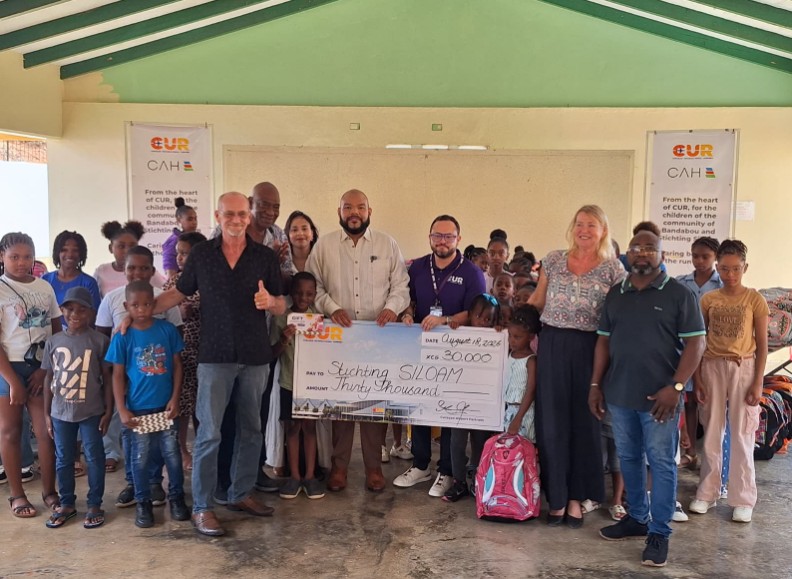
Speaking exclusively to Curaçao Chronicle, Hernández said the project with Stichting Siloam immediately resonated with CAP because of the foundation’s work with children, families and others in the community.
“For us, this is something very close to our hearts,” Hernández said. “As the airport, the main gateway, we believe that operating the airport is just as important as contributing to the community.”
The initiative includes a Cg 30,000 contribution from CAP and CAH to Stichting Siloam to support the foundation’s continued work. In addition, each of the 125 participating children received a backpack and school supplies ahead of the new school year.
The children also received other school essentials, including socks and belts, as well as a Cg 100 Skechers voucher allowing each child to choose a pair of sneakers for the new school year.
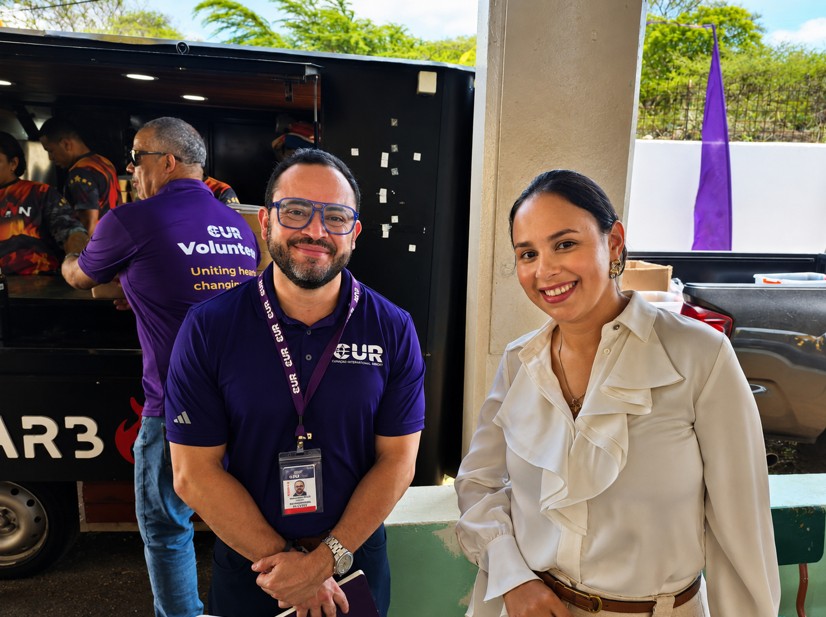
Ricardo Hernández and Priscilla Duin-Circkens
Hernández said supporting children is particularly important because of the long-term impact such assistance can have.
“Investing in children is investing in the future, investing in dreams and starting today to build a better Curaçao,” he told Curaçao Chronicle. “That is something to which we are completely committed.”
More than operating an airport
For Hernández, corporate social responsibility is not separate from CAP's core responsibilities.
He said an airport occupies a unique position in society because it is not simply infrastructure. As the principal point of entry and departure for Curaçao, it also has the opportunity to influence the broader community.
“When you have an airport, you don't only have the airport. You have the opportunity to influence and change the lives of the community if you take that responsibility seriously and put effort into it,” Hernández said.
He explained that giving back to surrounding communities is an approach that has also been followed at other airports where his organization has been involved.
“The community gave us the confidence to manage the main gateway for people entering and leaving the country, and that is no small thing,” Hernández said. “The least we can do is look for where we are needed most and give something back.”
He said CAP intends to continue and expand that approach in Curaçao.
Airport employees volunteer on their days off
Hernández was particularly impressed by the involvement of airport employees in the initiative.
According to the CEO, employees volunteered their own time to participate, despite the demanding nature of airport operations, where staff regularly work overnight, early-morning and other irregular shifts.
“All of the volunteers were there on their day off,” Hernández said. “At an airport, people have to work early in the morning and at night, and they donated their time because they believe in the cause. That is something that is very difficult to find.”
Hernández connected that commitment to the recognition Curaçao's airport staff received from Skytrax last year. He believes the recognition reflects a workplace culture in which employees see their role as extending beyond their daily airport duties.
“This is not a coincidence,” he said. “It is only when people believe and are committed to something that goes beyond the airport that you achieve this type of recognition.”
Hernández: ‘I feel very committed to Curaçao’
Hernández, who is not originally from Curaçao, also spoke about the personal connection he has developed with the island.
“I feel happy and very committed,” he told Curaçao Chronicle. “Curaçao has the people, it has the culture, it has the natural beauty, and I feel completely committed to doing my small part to make it better and better, from my own position and a little beyond that, which is what we are doing here.”
The CEO said CAP takes its social responsibility seriously because every child reached through such a project represents a future opportunity.
“You never know how far the life you touch will go,” Hernández said.
The Siloam initiative was not an improvised donation. Hernández said CAP had been considering the project for several months as part of a process to determine where its community investments could make the greatest difference.
For the company, children and education emerged as important priorities. Hernández pointed out that CAP had also recently been involved with the Ronald McDonald Foundation, again with a focus on children.
“If we touch childhood, we touch the future,” he said. “We all want to change the future, and I deeply believe this is the best way to do it.”
125 children receive back-to-school support
During the event, Hernández, CAH Managing Director Wilhelmus Ignacio and Duin-Circkens joined Minister Middelhof and representatives of Stichting Siloam for the presentation.
The children were able to select backpacks and school essentials appropriate for their age group, with volunteers coordinating and assisting them throughout the activity. Each of the 125 children also received the Cg 100 Skechers voucher.
The Cg 30,000 contribution goes beyond the individual back-to-school packages and is intended to support Stichting Siloam's continued work with children, families and individuals in the Curaçao community.
For Hernández, the event represents the type of relationship CAP wants to maintain with the island: an airport operator responsible not only for connecting Curaçao with the world, but also for remaining connected to the community beyond the airport's terminals and runways.
“Managing the airport well is just as important as giving back to the community,” Hernández said. “Each one of these children represents a future that we are opening and supporting.”