WILLEMSTAD – The democratic rule of law is facing increasing pressure from crime, disinformation, shifting political power structures and declining public confidence in government institutions, Aruba's Attorney General Amalin Flanegin warned during the installation of Sigmar Carmelia as the new president of the Joint Court of Justice.
Speaking at the ceremony held in Curaçao on Friday, Flanegin delivered a warning about the challenges confronting democratic institutions, emphasizing that protecting the rule of law is not exclusively the responsibility of judges and prosecutors.
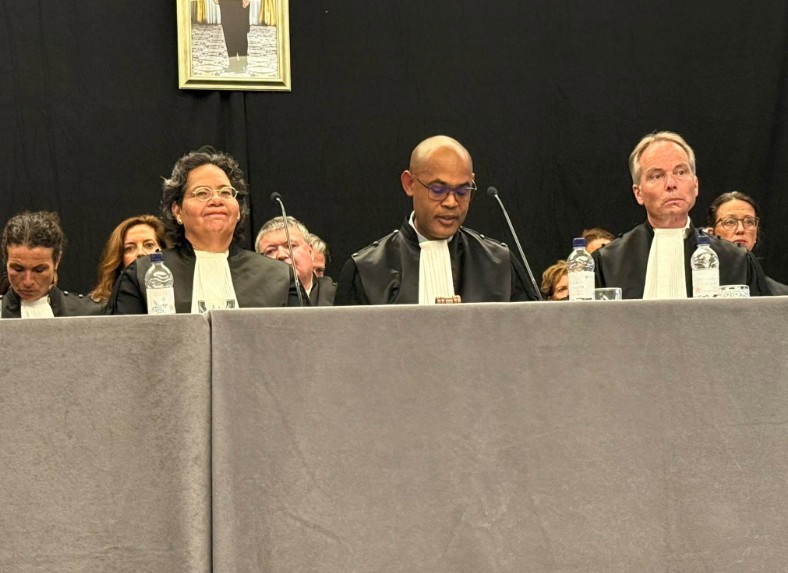
Aruba's AG left of new Court President
According to the Attorney General, governments, politicians, businesses, civil society organizations, journalists and ordinary citizens all share responsibility for defending the democratic principles on which the justice system is founded.
Flanegin described a society in which several problems are increasingly interconnected, creating conditions that can undermine public confidence in government and the administration of justice.
She pointed to rising gun violence, growing mental health challenges and insufficient capacity within government services, including institutions responsible for law enforcement and the administration of justice.
When citizens believe that government institutions cannot adequately assist them or that they are being treated unfairly, confidence in public authorities and the legal system can deteriorate, she warned.
The Attorney General emphasized that these developments should not be viewed as isolated problems, but as interconnected challenges that can weaken the foundations of democratic society.
Separation of Powers Must Be Protected
A central theme of Flanegin's address was the importance of maintaining the separation of powers between the executive, legislative and judicial branches of government.
In a democratic system, these institutions are expected to operate independently while providing checks and balances on one another.
Citizens must also retain the right to challenge government decisions before an independent and impartial judiciary.
Flanegin warned that this balance can no longer be taken for granted, pointing to international political developments that have raised concerns about the independence of democratic institutions.
As an example, she referred to Project 2025 in the United States, a conservative policy initiative whose proposals, in her assessment, seek to strengthen executive authority relative to other branches of government.
She placed this development within a broader international discussion about political power, institutional independence and the importance of protecting the judiciary from inappropriate interference.
Her remarks underscored the principle that an independent judiciary is essential for ensuring that governments remain accountable under the law.
Government Must Also Respect Democratic Principles
Flanegin stressed that the democratic rule of law involves more than elections, legislation and the formal existence of public institutions.
It also depends on fundamental values such as equality before the law, justice, fairness and respect for differing opinions.
Referring to the work of Herman Tjeenk Willink, former vice president of the Netherlands' Council of State, she emphasized that democratic principles must guide the conduct of government institutions themselves.
The Attorney General argued that public authorities cannot demand respect for the rule of law from citizens while failing to uphold those same principles in their own decisions and actions.
Her message was that the responsibility for maintaining democratic standards extends to every branch of government.
The judiciary must remain independent, legislators must exercise their responsibilities within the constitutional framework, and the executive must respect the limits of its authority.
Disinformation Threatens Confidence in Justice
Another major concern raised during the speech was the increasing spread of misinformation and deliberate disinformation.
Flanegin warned that judicial institutions and other public bodies are increasingly subjected to attacks that are not necessarily accompanied by substantive debate or factual criticism.
She referred to criticism and attacks directed at international institutions, including the International Criminal Court, as examples of the pressures facing judicial organizations.
According to the Attorney General, the repeated circulation of false or misleading information can create an environment in which factual evidence becomes less influential and personal beliefs are increasingly presented as established facts.
Such developments can undermine confidence in institutions responsible for applying the law and protecting individual rights.
Her remarks also highlighted the distinction between legitimate criticism of judicial decisions, which is an important element of democratic debate, and attacks that seek to discredit institutions through misinformation.
Shortage of Legal Professionals Could Become More Serious
Flanegin also expressed concern about the potential long-term consequences of sustained attacks on the judiciary and prosecution services.
She warned that young legal professionals could become discouraged from pursuing careers as judges or public prosecutors if judicial institutions are continually portrayed negatively or subjected to hostility.
This concern is particularly relevant to the Caribbean islands, where attracting and retaining qualified legal professionals is already challenging because of the relatively small populations and limited recruitment pools.
A shortage of qualified judges, prosecutors and other legal professionals could place additional pressure on institutions that are already dealing with capacity constraints.
Flanegin's warning therefore extended beyond the immediate effects of disinformation and political pressure to the future sustainability of the justice system itself.
A Shared Responsibility for the Future
The Attorney General concluded her address with an appeal to society to actively protect and defend the democratic rule of law.
She emphasized that judges and the Public Prosecutor's Office cannot carry this responsibility alone.
Political leaders, government officials, businesses, civil society organizations, journalists and citizens must all contribute to maintaining public confidence in democratic institutions and ensuring respect for fundamental legal principles.
Her remarks came during the formal installation of Sigmar Carmelia as president of the Joint Court of Justice, an institution serving Curaçao, Aruba, Sint Maarten and the Caribbean Netherlands.
The occasion provided a platform for reflecting not only on judicial leadership but also on the broader challenges confronting the administration of justice throughout the Caribbean part of the Kingdom.
Flanegin's central message was that the democratic rule of law cannot be sustained by legislation and institutions alone. It also requires public trust, independent institutions and a shared commitment to the values that underpin democracy.