Curaçao's tourism industry is heading toward the end of 2026 with impressive growth figures. More tourists are arriving, international markets are expanding, airlines are bringing additional passengers, and cruise tourism is continuing to recover and grow. However, a closer examination of the latest statistics from the Curaçao Tourist Board (CTB) reveals a more complex picture. Behind the impressive arrival numbers are significant changes in the composition of Curaçao's tourism markets, differences in visitor spending potential, and important questions about how much of this growth ultimately benefits the island's economy and its residents.
The October 2026 figures confirm that tourism remains one of Curaçao's strongest economic sectors. During the month, the island welcomed 68,162 stayover visitors, compared to 61,014 in October 2025. This represents an increase of 12 percent.

Curaçao hotel
Between January and October 2026, Curaçao received 710,538 stayover visitors, an increase of 11 percent compared to the 642,158 recorded during the same period last year.
In absolute terms, this means that 68,380 additional stayover visitors arrived during the first ten months of 2026.
These are substantial increases, particularly considering that Curaçao has already experienced several consecutive years of tourism expansion.
But the most interesting developments are found beneath the overall figures.
South America Is Becoming an Increasingly Important Tourism Market

Brazilian Azul
One of the clearest trends in the October statistics is the growing importance of South America.
During October, Curaçao welcomed 16,328 visitors from South American countries, compared to 12,918 in October 2025. This represents growth of 26 percent, making South America the fastest-growing regional market during the month.
The longer-term figures are even more revealing.
Between January and October 2026, South American arrivals reached 176,570, compared to 145,030 during the corresponding period in 2025.
That represents an increase of approximately 31,540 visitors, or 22 percent.
South America alone accounted for approximately 46 percent of Curaçao's total increase in stayover arrivals during the first ten months of the year.
This is a significant development.
For many years, Curaçao's tourism industry depended heavily on the Netherlands and, increasingly, the United States. While those countries remain essential, South America is now contributing a substantial share of the island's additional tourism demand.
Brazil recorded 36,338 visitors during the first ten months of 2026, an increase of 13 percent.
Colombia generated 49,625 visitors, representing growth of 12 percent.
Argentina, however, stands out.
Arrivals from Argentina increased from 19,240 during January through October 2025 to 32,837 during the same period in 2026.
That represents extraordinary growth of 71 percent.
The increase suggests that Argentina is becoming an increasingly important market for Curaçao, although the figures alone do not establish which factors are responsible for this development.
Peru also recorded remarkable growth, with arrivals increasing by 127 percent to 10,861 visitors during the first ten months of the year.
Chile registered growth of 116 percent, while Uruguay increased by 92 percent.
Although some of these markets remain relatively small in absolute numbers, their rapid expansion demonstrates the potential for Curaçao to diversify its international visitor base.
This diversification matters because excessive dependence on a limited number of countries can expose the tourism industry to economic downturns, changing consumer behavior, and fluctuations in airline connectivity.
A broader range of source markets can help distribute those risks.
The Netherlands Remains Number One, but Its Dominance Is Gradually Declining

KLM seats
The Netherlands continues to be Curaçao's largest individual tourism market.
During October, the island welcomed 21,877 Dutch visitors, representing approximately 32 percent of all stayover arrivals.
However, this was slightly below the 22,128 Dutch visitors recorded in October 2025.
For the first ten months of 2026, arrivals from the Netherlands increased by 4 percent, reaching 218,227 visitors.
The more revealing figure is the Netherlands' declining share of Curaçao's overall tourism market.
During January through October 2025, Dutch visitors accounted for approximately 32.6 percent of total stayover arrivals.
During the same period in 2026, their share declined to 30.7 percent.
This does not mean that the Dutch market is collapsing. On the contrary, the number of Dutch visitors continues to grow on an annual basis.
Instead, other markets are expanding more rapidly.
The same development can be observed in the European market as a whole.
Europe accounted for 39 percent of stayover arrivals in October 2026, compared to 44 percent in October 2025.
For the January-to-October period, Europe's share declined from 39 percent to 37 percent.
This changing market composition may have important implications for Curaçao's tourism industry, particularly because European visitors generally stay longer than those arriving from North and South America.
More Visitors Do Not Automatically Mean Longer Stays
One of the most important indicators in the CTB report is the number of visitor nights.
During October 2026, Curaçao recorded 543,192 visitor nights, compared to 488,199 in October 2025.
That represents growth of 11 percent.
For the first ten months of 2026, visitor nights increased from approximately 5.32 million to 5.85 million, representing growth of 10 percent.
While these figures are positive, they also reveal an important trend.
Visitor arrivals are increasing slightly faster than visitor nights.
This suggests that the average duration of visits is gradually declining.
Based on the January-to-October figures, the average stay decreased from approximately 8.29 nights in 2025 to 8.23 nights in 2026.
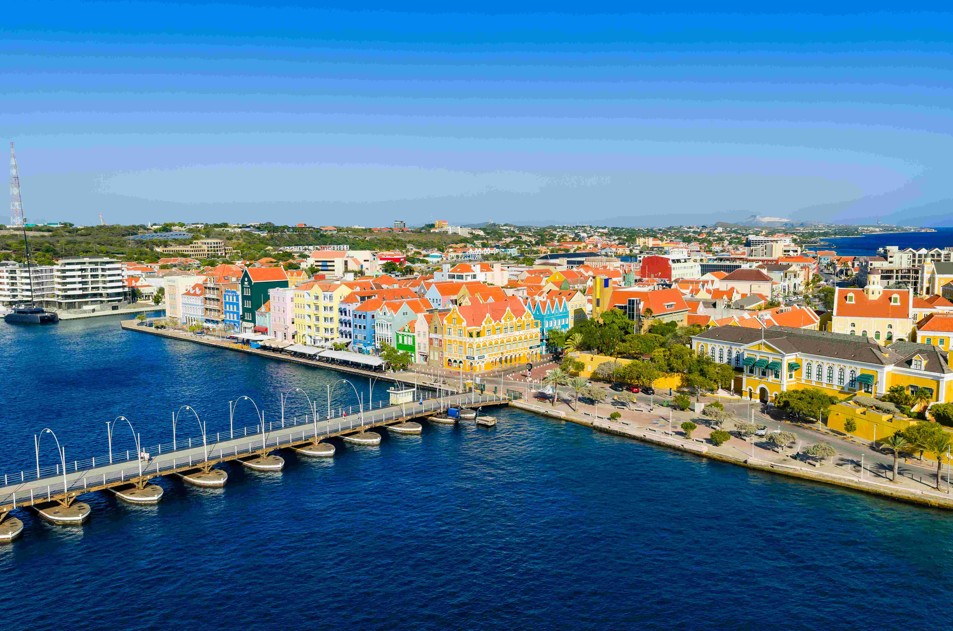
Willemstad
The difference is relatively small, but it deserves attention as Curaçao's tourism markets continue to change.
European visitors remain particularly important in terms of total nights spent on the island.
Although Europe accounted for approximately 37 percent of stayover arrivals during the first ten months of 2026, European visitors generated nearly 53 percent of all visitor nights.
The Netherlands alone accounted for approximately 2.61 million visitor nights.
By comparison, North America generated approximately 1.43 million visitor nights, while South America contributed approximately 1.12 million.
This distinction is important because the economic impact of tourism cannot be measured by arrival numbers alone.
A visitor who remains on the island for eleven nights may generate different economic activity from someone who stays for four or five nights.
However, length of stay must also be considered alongside daily spending, accommodation preferences, and the proportion of expenditure that remains within Curaçao's economy.
American Visitors Remain Particularly Valuable
The United States continues to be Curaçao's second-largest individual source market.
During October, 17,169 American visitors arrived on the island, representing growth of 12 percent compared to October 2025.

American Airlines in Curaçao
For the first ten months of 2026, the United States generated 186,884 visitors, an increase of 8 percent.
The United States accounted for approximately 26 percent of all stayover arrivals during this period.
According to CTB's 2025 Exit Survey, American visitors spend an average of US$407 per person per day.
This is considerably higher than the US$206 average daily expenditure recorded among Dutch visitors.
Colombian visitors spend an average of US$275 per person per day.
These differences illustrate why Curaçao should not evaluate the performance of its tourism industry solely by counting arriving passengers.
American visitors may stay for shorter periods, but their higher average daily expenditure creates significant opportunities for hotels, restaurants, attractions, transportation providers, and other businesses.
At the same time, the actual economic contribution depends on where visitors spend their money and how much of that spending remains in the local economy.
A dollar spent at a locally owned restaurant or business may circulate differently through Curaçao's economy than expenditure that is transferred abroad through imported goods, international booking platforms, or foreign-owned operations.
The available CTB arrival statistics do not measure these differences.
Consequently, the growth in visitor numbers should not automatically be interpreted as an equivalent increase in local economic prosperity.
Airline Figures Reveal Important Changes
The October report also provides valuable insight into the airlines transporting visitors to Curaçao.
American Airlines transported 9,694 stayover visitors during October, virtually unchanged from the same month last year.
KLM carried 9,757 visitors, a decline of 2 percent.
TUI transported 9,058 visitors, representing growth of 15 percent.
Copa Airlines recorded one of the most significant increases among major carriers, transporting 9,332 visitors compared to 6,213 in October 2025.
That represents growth of 50 percent.
For the first ten months of 2026, Copa transported 83,953 stayover visitors, compared to 55,995 during the corresponding period in 2025.
This increase of nearly 28,000 visitors is particularly noteworthy.
Copa's network through Panama provides connections to numerous destinations across Latin America, making the airline an important part of Curaçao's regional accessibility.
The increase in Copa passengers is consistent with the strong growth recorded from South American markets, although the CTB figures do not establish precisely how much of that regional growth can be attributed to the airline.
Avianca also performed positively, transporting 69,705 visitors during the first ten months, an increase of 9 percent.
TUI recorded growth of 14 percent, while Divi Divi Air increased its passenger contribution by 28 percent.
However, not every airline recorded growth.
Corendon transported 61,086 visitors during the first ten months, a decline of 7 percent.
Winair recorded a decrease of 10 percent, while Surinam Airways declined by 12 percent.
These figures show that Curaçao's aviation market is not expanding uniformly.
Some airlines and routes are growing rapidly, while others are experiencing declines.
For tourism policymakers, understanding these differences is essential when considering future airline partnerships and market development.
Cruise Tourism Is Growing, but Its Economic Impact Requires Separate Attention
Cruise tourism also recorded impressive results.
During October 2026, Curaçao welcomed 73,705 cruise passengers, compared to 53,360 in October 2025.
This represents growth of 38 percent.
Interestingly, the number of cruise ship calls increased only slightly, from 22 to 23.
The much larger increase in passenger arrivals suggests that the average number of passengers per ship call was considerably higher.
During the first ten months of 2026, Curaçao received 722,155 cruise passengers, compared to 645,373 during the same period last year.
That represents an increase of 12 percent.
The island also recorded 271 cruise ship calls, compared to 243 in 2025.
Cruise tourism is therefore growing in both passenger numbers and ship activity.
However, cruise visitors and stayover tourists have fundamentally different spending patterns.
Stayover visitors spend money on accommodations and generally have more opportunities to visit restaurants, rent vehicles, explore attractions, and participate in activities over several days.
Cruise passengers typically spend only part of a day on the island.
This does not mean cruise tourism is unimportant.
On the contrary, it supports businesses operating in Willemstad, transportation providers, tour operators, retail establishments, and other tourism-related services.
But cruise passenger arrivals should not be treated as economically equivalent to stayover arrivals.
The CTB report also shows that day-tripper arrivals declined by 35 percent during the first ten months of 2026, falling from 37,026 to 23,983.
Despite this decline, the combined number of cruise passengers, stayover visitors, and day-trippers increased by approximately 10 percent, reaching 1,456,676 arrivals.
These categories measure different forms of visitation and should be analyzed separately when assessing their economic contributions.
Tourism Growth Is Consistent, but Capacity Questions Remain
Another important finding is the consistency of Curaçao's stayover tourism growth.
The monthly comparison charts show that stayover arrivals exceeded their 2025 levels in every month from January through October 2026.
The island welcomed approximately 80,000 visitors in January, 75,000 in February, 80,000 in March, and 75,000 in April.
Although arrivals declined during May and June, they remained above the corresponding figures for 2025.
July brought another increase, followed by continued year-on-year growth in August, September, and October.
This pattern indicates that Curaçao's tourism expansion is not limited to a single exceptional month.
However, sustained growth also increases the importance of infrastructure planning.
More visitors create additional demand for airport facilities, roads, water, electricity, waste management, public spaces, and environmental protection.
Tourism growth may also increase competition for housing and accommodation, particularly where residential properties are converted into short-term vacation rentals.
The CTB figures do not establish the extent to which these pressures are currently affecting Curaçao.
Nevertheless, they demonstrate why visitor growth must be accompanied by careful planning and reliable information about infrastructure capacity and environmental sustainability.
A tourism strategy focused exclusively on attracting more people risks overlooking the broader conditions necessary to maintain a high-quality destination.
The Real Question Is How Much Curaçao Benefits
The October figures provide strong evidence that Curaçao remains an attractive destination for international travelers.
Stayover arrivals are increasing, visitor nights continue to grow, and the island is attracting visitors from a more diverse range of countries.
South America is contributing substantially to that growth, while the Netherlands and the United States remain the foundation of Curaçao's tourism market.
Airlines such as Copa are strengthening the island's connectivity, and cruise tourism continues to expand.
These are encouraging developments.
But the next stage of Curaçao's tourism development should involve measuring success more broadly.
The central question should not simply be how many tourists arrive.
It should also be how much money visitors spend, how much remains within the local economy, how many sustainable jobs are created, and whether residents experience meaningful improvements in their standard of living.
Reliable information about local procurement, tourism-related wages, small-business participation, environmental pressures, and infrastructure costs would provide a more complete picture of tourism's contribution.
Curaçao should also pay attention to the balance between attracting new visitors and increasing the economic value generated by existing tourism activity.
Higher visitor numbers are not necessarily the only route to stronger tourism revenues.
Encouraging longer stays, promoting locally owned businesses, strengthening cultural and heritage tourism, and increasing opportunities for local suppliers may also contribute to economic development.
The October 2026 figures confirm that Curaçao's tourism industry is expanding successfully in terms of arrivals.
The challenge now is to ensure that this expansion produces lasting and widely shared economic benefits.
Because ultimately, the success of tourism should not be measured only by how many people visit Curaçao, but also by how much Curaçao and its people gain from those visits.